
Eurasian Bittern vs American Bittern
Botaurus stellaris versus Botaurus lentiginosus
Play a quiz with Eurasian Bittern and American Bittern
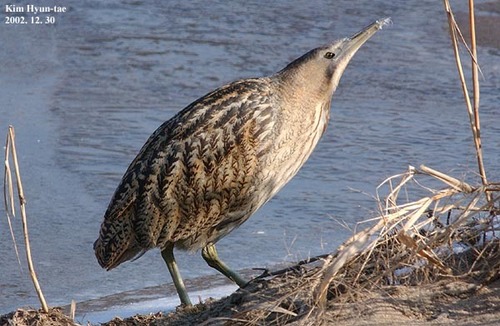 Eurasian Bittern
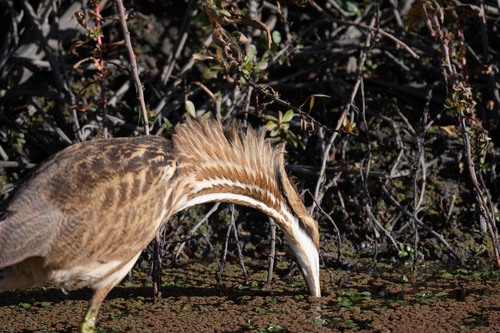 American Bittern
In short
The most reliable field mark between Eurasian Bittern and American Bittern is the pattern of barring versus speckling on the upperparts and underparts: Eurasian Bittern shows bold, dark barring and streaking, while American Bittern is more finely speckled and striped, especially below. Juvenile and adult plumages are similar in both, but Eurasian Bittern is larger and bulkier, with broader, more rounded wings in flight. Both species are extremely secretive and often freeze with necks extended, but Eurasian Bittern is more likely to appear massive and thickset. In the field, look for the Eurasian's heavier barring and larger size versus the American's finer, freckled look and slightly smaller, slimmer build.
Identification tips
- Upperpart pattern: Eurasian Bittern shows bold, dark barring and streaking on mantle, scapulars, and back; American Bittern is more finely speckled and less heavily barred. This is consistent in both adults and juveniles.
- Underpart pattern: Eurasian Bittern has broad brown stripes at the sides and narrower stripes centrally on a yellowish-buff background; American Bittern's underparts are buff and rust with fine black outlining, appearing more striped or freckled than boldly barred.
- Neck sides: American Bittern (especially males) has a bluish-black elongated patch on the side of the neck; Eurasian Bittern's neck sides are rusty-brown with faint barring.
- Supercilium and moustachial stripe: Both have a buff supercilium and mustachial stripe, but Eurasian Bittern's are more yellowish-buff and brownish-black, while American Bittern's are buff and brown.
- Crown and nape: Eurasian Bittern has black crown and nape with buff tips; American Bittern's crown is chestnut brown with black centers.
- Bill color: Both have greenish or yellowish bills, but Eurasian Bittern's is greenish-yellow with a darker tip, while American Bittern's is yellowish-green, upper mandible darker.
- Leg color: Both species have greenish or yellowish-green legs and feet; not reliably diagnostic.
- Size and bulk: Eurasian Bittern is much larger and heavier, with a thicker neck and more massive body; American Bittern is slimmer and lighter. Use this when size context is available.
- Wing shape in flight: Eurasian Bittern has broader, more rounded wings and appears bulkier in flight; American Bittern's wings are broad but the bird is slimmer overall.
- Flight posture: Both species extend the neck on takeoff but retract it in sustained flight; not a strong separator.
- Behavior: Both freeze with bill upward when alarmed, but Eurasian Bittern is even more reluctant to fly and prefers to move through reeds on foot.
- Habitat and range: Use geography—Eurasian Bittern in Eurasia/Africa, American Bittern in North America. Habitat structure is similar, so context is key.
- Vocalization: American Bittern's call is a repeated, mechanical 'oong, kach, oonk'; Eurasian Bittern's is a deep, foghorn-like boom. Both are most often heard at dawn/dusk.
- Juvenile plumage: Both species' juveniles resemble adults but are paler and less distinctly marked; Eurasian Bittern juveniles still show barring, American Bittern juveniles have less olive on neck sides.
- Sex differences: American Bittern males have a larger bluish-black neck patch; Eurasian Bittern males are larger but not otherwise strongly sexually dimorphic in plumage.
Size
Eurasian Bittern is substantially heavier and larger: body mass averages about 2461.5 g [wikidata], with a length of 69–81 cm and wingspan of 100–130 cm [wikipedia]. American Bittern is smaller, with a length of 58–85 cm and wingspan of 92–115 cm, and a much lower body mass (370–1072 g) [wikipedia]. In direct comparison, Eurasian Bittern appears bulkier, with a thicker neck and more massive body, while American Bittern is slimmer and lighter overall. This size difference is most apparent when seen side by side or with clear size context.
Plumage
Juvenile and adult Eurasian Bitterns both show bold, dark barring and streaking throughout the upperparts and underparts, with a generally buffy-brown base color. The crown and nape are black with buff tips, and the back and scapulars are heavily barred and streaked. The underparts are yellowish-buff with broad brown stripes at the sides and narrow stripes centrally. Juveniles are paler but retain the barred pattern. In contrast, American Bittern is more finely speckled and striped: the upperparts are chestnut-brown with black speckling and some barring, but the pattern is less bold and more 'freckled' than barred. The underparts are buff and rust with fine black outlining, giving a striped effect rather than the Eurasian's heavy barring. Both species have a buff supercilium and mustachial stripe, but American Bittern's neck sides have a bluish-black patch (especially in males), while Eurasian Bittern's neck sides are rusty-brown with faint barring. In flight, both show broad, rounded wings, but Eurasian Bittern's wings are proportionally broader and the bird appears more massive.
Behaviour
Both species are secretive, solitary, and rely on cryptic plumage, often freezing with neck extended and bill upward ('bitterning'). Eurasian Bittern is more likely to be seen walking slowly or standing at the edge of reeds, sometimes in the open during harsh weather but always near cover. American Bittern is mainly nocturnal and most active at dusk, usually hunting by stealth or ambush in shallow water. Both species are difficult to flush and prefer to remain hidden, but Eurasian Bittern is even more reluctant to fly, moving through reeds on foot unless feeding young.
Habitat
Both species inhabit dense marshes and reed beds, but their ranges do not overlap: Eurasian Bittern is found in the Old World (Europe, Asia, parts of Africa), while American Bittern is strictly Nearctic (North America, including Canada, US, and parts of Central America in winter). Habitat structure is similar—dense, tall emergent vegetation over shallow water—but context and geography are key: Eurasian Bittern in Eurasian reedbeds, American Bittern in North American cattail and bulrush marshes.
Voice
Both species have deep, booming calls, but the American Bittern's is famously described as a 'congested pump' or 'oong, kach, oonk,' with the head thrown upward and forward. Eurasian Bittern's call is also a deep boom, likened to a foghorn, but is not described in detail in the notes. Both are more often heard than seen, especially at dawn and dusk. Without direct comparison, voice alone may not be diagnostic in the field, but the American's call is more rhythmically repeated and mechanical.