
Eurasian Bittern vs Little Bittern
Botaurus stellaris versus Botaurus minutus
Play a quiz with Eurasian Bittern and Little Bittern
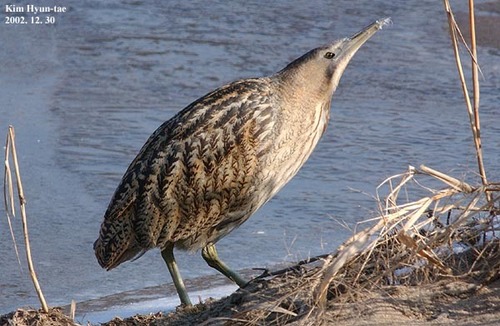 Eurasian Bittern
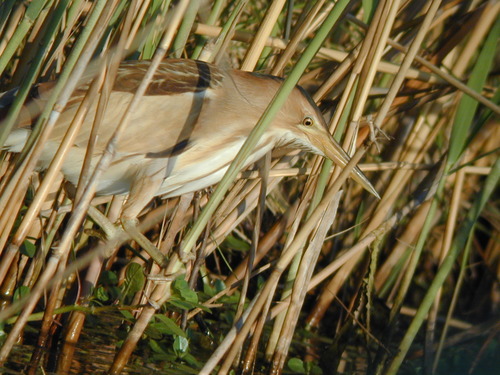 Little Bittern
In short
The most reliable way to separate Eurasian Bittern from Little Bittern is by size and structure: the Eurasian Bittern is a massive, thickset heron, while the Little Bittern is truly tiny, even compared to other small herons. In flight, Little Bitterns show a distinctive pale or pinkish-buff forewing panel (especially males), which is never present on Eurasian Bitterns. Juvenile Little Bitterns are more rufous and heavily streaked than juvenile Eurasian Bitterns, but both can appear cryptic in dense reeds. If you see a large, broad-winged bird with strong dark barring and a slow, deliberate gait, it's a Eurasian Bittern; a much smaller, slim-necked bird with a contrasting forewing panel and quick, fluttery flight is a Little Bittern.
Identification tips
- Size is the fastest check: Eurasian Bittern is huge, Little Bittern is tiny—if you see both in the same area, the difference is unmistakable. Use this especially if you have context (other herons, ducks, or moorhens for scale).
- Pale forewing panel (Little Bittern): Adult male Little Bitterns show a contrasting pale or pinkish-buff patch on the inner wing coverts, visible in flight and at rest; females and juveniles have a duller but still present panel. Eurasian Bittern never shows this panel at any age.
- Upperwing in flight (juveniles): Juvenile Little Bitterns are rufous and heavily streaked above and below, including the wing coverts; Eurasian Bittern juveniles are paler, less distinctly marked, and more buffy overall.
- Crown and nape: Eurasian Bittern has a black crown and nape with long, loose feathers; Little Bittern males have a glossy black crown, but females and juveniles have brownish-black with paler margins.
- Underparts: Eurasian Bittern shows yellowish-buff underparts with broad brown stripes at the sides and narrow central stripes; Little Bittern males have clean, pale buff underparts, females and juveniles are more streaked but never as heavily barred as Eurasian Bittern.
- Supercilium and moustachial stripe: Eurasian Bittern has a yellowish-buff supercilium and a brownish-black moustachial stripe; Little Bittern lacks such strong facial markings.
- Bill: Both have long bills, but Little Bittern's is proportionally longer and sharper for its size; Eurasian Bittern's is thick, powerful, and greenish-yellow with a darker tip.
- Leg color: Eurasian Bittern has greenish legs with yellow on the tarsal joint and yellow soles; Little Bittern's leg color is less distinctive in the field.
- Flight style: Eurasian Bittern is heavy, slow, and deliberate in flight with broad, rounded wings; Little Bittern is quick, fluttery, and weak, with rapid wingbeats and a much smaller profile.
- Behavior when disturbed: Eurasian Bittern often freezes with bill upward ('bitterning'), blending into reeds; Little Bittern is more likely to flush and fly a short distance.
- Habitat context: Eurasian Bitterns need large, dense reedbeds; Little Bitterns can be found in smaller reed patches or even ornamental ponds.
- Seasonal presence: Little Bittern is migratory in Europe, present mainly from April to September; Eurasian Bittern is more likely to be resident or wintering.
- Sex differences: Male Little Bitterns are more contrasting and cleanly marked than females or juveniles; Eurasian Bitterns are less sexually dimorphic, though males are larger.
- Juvenile confusion: Both species' juveniles are streaked, but Little Bittern juveniles are more rufous and heavily marked, especially on the wing coverts.
- Plumage texture: Eurasian Bittern has loose, elongated feathers on crown, neck, and breast that can be erected; Little Bittern lacks this feature.
Size
Eurasian Bittern is dramatically larger: body mass averages about 2460 g, length 69–81 cm, and wingspan 100–130 cm. Little Bittern is tiny by comparison, averaging just 147 g, with a length of 33–38 cm and wingspan of 52–58 cm. Even at a distance, Eurasian Bittern looks like a hulking heron, while Little Bittern is smaller than most moorhens and can look almost sparrow-sized in flight. Size alone is often enough for separation if seen together or with context.
Plumage
Juvenile Little Bitterns are more rufous and heavily streaked above and below than juvenile Eurasian Bitterns, which are paler and less distinctly marked. In all ages, male Little Bitterns show a striking pale or pinkish-buff forewing panel (formed by the inner wing coverts) that contrasts with otherwise black wings—this is visible in flight and at rest, and is unique among European herons. Females and juveniles have a duller, less obvious panel, but still show some contrast. Eurasian Bitterns never show a pale wing panel; instead, their wings are pale rusty-brown, irregularly barred, streaked, and mottled with black, matching the rest of their cryptic, streaked body. Eurasian Bitterns have a black crown and nape with long, loose feathers, a yellowish-buff supercilium, and strong dark barring throughout. Little Bittern males have glossy black upperparts with a green sheen, pale buff underparts, and a clean, sharply demarcated look; females are browner and more streaked, but still lack the heavy barring of Eurasian Bittern. Underwing is whitish in Little Bittern, not distinctly marked as in Eurasian Bittern. Bill is greenish-yellow in Eurasian Bittern, long and sharp in Little Bittern.
Behaviour
Eurasian Bitterns are solitary, secretive, and slow-moving, often freezing with bill pointed upward ('bitterning') to blend into reeds. They usually walk stealthily or stand motionless, rarely flying except when disturbed or feeding young; in flight, they are heavy, with broad, rounded wings and trailing legs. Little Bitterns are also secretive but much more agile: they move quickly through reeds, often clambering about or making short, fluttery flights low over vegetation. Their flight is rapid and weak, with quick wingbeats and legs trailing, but their small size and contrasting wing panel make them look very different from the lumbering Eurasian Bittern.
Habitat
Both species are reedbed specialists, but Eurasian Bitterns require extensive, dense reedbeds and are rarely seen away from large wetlands. Little Bitterns can use smaller reed-fringed pools and ditches, and are more likely to be found in small, scattered reedbeds or even ornamental ponds. Eurasian Bitterns are more likely to be seen standing at the edge of reeds or in open water during hard weather, while Little Bitterns keep to cover but may be flushed from small patches of reeds.