Birdr

Eurasian Curlew vs Bar-tailed Godwit

Numenius arquata versus Limosa lapponica

Play a quiz with Eurasian Curlew and Bar-tailed Godwit

Eurasian Curlew (Numenius arquata) Eurasian Curlew
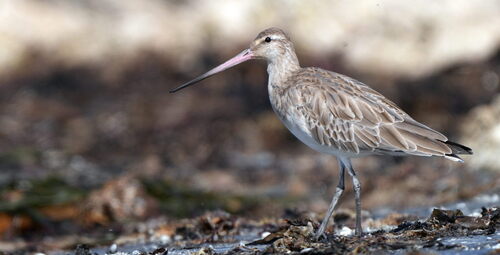
Bar-tailed Godwit (Limosa lapponica) Bar-tailed Godwit

Media

Loading…

In short

The Eurasian Curlew and Bar-tailed Godwit can be distinguished primarily by their bill shape and length. The Eurasian Curlew has a long, decurved bill, while the Bar-tailed Godwit features a straighter, slightly upturned bill. Both species are large waders, but their plumage and habitat preferences offer additional clues.

Identification tips

  1. Bill Shape: Look for the long, decurved bill of the Eurasian Curlew versus the straighter, slightly upturned bill of the Bar-tailed Godwit.
  2. Plumage: In breeding season, check for the reddish underparts of the Bar-tailed Godwit.
  3. Size and Structure: Note the bulkier body of the Eurasian Curlew.
  4. Habitat: Observe the habitat; curlews are more versatile in wetland types, while godwits prefer coastal areas.
  5. Calls: Listen for the curlew's bubbling call compared to the godwit's rapid 'wit-wit'.

Size

Both species are large waders, but the Eurasian Curlew is generally larger and bulkier than the Bar-tailed Godwit.

Plumage

The Eurasian Curlew has a more uniform brownish plumage with streaks, while the Bar-tailed Godwit shows more contrast with a paler belly and, in breeding plumage, a distinctive reddish hue on the underparts.

Behaviour

Both species are often found in flocks, but the Bar-tailed Godwit is known for its long, non-stop migratory flights. The Eurasian Curlew tends to forage in a more solitary manner compared to the often gregarious Bar-tailed Godwit.

Habitat

Eurasian Curlews are typically found in a variety of wetland habitats, including estuaries and mudflats, whereas Bar-tailed Godwits prefer coastal mudflats and sandy shores during migration and winter.

Voice

The Eurasian Curlew has a distinctive, bubbling call, while the Bar-tailed Godwit's call is more of a rapid, high-pitched 'wit-wit' sound.

Submit a better description

Use the same sections as the comparison. Your text is published immediately.

The Eurasian Curlew and Bar-tailed Godwit can be distinguished primarily by their bill shape and length. The Eurasian Curlew has a long, decurved bill, while the Bar-tailed Godwit features a straighter, slightly upturned bill. Both species are large waders, but their plumage and habitat preferences offer additional clues.

  1. Bill Shape: Look for the long, decurved bill of the Eurasian Curlew versus the straighter, slightly upturned bill of the Bar-tailed Godwit.
  2. Plumage: In breeding season, check for the reddish underparts of the Bar-tailed Godwit.
  3. Size and Structure: Note the bulkier body of the Eurasian Curlew.
  4. Habitat: Observe the habitat; curlews are more versatile in wetland types, while godwits prefer coastal areas.
  5. Calls: Listen for the curlew's bubbling call compared to the godwit's rapid 'wit-wit'.

Both species are large waders, but the Eurasian Curlew is generally larger and bulkier than the Bar-tailed Godwit.

The Eurasian Curlew has a more uniform brownish plumage with streaks, while the Bar-tailed Godwit shows more contrast with a paler belly and, in breeding plumage, a distinctive reddish hue on the underparts.

Both species are often found in flocks, but the Bar-tailed Godwit is known for its long, non-stop migratory flights. The Eurasian Curlew tends to forage in a more solitary manner compared to the often gregarious Bar-tailed Godwit.

Eurasian Curlews are typically found in a variety of wetland habitats, including estuaries and mudflats, whereas Bar-tailed Godwits prefer coastal mudflats and sandy shores during migration and winter.

The Eurasian Curlew has a distinctive, bubbling call, while the Bar-tailed Godwit's call is more of a rapid, high-pitched 'wit-wit' sound.

Discard your changes?

You have unsaved edits. If you leave now, those changes will be lost.

Eurasian Curlew · Bar-tailed Godwit · My Tricky Birds