Birdr

Eurasian Curlew vs Black-tailed Godwit

Numenius arquata versus Limosa limosa

Play a quiz with Eurasian Curlew and Black-tailed Godwit

Eurasian Curlew (Numenius arquata) Eurasian Curlew
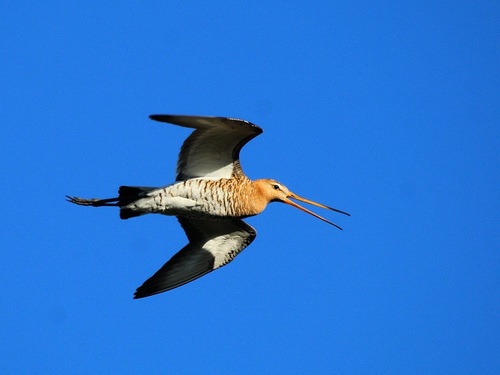
Black-tailed Godwit (Limosa limosa) Black-tailed Godwit

Media

Loading…

In short

The Eurasian Curlew and Black-tailed Godwit can be distinguished by their bill shape and tail patterns. The Curlew has a long, decurved bill, while the Godwit features a straight, slightly upturned bill. In flight, the Curlew lacks the black tail and white wing bars that are prominent in the Godwit.

Identification tips

  1. Look for the bill shape: Curlew's is long and decurved, Godwit's is straight and slightly upturned. 2. Check the tail pattern in flight: Godwit has a black tail and white wing bars, absent in Curlew. 3. Note the size: Curlew is larger and bulkier. 4. Listen for calls: Curlew has a bubbling 'cur-lee', Godwit a 'wick-wick'.

Size

The Eurasian Curlew is generally larger and bulkier than the Black-tailed Godwit.

Plumage

The Curlew has a more uniform brownish plumage with streaking, while the Godwit shows a more contrasting plumage with a distinct black tail and white wing bars in flight.

Behaviour

Both species can be seen probing in mudflats and marshes, but the Curlew often forages in deeper water compared to the Godwit.

Habitat

Both species inhabit wetlands, but the Curlew is more frequently found in coastal areas, while the Godwit can also be found in inland wetlands.

Voice

The Curlew's call is a distinctive, bubbling 'cur-lee' sound, whereas the Godwit's call is a more rapid 'wick-wick' or 'god-wit'.

Submit a better description

Use the same sections as the comparison. Your text is published immediately.

The Eurasian Curlew and Black-tailed Godwit can be distinguished by their bill shape and tail patterns. The Curlew has a long, decurved bill, while the Godwit features a straight, slightly upturned bill. In flight, the Curlew lacks the black tail and white wing bars that are prominent in the Godwit.

  1. Look for the bill shape: Curlew's is long and decurved, Godwit's is straight and slightly upturned. 2. Check the tail pattern in flight: Godwit has a black tail and white wing bars, absent in Curlew. 3. Note the size: Curlew is larger and bulkier. 4. Listen for calls: Curlew has a bubbling 'cur-lee', Godwit a 'wick-wick'.

The Eurasian Curlew is generally larger and bulkier than the Black-tailed Godwit.

The Curlew has a more uniform brownish plumage with streaking, while the Godwit shows a more contrasting plumage with a distinct black tail and white wing bars in flight.

Both species can be seen probing in mudflats and marshes, but the Curlew often forages in deeper water compared to the Godwit.

Both species inhabit wetlands, but the Curlew is more frequently found in coastal areas, while the Godwit can also be found in inland wetlands.

The Curlew's call is a distinctive, bubbling 'cur-lee' sound, whereas the Godwit's call is a more rapid 'wick-wick' or 'god-wit'.

Discard your changes?

You have unsaved edits. If you leave now, those changes will be lost.

Eurasian Curlew · Black-tailed Godwit · My Tricky Birds