
Eurasian Green Woodpecker vs Iberian Green Woodpecker
Picus viridis versus Picus sharpei
Play a quiz with Eurasian Green Woodpecker and Iberian Green Woodpecker
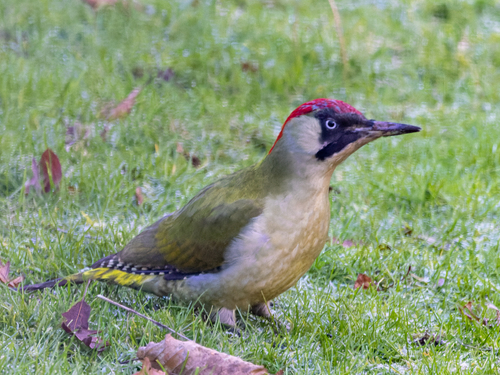 Eurasian Green Woodpecker
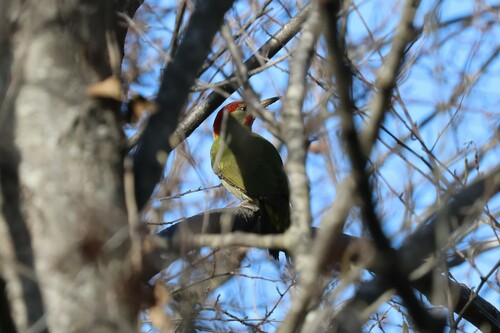 Iberian Green Woodpecker
In short
The most reliable field mark to separate Eurasian Green Woodpecker from Iberian Green Woodpecker is the color and extent of black on the head: Eurasian has a bold black mask through the lores and around the white eye, while Iberian shows little black on the head and a dusky or greyish, not black, ring around the eye. Both species share green upperparts, yellow rumps, and red crowns, but the facial pattern is key at all ages. Juveniles of both are streaked and spotty, so focus on the facial mask and eye-ring color in all plumages. Calls differ subtly but are less reliable in the field than head pattern.
Identification tips
- Facial Mask (All Ages): Eurasian Green Woodpecker always shows a bold black mask through the lores and around the white eye; Iberian Green Woodpecker has little black on the head, with a dusky or greyish (not black) ring around the eye. This is the most consistent and reliable field mark.
- Moustache Stripe (Adult Males): Eurasian males have a black moustache with a red center; Iberian males may show a similar pattern but with less contrast due to reduced black on the head. Females of both have a solid black moustache, but again, the overall mask is less in Iberian.
- Crown and Nape (Adults): Both species have a bright red crown and nape, so this is not a separator.
- Juvenile Plumage: Juveniles of both are spotty and streaked, making them hard to separate by body pattern; rely on the facial mask and eye-ring color.
- Eye-ring Color: Eurasian has a black ring around the white eye; Iberian's is dusky or greyish, not black.
- Upperparts and Rump: Both show green upperparts and a yellow rump; these are not diagnostic.
- Underparts: Both have pale yellowish-green underparts; not useful for separation.
- Flight Views: No distinctive wing or upperwing pattern is noted to separate the two; focus on the head pattern if visible.
- Size and Structure: Both are robust, medium-to-large woodpeckers with similar proportions; size is not a reliable field mark.
- Behavior: Both species feed on the ground and rarely drum; behavior is not helpful for separation.
- Vocalizations: Eurasian gives a loud, laughing 'yaffle'; Iberian's call is more sibilant or hiss-like. This difference is subtle and best used by experienced birders.
- Geographic Range: In Spain and Portugal, expect Iberian Green Woodpecker; elsewhere in Europe, Eurasian is the default. Where ranges meet, use facial pattern for confirmation.
- Sex Differences: In Eurasian, only males have a red center in the moustache; in Iberian, the moustache is less well-defined due to reduced black on the head.
- Seasonality: Both species are resident and do not show strong seasonal plumage changes; facial pattern is reliable year-round.
- Pitfalls: Do not rely on rump color, underparts, or overall size. Juveniles are especially tricky—always check the facial mask and eye-ring color.
Size
Eurasian Green Woodpecker is a large woodpecker, with an average mass of 193g [wikidata]. No direct measurement is available for Iberian Green Woodpecker, but it is described as medium-sized and very similar in structure and size to Eurasian, so size is not a reliable separator in the field. Both birds are robust with similar proportions.
Plumage
Juvenile plumage in both species is streaked and spotty overall, making them very similar at a glance. The key difference is in the head: Eurasian Green Woodpecker (all ages) has a strong black mask through the lores and around the eye, while Iberian Green Woodpecker shows much less black on the head, with a dusky or greyish, not black, ring around the eye. In adults, both sexes of Eurasian have a bright red crown and nape, green upperparts, yellow rump, and pale yellowish-green underparts. Males of Eurasian have a black moustache with a red center, females have a solid black moustache. Iberian Green Woodpecker is similar in overall coloration but lacks the bold black facial mask and has a more muted, dusky eye-ring. In flight, both show green upperparts and yellow rumps, with no mention of distinctive wing patterns separating the two. The facial pattern remains the most consistent field mark across all ages and seasons.
Behaviour
Both species behave similarly, spending much time on the ground feeding on ants and rarely drumming on trees. Their flight is undulating, with several wingbeats followed by a glide. Eurasian Green Woodpecker is described as shy and more often heard than seen, which likely applies to Iberian as well. Behavioral differences are not diagnostic.
Habitat
Eurasian Green Woodpecker is widespread across Europe and the western Palearctic, but is replaced by Iberian Green Woodpecker in Spain and Portugal. Both favor open woodlands, parks, and areas with scattered trees, especially where ants are abundant. Habitat overlap is minimal due to geographic separation, but where ranges meet, habitat preferences are similar.
Voice
Eurasian Green Woodpecker has a loud, laughing 'yaffle' call (kyü-kyü-kyück) and a series of 'klü' notes, with the female giving a thinner 'pü-pü-pü'. Iberian Green Woodpecker's call is described as more sibilant or hiss-like, but this difference is subtle and may be difficult to judge without experience. Vocal differences are real but less reliable than facial pattern in the field.
Eurasian Green Woodpecker · Iberian Green Woodpecker · My Tricky Birds