
Eurasian Jackdaw vs Daurian Jackdaw
Coloeus monedula versus Coloeus dauuricus
Play a quiz with Eurasian Jackdaw and Daurian Jackdaw
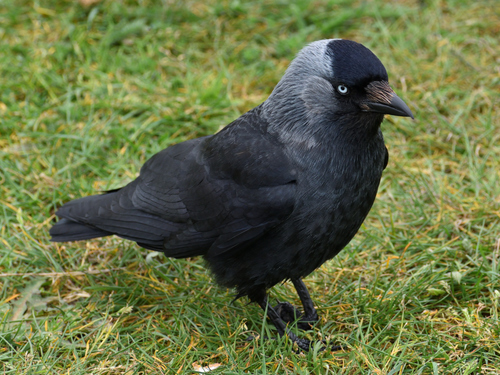 Eurasian Jackdaw
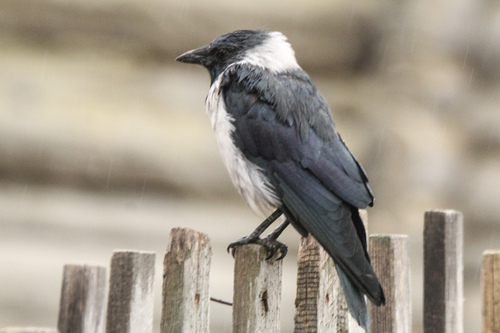 Daurian Jackdaw
In short
The most reliable field mark to separate adult Eurasian Jackdaw from Daurian Jackdaw is the eye color: Eurasian shows pale silvery or grey-white irises, while Daurian always has dark (black) eyes. For adults, Daurian Jackdaw often shows extensive creamy white on the underparts and neck, forming a broad collar, whereas Eurasian Jackdaw is overall dark with a contrasting pale grey nape and sides of the neck. Juvenile and dark-plumaged Daurian Jackdaws can closely resemble Eurasian, but the iris color remains a safe separator at all ages. Both species are similar in size and shape, but careful attention to plumage and eye color is essential, especially in mixed flocks or vagrant situations.
Identification tips
- Iris color is the single most reliable mark: Adult Eurasian Jackdaw has pale silvery or grey-white eyes; Daurian Jackdaw always has black eyes. This works at all ages and distances where the eye is visible.
- Adult Daurian Jackdaw often shows a broad, creamy white collar and white underparts: If you see extensive white below and around the neck, it is Daurian. Eurasian Jackdaw never shows this much white.
- Eurasian Jackdaw has a pale grey to silvery nape and neck sides: This creates a sharp contrast with the black crown and face, but does not extend as a full collar or onto the underparts. Daurian's white is more extensive and wraps around the neck.
- Juvenile and dark-plumaged Daurian Jackdaws can closely resemble Eurasian Jackdaw: In these birds, white is reduced or absent, and plumage may be uniformly dark. In such cases, iris color remains the best separator.
- Eurasian Jackdaw juveniles have blue to brownish eyes, becoming pale by one year: If you see a dark-eyed juvenile, check for other marks, but beware that young Eurasian Jackdaws can briefly show darker eyes before they pale.
- Both species have similar overall structure: Short, stout bill, compact body, and upright stance. Do not rely on structure alone to separate them.
- Both show glossy black on the head, wings, and tail: The difference is in the extent and placement of pale areas, not in the gloss or shade of black.
- No distinctive age-specific upperwing or flight pattern differences are noted: Both species have similar wing shapes and flight styles; do not use wing pattern to separate them in flight.
- Bill color and shape are not diagnostic: Both species have black, short, and stout bills.
- Sexes are alike in both species: Do not attempt to sex birds by plumage or size in the field.
- In mixed flocks or vagrant situations, always check the eye color first, then look for white collar/underparts: This is especially important in eastern Asia or at the edge of either species' range.
- If you see a jackdaw with a pale nape but no white collar or underparts, and pale eyes, it is Eurasian Jackdaw: If the eyes are black and there is a white collar or underparts, it is Daurian Jackdaw.
- Daurian Jackdaw's grizzled grey ear coverts are subtle and may not be visible at a distance: Focus on the more obvious white collar and underparts.
- In poor light or at a distance, use a combination of iris color and extent of pale on neck/underparts: If neither is visible, identification may not be possible.
- Voice is not described as a separator: Do not rely on calls or vocalizations to distinguish these species.
Size
Both species are very similar in size and structure, with Eurasian Jackdaw measuring 34–39 cm in length and Daurian Jackdaw about 32 cm. Proportions are nearly identical, and both have short, stout bills and compact bodies. There is slight variation, with Daurian Jackdaw sometimes appearing marginally smaller, but this is rarely useful in the field. Weight and wingspan are not reliably separable without measurement. Use plumage and eye color for identification rather than size.
Plumage
For adults, Daurian Jackdaw is often strikingly pied, with large areas of creamy white on the lower underparts and up around the neck as a broad collar, contrasting with glossy black head, throat, wings, and tail. Eurasian Jackdaw is mostly shiny black with a purple or blue sheen on the crown and secondaries, and a distinctive pale grey to silvery nape and neck sides, but never shows extensive white below. The underparts of Eurasian are slate-grey, not white. The most consistent difference at all ages is iris color: adult Eurasian Jackdaw has pale silvery or grey-white eyes, while Daurian Jackdaw has black eyes. Juvenile and dark-plumaged Daurian Jackdaws can appear very similar to Eurasian, with more uniformly dark plumage and less white, but the iris remains dark. Eurasian juveniles have blue to brownish eyes, becoming pale by one year, while Daurian remains dark-eyed throughout. In flight, both species show similar wing and tail patterns, with no mention of age-specific upperwing contrasts; focus on head, neck, and iris.
Behaviour
Both species share similar habits: they are social, often seen in flocks, and display brisk, upright walking on the ground. Flight is agile and direct, with rapid, deep wingbeats and tight flocking. Eurasian Jackdaw is noted for its jerky wingbeats and maneuverability, but this is not highlighted as a separator from Daurian. Both species feed in open areas, often on the ground, and use similar foraging postures. Behavioral differences are not diagnostic for field separation.
Habitat
Habitat preferences are broadly similar: both species use open country, farmland, and settlements, nesting in cavities in trees, rocks, or buildings. Eurasian Jackdaw is found across Europe, western Asia, and North Africa, while Daurian Jackdaw is native to eastern Asia. In areas of range overlap, habitat does not reliably separate them. Context may help in vagrancy situations, but is not diagnostic in the field.