Birdr

Eurasian Nightjar vs Common Swift

Caprimulgus europaeus versus Apus apus

Play a quiz with Eurasian Nightjar and Common Swift
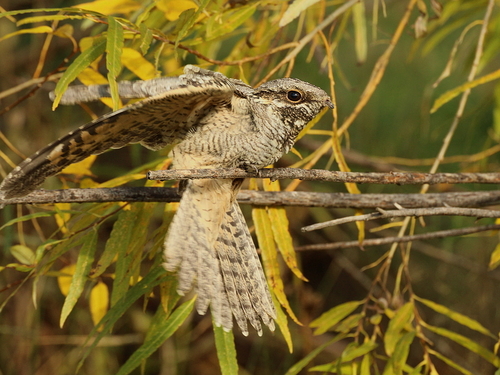
Eurasian Nightjar (Caprimulgus europaeus) Eurasian Nightjar
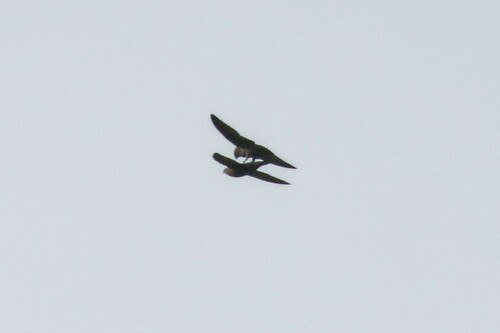
Common Swift (Apus apus) Common Swift

Media

Loading…

In short

The Eurasian Nightjar and Common Swift are both aerial insectivores but differ significantly in appearance and behavior. The Nightjar is cryptically colored with white patches in the male's wings and tail, while the Swift is uniformly dark with a distinctive forked tail and pointed wings. The Nightjar is often heard at dusk, whereas the Swift is almost always in flight during the day.

Identification tips

  1. Tail Shape: Look for the deeply forked tail of the Swift versus the more rounded tail of the Nightjar. 2. Activity Time: Observe the time of day; Nightjars are active at dusk, Swifts during daylight. 3. Plumage: Note the white patches on male Nightjars' wings and tail, absent in Swifts. 4. Flight Behavior: Swifts are almost constantly in flight, while Nightjars are more likely to be seen perched or flying low at dusk.

Size

The Common Swift is slightly larger with a wingspan of 42–48 cm, compared to the more compact Eurasian Nightjar.

Plumage

Eurasian Nightjar males have white patches on the wings and tail, which are absent in females. The Common Swift is uniformly dark brown with a small off-white throat patch, lacking any white wing or tail markings.

Behaviour

The Eurasian Nightjar is mostly nocturnal and relies on camouflage during the day, while the Common Swift is diurnal and spends nearly all its time airborne.

Habitat

Nightjars are found in open woodlands and heathlands, often on the ground. Swifts are seen over a wide range of habitats, from urban areas to open countryside, rarely landing except to breed.

Voice

The Eurasian Nightjar is known for its distinctive churring song at dusk, while the Common Swift produces high-pitched screams during flight.

Submit a better description

Use the same sections as the comparison. Your text is published immediately.

The Eurasian Nightjar and Common Swift are both aerial insectivores but differ significantly in appearance and behavior. The Nightjar is cryptically colored with white patches in the male's wings and tail, while the Swift is uniformly dark with a distinctive forked tail and pointed wings. The Nightjar is often heard at dusk, whereas the Swift is almost always in flight during the day.

  1. Tail Shape: Look for the deeply forked tail of the Swift versus the more rounded tail of the Nightjar. 2. Activity Time: Observe the time of day; Nightjars are active at dusk, Swifts during daylight. 3. Plumage: Note the white patches on male Nightjars' wings and tail, absent in Swifts. 4. Flight Behavior: Swifts are almost constantly in flight, while Nightjars are more likely to be seen perched or flying low at dusk.

The Common Swift is slightly larger with a wingspan of 42–48 cm, compared to the more compact Eurasian Nightjar.

Eurasian Nightjar males have white patches on the wings and tail, which are absent in females. The Common Swift is uniformly dark brown with a small off-white throat patch, lacking any white wing or tail markings.

The Eurasian Nightjar is mostly nocturnal and relies on camouflage during the day, while the Common Swift is diurnal and spends nearly all its time airborne.

Nightjars are found in open woodlands and heathlands, often on the ground. Swifts are seen over a wide range of habitats, from urban areas to open countryside, rarely landing except to breed.

The Eurasian Nightjar is known for its distinctive churring song at dusk, while the Common Swift produces high-pitched screams during flight.

Discard your changes?

You have unsaved edits. If you leave now, those changes will be lost.

Eurasian Nightjar · Common Swift · My Tricky Birds