Birdr

Eurasian Skylark vs Meadow Pipit

Alauda arvensis versus Anthus pratensis

Play a quiz with Eurasian Skylark and Meadow Pipit
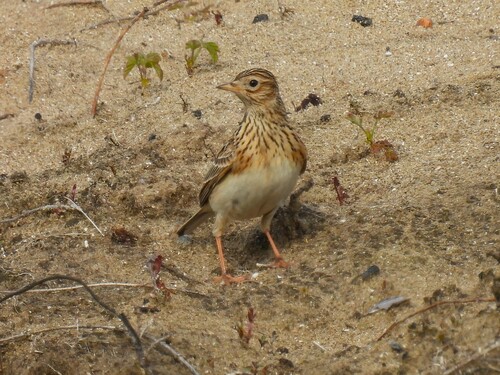
Eurasian Skylark (Alauda arvensis) Eurasian Skylark
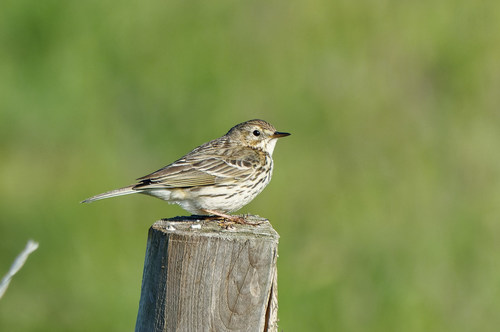
Meadow Pipit (Anthus pratensis) Meadow Pipit

Media

Loading…

In short

The most reliable field mark to separate Eurasian Skylark from Meadow Pipit is the presence of bold white edges on the tail and rear wing in flight on the Skylark, which are visible when the bird is flying away but not towards you. Skylark is noticeably larger and chunkier, with a short, broad wing and a short tail, while Meadow Pipit is more slender, with a thinner bill and a longer, more pointed tail edged narrowly with white. Skylark often shows a small, blunt crest on the head and hovers high while singing, whereas Meadow Pipit lacks a crest and performs short, fluttering song flights. Both are brown and streaked, but Skylark is paler below and Meadow Pipit is more buff with heavier streaking. Voice and behavior in the field can help, but focus first on structure and flight pattern.

Identification tips

  1. White tail and wing edges in flight (Skylark): When the bird flies away, look for bold white edges on the tail and rear wings—diagnostic for Skylark at all ages. Meadow Pipit only has narrow white tail edges, not visible at a distance.
  2. Size and build: Skylark is larger and bulkier, with a rounder body and broader wings, while Meadow Pipit is smaller, slimmer, and more delicate.
  3. Head shape and crest: Skylark often shows a small, blunt crest that can be raised or flattened—unique among these two. Meadow Pipit’s head is smooth and never crested.
  4. Bill shape: Skylark has a stouter, more conical bill; Meadow Pipit’s bill is thin and fine, suited for insectivory.
  5. Legs and rear claw: Meadow Pipit has a conspicuously long hind claw, longer than the rear toes, visible at close range or in photos. Skylark’s hind claw is not unusually long.
  6. Underpart streaking: Meadow Pipit is more heavily streaked below, especially on the breast and flanks, while Skylark is paler and plainer underneath, with less distinct streaking.
  7. Upperpart color: Both are brown above, but Meadow Pipit is often slightly darker and more heavily barred, especially in western populations.
  8. Tail shape: Skylark’s tail is short and slightly squared; Meadow Pipit’s tail is longer and more pointed, with narrow white edges.
  9. Song flight: Skylark sings in long, high, hovering flights, often out of sight; Meadow Pipit’s song flight is short, fluttery, and parachuting, usually visible and close to the ground.
  10. Perching behavior: Meadow Pipit often perches on wires, posts, or exposed stems; Skylark is more likely to stay on the ground or in low vegetation.
  11. Habitat preference: Skylark prefers open, dry farmland and heath; Meadow Pipit is more common in damp grassland, moor, and rough pasture, especially in winter.
  12. Voice: Skylark’s song is a long, continuous, complex warble; Meadow Pipit’s is a short, repetitive burst. Meadow Pipit’s call is a faint 'tsi-tsi', while Skylark’s calls are less distinctive in the field.
  13. Sex differences: Male Skylarks have broader wings than females, but this is subtle and only seen in direct comparison.
  14. Juvenile confusion: Young birds of both species are similar in color, but the white tail and wing edges of Skylark remain a reliable separator in flight.
  15. Pitfalls: Distant perched birds may look similar in color and streaking; rely on structure, crest, and flight marks rather than plumage alone.

Size

Eurasian Skylark is distinctly larger (18–19 cm) than Meadow Pipit (14.5–15 cm), and also bulkier in build. Skylark has a more robust body and broader wings, especially in males, while Meadow Pipit is lighter and more delicate overall. The pipit’s bill is thinner and finer, and its legs are also more slender, with a notably long rear claw (longer than the rest of the rear toes), which is not present in Skylark. Weight is also higher in Skylark, but this is not visible in the field.

Plumage

In flight, adult and immature Eurasian Skylarks show bold white edges on the tail and along the rear edge of the wings, which are most visible when the bird is flying away. These white edges are absent in Meadow Pipit, which instead has a brown tail with only narrow white lateral edges. Both species are brown above and paler below, but Skylark appears plainer and paler, with less distinct streaking below, while Meadow Pipit is buffier and more heavily streaked on the underparts. Skylark often shows a short, blunt crest on the head, which can be raised or flattened, whereas Meadow Pipit’s head is smooth and uncrested. Both species have brown upperparts, but Meadow Pipit’s streaking is more pronounced across most plumage. Juvenile and first-winter birds of both species are similar in overall color, but the Skylark’s white tail and wing edges remain a key separator in flight at all ages.

Behaviour

Eurasian Skylark is famous for its long, hovering song flights, often delivered high above open ground, sometimes appearing as a distant dot in the sky for several minutes. It may circle or hover in place for extended periods. Meadow Pipit also sings in flight, but its song flight is much shorter, lower, and more fluttery, typically rising a short distance before parachuting down. On the ground, Skylark walks with a more upright, robust posture and may raise its crest, while Meadow Pipit moves with a more delicate, creeping gait and never shows a crest. Skylark is less likely to perch on wires or exposed perches than Meadow Pipit, which often does so.

Habitat

Both species occur in open country, but Skylark favors open farmland and heath, often in larger, more continuous expanses, while Meadow Pipit is more flexible, breeding in grasslands, moorland, and sometimes rough pastures. In winter, Meadow Pipit may be found in a wider range of open habitats, including coastal areas and lowlands, and is more likely to be seen in smaller, wetter, or rougher patches than Skylark. Skylark is less common in very wet or boggy ground, which Meadow Pipit may frequent.

Voice

Skylark’s song is a long, unbroken, bubbling warble delivered high in the air, often lasting two to three minutes or even longer, and is famous for its complexity and duration. Meadow Pipit’s song is much simpler and shorter, given in a brief, repetitive burst during a short song flight, and its call is a faint, high-pitched 'tsi-tsi'. Skylark’s song is usually heard from much higher up, and the bird may be almost invisible, while Meadow Pipit’s song is delivered from much lower and the bird is usually visible.

Submit a better description

Use the same sections as the comparison. Your text is published immediately.

The most reliable field mark to separate Eurasian Skylark from Meadow Pipit is the presence of bold white edges on the tail and rear wing in flight on the Skylark, which are visible when the bird is flying away but not towards you. Skylark is noticeably larger and chunkier, with a short, broad wing and a short tail, while Meadow Pipit is more slender, with a thinner bill and a longer, more pointed tail edged narrowly with white. Skylark often shows a small, blunt crest on the head and hovers high while singing, whereas Meadow Pipit lacks a crest and performs short, fluttering song flights. Both are brown and streaked, but Skylark is paler below and Meadow Pipit is more buff with heavier streaking. Voice and behavior in the field can help, but focus first on structure and flight pattern.

  1. White tail and wing edges in flight (Skylark): When the bird flies away, look for bold white edges on the tail and rear wings—diagnostic for Skylark at all ages. Meadow Pipit only has narrow white tail edges, not visible at a distance.
  2. Size and build: Skylark is larger and bulkier, with a rounder body and broader wings, while Meadow Pipit is smaller, slimmer, and more delicate.
  3. Head shape and crest: Skylark often shows a small, blunt crest that can be raised or flattened—unique among these two. Meadow Pipit’s head is smooth and never crested.
  4. Bill shape: Skylark has a stouter, more conical bill; Meadow Pipit’s bill is thin and fine, suited for insectivory.
  5. Legs and rear claw: Meadow Pipit has a conspicuously long hind claw, longer than the rear toes, visible at close range or in photos. Skylark’s hind claw is not unusually long.
  6. Underpart streaking: Meadow Pipit is more heavily streaked below, especially on the breast and flanks, while Skylark is paler and plainer underneath, with less distinct streaking.
  7. Upperpart color: Both are brown above, but Meadow Pipit is often slightly darker and more heavily barred, especially in western populations.
  8. Tail shape: Skylark’s tail is short and slightly squared; Meadow Pipit’s tail is longer and more pointed, with narrow white edges.
  9. Song flight: Skylark sings in long, high, hovering flights, often out of sight; Meadow Pipit’s song flight is short, fluttery, and parachuting, usually visible and close to the ground.
  10. Perching behavior: Meadow Pipit often perches on wires, posts, or exposed stems; Skylark is more likely to stay on the ground or in low vegetation.
  11. Habitat preference: Skylark prefers open, dry farmland and heath; Meadow Pipit is more common in damp grassland, moor, and rough pasture, especially in winter.
  12. Voice: Skylark’s song is a long, continuous, complex warble; Meadow Pipit’s is a short, repetitive burst. Meadow Pipit’s call is a faint 'tsi-tsi', while Skylark’s calls are less distinctive in the field.
  13. Sex differences: Male Skylarks have broader wings than females, but this is subtle and only seen in direct comparison.
  14. Juvenile confusion: Young birds of both species are similar in color, but the white tail and wing edges of Skylark remain a reliable separator in flight.
  15. Pitfalls: Distant perched birds may look similar in color and streaking; rely on structure, crest, and flight marks rather than plumage alone.

Eurasian Skylark is distinctly larger (18–19 cm) than Meadow Pipit (14.5–15 cm), and also bulkier in build. Skylark has a more robust body and broader wings, especially in males, while Meadow Pipit is lighter and more delicate overall. The pipit’s bill is thinner and finer, and its legs are also more slender, with a notably long rear claw (longer than the rest of the rear toes), which is not present in Skylark. Weight is also higher in Skylark, but this is not visible in the field.

In flight, adult and immature Eurasian Skylarks show bold white edges on the tail and along the rear edge of the wings, which are most visible when the bird is flying away. These white edges are absent in Meadow Pipit, which instead has a brown tail with only narrow white lateral edges. Both species are brown above and paler below, but Skylark appears plainer and paler, with less distinct streaking below, while Meadow Pipit is buffier and more heavily streaked on the underparts. Skylark often shows a short, blunt crest on the head, which can be raised or flattened, whereas Meadow Pipit’s head is smooth and uncrested. Both species have brown upperparts, but Meadow Pipit’s streaking is more pronounced across most plumage. Juvenile and first-winter birds of both species are similar in overall color, but the Skylark’s white tail and wing edges remain a key separator in flight at all ages.

Eurasian Skylark is famous for its long, hovering song flights, often delivered high above open ground, sometimes appearing as a distant dot in the sky for several minutes. It may circle or hover in place for extended periods. Meadow Pipit also sings in flight, but its song flight is much shorter, lower, and more fluttery, typically rising a short distance before parachuting down. On the ground, Skylark walks with a more upright, robust posture and may raise its crest, while Meadow Pipit moves with a more delicate, creeping gait and never shows a crest. Skylark is less likely to perch on wires or exposed perches than Meadow Pipit, which often does so.

Both species occur in open country, but Skylark favors open farmland and heath, often in larger, more continuous expanses, while Meadow Pipit is more flexible, breeding in grasslands, moorland, and sometimes rough pastures. In winter, Meadow Pipit may be found in a wider range of open habitats, including coastal areas and lowlands, and is more likely to be seen in smaller, wetter, or rougher patches than Skylark. Skylark is less common in very wet or boggy ground, which Meadow Pipit may frequent.

Skylark’s song is a long, unbroken, bubbling warble delivered high in the air, often lasting two to three minutes or even longer, and is famous for its complexity and duration. Meadow Pipit’s song is much simpler and shorter, given in a brief, repetitive burst during a short song flight, and its call is a faint, high-pitched 'tsi-tsi'. Skylark’s song is usually heard from much higher up, and the bird may be almost invisible, while Meadow Pipit’s song is delivered from much lower and the bird is usually visible.

Discard your changes?

You have unsaved edits. If you leave now, those changes will be lost.

Eurasian Skylark · Meadow Pipit · My Tricky Birds