
Eurasian Sparrowhawk vs Eurasian Goshawk
Accipiter nisus versus Astur gentilis
Play a quiz with Eurasian Sparrowhawk and Eurasian Goshawk
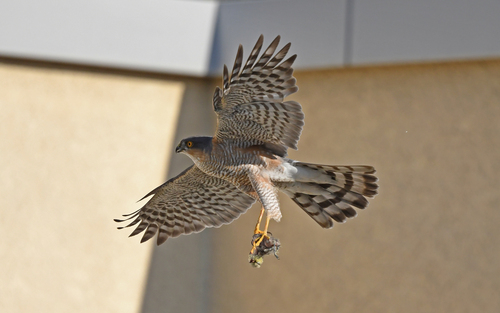 Eurasian Sparrowhawk
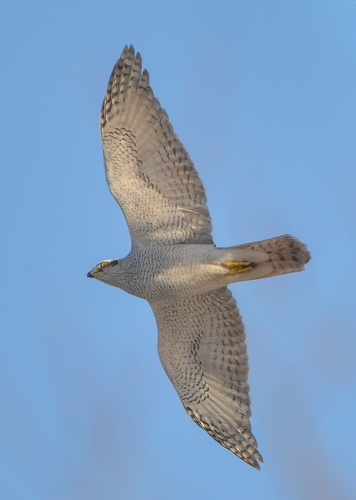 Eurasian Goshawk
In short
The most reliable field mark to separate Eurasian Sparrowhawk from Eurasian Goshawk is overall size and structure: even a male Goshawk is much bulkier, with longer, more pointed wings and a heavier build than a female Sparrowhawk, their closest overlap. Juvenile plumage can be confusing, but adult Goshawks never show the rusty-orange barring of male Sparrowhawks, and always have a bold white supercilium (eyebrow). In flight, Goshawks have deeper, slower wingbeats and can soar steadily, while Sparrowhawks are more fluttery and rarely soar for long. If you see a small, slim Accipiter with rapid wingbeats and orange-barred underparts, it's a Sparrowhawk; a large, powerful bird with a white eyebrow and broad, grey-barred underparts is a Goshawk.
Identification tips
- Size and bulk: Goshawk is much larger and heavier than Sparrowhawk—use this when both are seen in the same area or with familiar birds for scale. A Goshawk can appear almost buzzard-sized; Sparrowhawk is pigeon-sized.
- Wing shape in flight: Goshawk's wings are longer, broader, and more pointed; Sparrowhawk's are shorter, more rounded, and boxy. This is especially evident in soaring birds.
- Flight style: Sparrowhawk has rapid, fluttery wingbeats and rarely soars for long; Goshawk's wingbeats are slower, deeper, and it can soar steadily for extended periods.
- Tail shape: Sparrowhawk's tail is long and square-tipped; Goshawk's is also long but appears more rounded at the tip, especially when spread.
- White supercilium (eyebrow): Adult and juvenile Goshawks always show a bold white eyebrow; Sparrowhawks lack this feature at all ages.
- Underpart barring: Adult male Sparrowhawks have fine, orange (rusty) barring below; Goshawks never show orange barring—adults are grey-barred, juveniles are streaked brown.
- Juvenile underparts: Juvenile Goshawks have broad, dark brown streaks on a pale background; juvenile Sparrowhawks are more coarsely barred or spotted, not streaked, and often warmer brown.
- Upperparts color: Adult male Sparrowhawks are blue-grey above; Goshawks (both sexes) are blue-grey or brownish-grey, but never as finely colored as male Sparrowhawk.
- Head and neck: Goshawks have a thick neck and large head with a fierce expression; Sparrowhawks have a smaller, rounder head and slimmer neck.
- Legs and feet: Goshawk's legs and toes are thicker and more robust; Sparrowhawk's are finer and more delicate, especially in males.
- Eye color: Both can have orange eyes as adults, but juvenile Goshawks and Sparrowhawks both start with yellow eyes; this is not diagnostic on its own but can help in combination with other features.
- Habitat context: In urban or suburban areas, Sparrowhawk is much more likely; Goshawk is rarely seen away from large forests.
- Perched posture: Goshawk perches upright and looks imposing; Sparrowhawk appears slimmer and less robust.
- Plumage variability: Goshawk shows more variation in plumage (especially in Asia), but always has the white eyebrow and lacks orange barring.
- Direct comparison: If you see both together, the Goshawk will dwarf the Sparrowhawk—this is the ultimate check if possible.
Size
Eurasian Goshawk is dramatically larger and heavier than Eurasian Sparrowhawk: average body mass is about 926 g for Goshawk versus 220 g for Sparrowhawk. Even the smallest male Goshawk is bulkier than the largest female Sparrowhawk. Goshawks have a much more robust frame, with a thick neck, large head, and powerful legs and feet. Sparrowhawks are noticeably more slender, with finer legs and a smaller, rounder head. In the field, size alone can be deceptive due to distance or lone birds, but direct comparison or experience with both makes the difference obvious.
Plumage
Juvenile plumage is the main pitfall: both species are brown above and streaked or barred below, but juvenile Goshawks show variable but often broad, dark cinnamon-brown streaking on a white to buffy background, and always have a barred tail with 3–5 dark bands. Juvenile Sparrowhawks are warm brown above with rusty fringes, and their underparts are coarsely barred or spotted brown, lacking the bold, dark streaks of Goshawk. Critically, adult male Sparrowhawks have blue-grey upperparts and fine orange barring below, while adult Goshawks (of both sexes) are blue-grey or brownish-grey above with grey or white underparts barred with dark lines—never orange. Adult Goshawks always show a distinct white supercilium, which is absent in Sparrowhawk. Eye color can help: adults of both can have orange eyes, but juvenile Goshawks have pale yellow eyes, while juvenile Sparrowhawks also have pale yellow but tend to be brighter. Goshawk plumage is more variable overall, especially in Asian subspecies, but the white eyebrow and lack of orange barring are consistent.
Behaviour
In flight, Sparrowhawks have a rapid, fluttery 'flap-flap-glide' style, with quick, shallow wingbeats and a square-ended tail. Goshawks also use a 'flap-flap-glide' but with deeper, slower, more powerful wingbeats and a tendency to soar for longer periods, especially in migration. Perched, Goshawks appear more upright and imposing, with a heavy build and large head, while Sparrowhawks look slimmer and more delicate. Goshawks are more likely to be seen soaring high or making long flights over open areas, while Sparrowhawks usually hunt with rapid dashes through cover.
Habitat
Both species are woodland raptors, but Goshawks prefer larger tracts of mature forest and are more secretive, often staying deep within woods. Sparrowhawks are more adaptable, frequently seen in smaller woodlots, parks, gardens, and even urban areas. If you see an Accipiter in a city or small woodland, Sparrowhawk is far more likely; Goshawk is rarely seen in such open or urban habitats.