Birdr

Eurasian Wigeon vs American Wigeon

Mareca penelope versus Mareca americana

Play a quiz with Eurasian Wigeon and American Wigeon

Eurasian Wigeon (Mareca penelope) Eurasian Wigeon
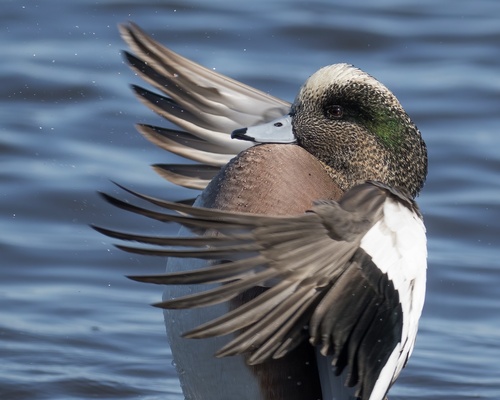
American Wigeon (Mareca americana) American Wigeon

Media

Loading…

In short

The Eurasian Wigeon and American Wigeon are similar dabbling ducks, but they can be distinguished by the male's head coloration and vocalizations. Males of the Eurasian Wigeon have a distinctive rufous-brown head with a creamy forehead, while American Wigeon males display a white crown and green eye-stripe. Both species share similar habitats and behavior, making vocalizations and head patterns key identifiers.

Identification tips

  1. Look for the male's head pattern: Eurasian Wigeon males have a rufous-brown head with a creamy forehead; American Wigeon males have a white crown and green eye-stripe. 2. Listen for vocalizations: American Wigeons have a high-pitched, squeaky call, while Eurasian Wigeons have a softer whistle. 3. Observe behavior: American Wigeons may exhibit aggressive feeding habits. 4. Consider location: Eurasian Wigeons are more common in Europe and Asia, while American Wigeons are primarily in North America.

Size

Both species are similar in size, with no significant differences in structure that are easily observable in the field.

Plumage

Male Eurasian Wigeons have a rufous-brown head with a creamy forehead, whereas male American Wigeons have a white crown and green eye-stripe. Female and eclipse males of both species can be more challenging to distinguish, as they share similar mottled brown plumage.

Behaviour

Both species exhibit similar dabbling behavior, often seen grazing on land or in shallow water. American Wigeons are known for their aggressive feeding behavior, sometimes stealing food from other ducks.

Habitat

Both species frequent wetlands, lakes, and ponds, with American Wigeons also commonly found in urban parks and golf courses. Eurasian Wigeons are more widespread in Europe and Asia, while American Wigeons are primarily found in North America.

Voice

The American Wigeon is known for its distinct, high-pitched, three-note call reminiscent of a squeaky toy. The Eurasian Wigeon's call is a softer, whistling sound. These vocal differences are a reliable field mark.

Submit a better description

Use the same sections as the comparison. Your text is published immediately.

The Eurasian Wigeon and American Wigeon are similar dabbling ducks, but they can be distinguished by the male's head coloration and vocalizations. Males of the Eurasian Wigeon have a distinctive rufous-brown head with a creamy forehead, while American Wigeon males display a white crown and green eye-stripe. Both species share similar habitats and behavior, making vocalizations and head patterns key identifiers.

  1. Look for the male's head pattern: Eurasian Wigeon males have a rufous-brown head with a creamy forehead; American Wigeon males have a white crown and green eye-stripe. 2. Listen for vocalizations: American Wigeons have a high-pitched, squeaky call, while Eurasian Wigeons have a softer whistle. 3. Observe behavior: American Wigeons may exhibit aggressive feeding habits. 4. Consider location: Eurasian Wigeons are more common in Europe and Asia, while American Wigeons are primarily in North America.

Both species are similar in size, with no significant differences in structure that are easily observable in the field.

Male Eurasian Wigeons have a rufous-brown head with a creamy forehead, whereas male American Wigeons have a white crown and green eye-stripe. Female and eclipse males of both species can be more challenging to distinguish, as they share similar mottled brown plumage.

Both species exhibit similar dabbling behavior, often seen grazing on land or in shallow water. American Wigeons are known for their aggressive feeding behavior, sometimes stealing food from other ducks.

Both species frequent wetlands, lakes, and ponds, with American Wigeons also commonly found in urban parks and golf courses. Eurasian Wigeons are more widespread in Europe and Asia, while American Wigeons are primarily found in North America.

The American Wigeon is known for its distinct, high-pitched, three-note call reminiscent of a squeaky toy. The Eurasian Wigeon's call is a softer, whistling sound. These vocal differences are a reliable field mark.

Discard your changes?

You have unsaved edits. If you leave now, those changes will be lost.

Eurasian Wigeon · American Wigeon · My Tricky Birds