Birdr

European Honey-buzzard vs Eurasian Goshawk

Pernis apivorus versus Astur gentilis

Play a quiz with European Honey-buzzard and Eurasian Goshawk
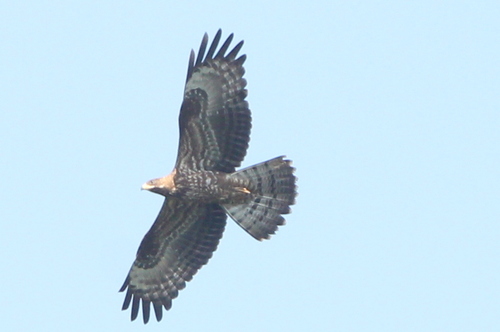
European Honey-buzzard (Pernis apivorus) European Honey-buzzard
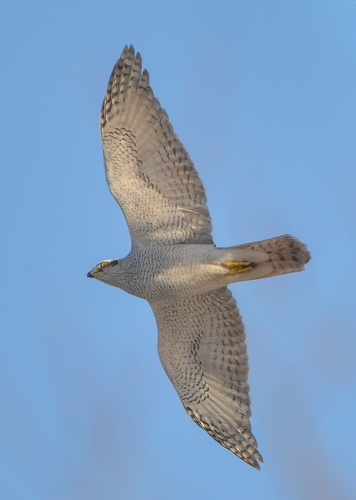
Eurasian Goshawk (Astur gentilis) Eurasian Goshawk

Media

Loading…

In short

The European Honey-buzzard and the Eurasian Goshawk can be distinguished by their structure and behavior. The Honey-buzzard has a longer tail and wings, and a more slender build compared to the robust and broad-winged Goshawk. In flight, the Honey-buzzard often glides with flat wings, while the Goshawk shows more powerful, flapping flight.

Identification tips

Look for the slender build and longer tail of the Honey-buzzard, especially when soaring. Note the white supercilium and broad wings of the Goshawk. In flight, observe the Honey-buzzard's flat-winged gliding versus the Goshawk's powerful flapping. Habitat preference can also help: open forests for Honey-buzzard, dense woods for Goshawk.

Size

The European Honey-buzzard is generally similar in size to the Eurasian Goshawk, but appears more slender and elongated.

Plumage

The Honey-buzzard has a more uniform and less contrasting plumage with a distinctive barred tail and underparts, while the Goshawk has a striking white supercilium and more contrasting barring on the underparts.

Behaviour

The Honey-buzzard is often seen soaring with flat wings and is less aggressive in hunting behavior compared to the Goshawk, which is known for its powerful and agile hunting flights.

Habitat

Both species can be found in wooded areas, but the Honey-buzzard prefers more open forests and edges, while the Goshawk is more often found in dense forests.

Voice

The Honey-buzzard is generally quieter, with a high-pitched, plaintive call, while the Goshawk is more vocal, especially during the breeding season, with a series of loud, rapid 'kak' calls.

Submit a better description

Use the same sections as the comparison. Your text is published immediately.

The European Honey-buzzard and the Eurasian Goshawk can be distinguished by their structure and behavior. The Honey-buzzard has a longer tail and wings, and a more slender build compared to the robust and broad-winged Goshawk. In flight, the Honey-buzzard often glides with flat wings, while the Goshawk shows more powerful, flapping flight.

Look for the slender build and longer tail of the Honey-buzzard, especially when soaring. Note the white supercilium and broad wings of the Goshawk. In flight, observe the Honey-buzzard's flat-winged gliding versus the Goshawk's powerful flapping. Habitat preference can also help: open forests for Honey-buzzard, dense woods for Goshawk.

The European Honey-buzzard is generally similar in size to the Eurasian Goshawk, but appears more slender and elongated.

The Honey-buzzard has a more uniform and less contrasting plumage with a distinctive barred tail and underparts, while the Goshawk has a striking white supercilium and more contrasting barring on the underparts.

The Honey-buzzard is often seen soaring with flat wings and is less aggressive in hunting behavior compared to the Goshawk, which is known for its powerful and agile hunting flights.

Both species can be found in wooded areas, but the Honey-buzzard prefers more open forests and edges, while the Goshawk is more often found in dense forests.

The Honey-buzzard is generally quieter, with a high-pitched, plaintive call, while the Goshawk is more vocal, especially during the breeding season, with a series of loud, rapid 'kak' calls.

Discard your changes?

You have unsaved edits. If you leave now, those changes will be lost.

European Honey-buzzard · Eurasian Goshawk · My Tricky Birds