Birdr

European Honey-buzzard vs Levant Sparrowhawk

Pernis apivorus versus Tachyspiza brevipes

Play a quiz with European Honey-buzzard and Levant Sparrowhawk
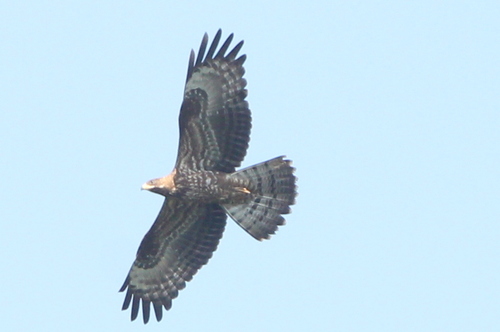
European Honey-buzzard (Pernis apivorus) European Honey-buzzard
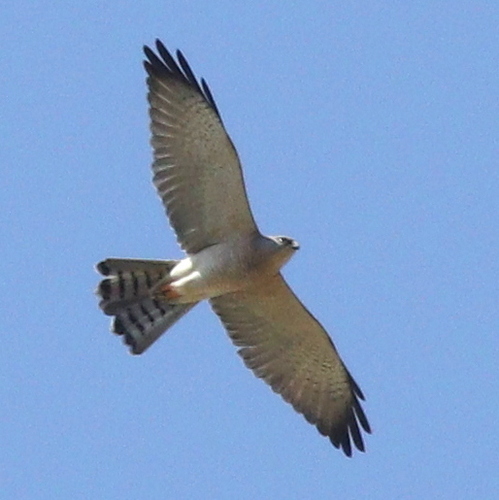
Levant Sparrowhawk (Tachyspiza brevipes) Levant Sparrowhawk

Media

Loading…

In short

The European Honey-buzzard and Levant Sparrowhawk can be distinguished by their structure and behavior. The Honey-buzzard has a longer tail and neck, giving it a more elongated appearance, while the Sparrowhawk is more compact with shorter wings and tail. In flight, the Honey-buzzard's wings are held flat, unlike the Sparrowhawk's slightly raised wings.

Identification tips

1. Structure: Look for the Honey-buzzard's longer tail and neck, and flat-winged gliding flight. 2. Wing Shape: Honey-buzzard wings are flat, while Sparrowhawk wings are slightly raised. 3. Behavior: Observe flight style; Honey-buzzards glide more, Sparrowhawks flap more. 4. Habitat: Note the environment; Honey-buzzards in forests, Sparrowhawks in open woodlands. 5. Plumage: Check for uniformity in Honey-buzzard vs. contrast in Sparrowhawk.

Size

The European Honey-buzzard is generally larger and more elongated than the Levant Sparrowhawk, which is more compact and smaller.

Plumage

Both species have variable plumage, but the Honey-buzzard often shows a more uniform brown with less contrast, while the Sparrowhawk may exhibit more distinct barring and a contrasting head pattern.

Behaviour

Honey-buzzards are often seen gliding with flat wings, whereas Sparrowhawks flap more frequently and have a more rapid flight.

Habitat

European Honey-buzzards are typically found in forested areas during migration and breeding, while Levant Sparrowhawks prefer open woodlands and edges.

Voice

Vocalizations are not a reliable differentiator in the field, as both species are generally silent outside of the breeding season.

Submit a better description

Use the same sections as the comparison. Your text is published immediately.

The European Honey-buzzard and Levant Sparrowhawk can be distinguished by their structure and behavior. The Honey-buzzard has a longer tail and neck, giving it a more elongated appearance, while the Sparrowhawk is more compact with shorter wings and tail. In flight, the Honey-buzzard's wings are held flat, unlike the Sparrowhawk's slightly raised wings.

1. Structure: Look for the Honey-buzzard's longer tail and neck, and flat-winged gliding flight. 2. Wing Shape: Honey-buzzard wings are flat, while Sparrowhawk wings are slightly raised. 3. Behavior: Observe flight style; Honey-buzzards glide more, Sparrowhawks flap more. 4. Habitat: Note the environment; Honey-buzzards in forests, Sparrowhawks in open woodlands. 5. Plumage: Check for uniformity in Honey-buzzard vs. contrast in Sparrowhawk.

The European Honey-buzzard is generally larger and more elongated than the Levant Sparrowhawk, which is more compact and smaller.

Both species have variable plumage, but the Honey-buzzard often shows a more uniform brown with less contrast, while the Sparrowhawk may exhibit more distinct barring and a contrasting head pattern.

Honey-buzzards are often seen gliding with flat wings, whereas Sparrowhawks flap more frequently and have a more rapid flight.

European Honey-buzzards are typically found in forested areas during migration and breeding, while Levant Sparrowhawks prefer open woodlands and edges.

Vocalizations are not a reliable differentiator in the field, as both species are generally silent outside of the breeding season.

Discard your changes?

You have unsaved edits. If you leave now, those changes will be lost.

European Honey-buzzard · Levant Sparrowhawk · My Tricky Birds