Birdr

European Honey-buzzard vs Montagu's Harrier

Pernis apivorus versus Circus pygargus

Play a quiz with European Honey-buzzard and Montagu's Harrier
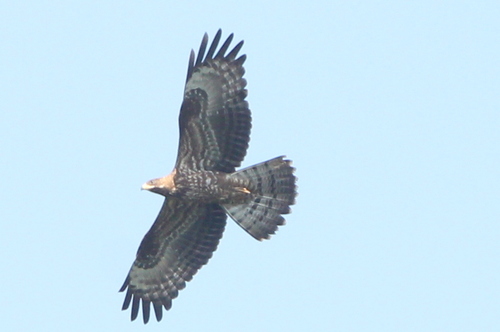
European Honey-buzzard (Pernis apivorus) European Honey-buzzard
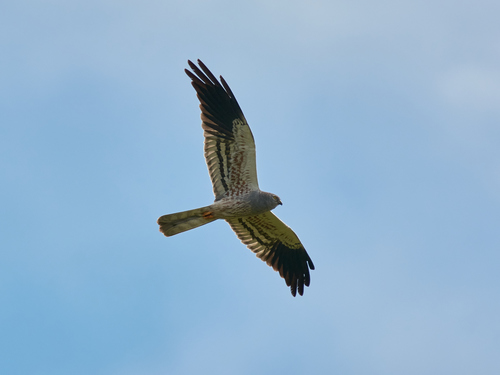
Montagu's Harrier (Circus pygargus) Montagu's Harrier

Media

Loading…

In short

The European Honey-buzzard and Montagu's Harrier can be distinguished by their wing shape and flight behavior. Honey-buzzards have broader wings and a more buoyant flight, while Montagu's Harriers have narrower wings and a more direct flight style. Both species are similar in size, but their plumage and behavior offer additional clues.

Identification tips

Size

Both species are similar in size, falling within the medium-sized raptor range.

Plumage

European Honey-buzzards have a more uniform plumage with subtle barring and a distinctively small head. Montagu's Harriers, especially males, show more contrast with grey and black wing tips, while females and juveniles have a brownish hue with a white rump patch.

Behaviour

Honey-buzzards exhibit a more buoyant and gliding flight, often soaring with wings held flat. Montagu's Harriers have a more direct and low flight, often seen quartering fields and marshes.

Habitat

Honey-buzzards are typically found in wooded areas, often near open spaces. Montagu's Harriers prefer open habitats like grasslands, marshes, and agricultural fields.

Voice

Vocalizations are not a primary distinguishing feature in the field, as both species are generally silent outside of the breeding season.

Submit a better description

Use the same sections as the comparison. Your text is published immediately.

The European Honey-buzzard and Montagu's Harrier can be distinguished by their wing shape and flight behavior. Honey-buzzards have broader wings and a more buoyant flight, while Montagu's Harriers have narrower wings and a more direct flight style. Both species are similar in size, but their plumage and behavior offer additional clues.

  • Wing shape: Honey-buzzards have broader wings compared to the narrower wings of Montagu's Harriers.
  • Flight style: Look for the buoyant, gliding flight of the Honey-buzzard versus the direct, low flight of the Harrier.
  • Plumage: Note the subtle barring and small head of the Honey-buzzard against the more contrasting plumage of the Harrier.
  • Habitat: Consider the environment; wooded areas suggest Honey-buzzard, while open fields suggest Harrier.
  • Seasonal behavior: Be aware that Montagu's Harriers are more likely to be seen in open fields during migration and breeding seasons.

Both species are similar in size, falling within the medium-sized raptor range.

European Honey-buzzards have a more uniform plumage with subtle barring and a distinctively small head. Montagu's Harriers, especially males, show more contrast with grey and black wing tips, while females and juveniles have a brownish hue with a white rump patch.

Honey-buzzards exhibit a more buoyant and gliding flight, often soaring with wings held flat. Montagu's Harriers have a more direct and low flight, often seen quartering fields and marshes.

Honey-buzzards are typically found in wooded areas, often near open spaces. Montagu's Harriers prefer open habitats like grasslands, marshes, and agricultural fields.

Vocalizations are not a primary distinguishing feature in the field, as both species are generally silent outside of the breeding season.

Discard your changes?

You have unsaved edits. If you leave now, those changes will be lost.

European Honey-buzzard · Montagu's Harrier · My Tricky Birds