
European Robin vs Common Nightingale
Erithacus rubecula versus Luscinia megarhynchos
Play a quiz with European Robin and Common Nightingale
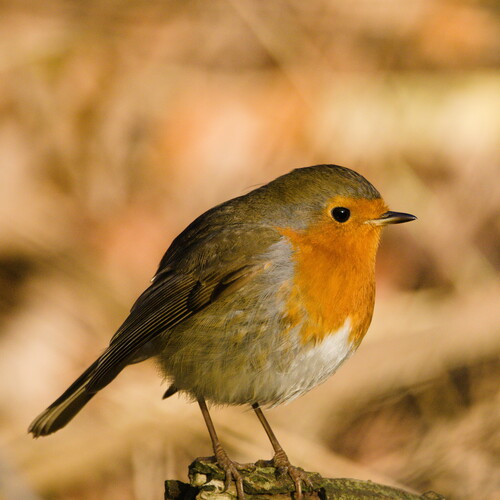 European Robin
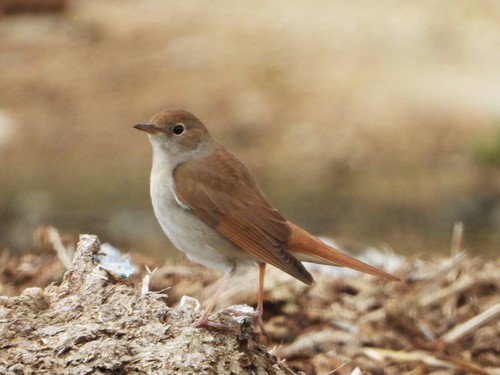 Common Nightingale
In short
The most reliable way to separate European Robin from Common Nightingale is by the robin's bright orange-red breast and face, which is never shown by nightingale of any age or sex. Juvenile robins are brown and speckled, but even then, nightingales are plainer and have a distinctive rufous tail contrasting with brown upperparts. Nightingales are larger and longer-tailed, with a more uniformly brown appearance above and buff-white below, lacking any orange or strong facial color. In flight or perched, look for the robin's compact, round-bodied shape versus the nightingale's longer, more slender profile and reddish tail. Both species can be found in similar habitats, but nightingale is much scarcer and highly localized in much of northern and western Europe.
Identification tips
- Orange-red breast and face (adult robin): Only European Robin shows this; nightingale never does. Works for all adults and most first-winters after partial molt.
- Juvenile robin vs nightingale: Juvenile robins are mottled brown and white, lacking orange, but still appear round-bodied and short-tailed. Juvenile nightingales are plain brown above, buff below, with a rufous tail—never mottled or spotted.
- Rufous tail (nightingale): Nightingale of all ages shows a distinctly rufous tail, contrasting with the brown back. Robin's tail is brown and never rufous.
- Body shape: Robin is compact, round, and short-tailed; nightingale is longer, more slender, and has a longer tail.
- Wing covert tips (first-winter robin): First-winter robins may show yellow-brown tips to the wing coverts, which are absent in nightingale.
- Facial pattern: Robin has a strong orange face; nightingale's face is plain brown, sometimes with a faint pale supercilium in eastern subspecies, but never orange.
- Underparts: Robin has a white belly with orange breast; nightingale is buff to white below, with no orange or red.
- Bill and eye: Both have dark bills and eyes; not a useful separator.
- Perched behavior: Robin often perches in the open and is tame; nightingale is shy, usually stays in dense cover.
- Flight silhouette: Robin appears short-tailed and compact in flight; nightingale is longer, with a more pointed tail.
- Song: Robin's song is sweet and melancholy, heard year-round; nightingale's song is much louder, more varied, and delivered mostly in spring from deep cover.
- Habitat: Robin is common in gardens, parks, and woods; nightingale is rare and local, favoring dense scrub and thickets, especially in southeast England and continental Europe.
- Season: Nightingale is present only in spring and summer in most of its range; robin is resident year-round in most areas.
- Sex differences: Both species are sexually monomorphic in plumage; sex cannot be determined by appearance.
- Pitfalls: Beware of juvenile robin (no orange) and nightingale in poor light—shape, tail color, and habitat are key then.
Size
European Robin is smaller, measuring 12.5–14.0 cm in length with a wingspan of 20–22 cm and weighing 16–22 g [wikipedia][avonet]. Common Nightingale is noticeably larger at 15–16.5 cm in length [wikipedia], with a longer body and tail. The difference is subtle at a distance but obvious with good views or when both are seen together. Nightingale appears more elongated and less compact than robin.
Plumage
- Juvenile/First-winter: Juvenile robins are mottled brown and white, lacking any orange or red on the breast or face, but still show a compact, round shape and short tail. First-winter robins resemble adults but may show yellow-brown tips to the wing coverts, a feature not present in nightingale. Juvenile nightingales are similar to adults: plain brown above, buff to white below, with a rufous tail and no orange or red anywhere.
- Adult: Adult robins of both sexes have a vivid orange-red breast and face bordered by bluish-grey, brownish upperparts, and a whitish belly. Nightingales are plain brown above (sometimes paler in eastern subspecies), with a strong rufous tail, buff to white underparts, and sometimes a faint pale supercilium in eastern birds. Nightingales never show any orange or red on the face or breast.
- Flight/Upperwing: No distinctive upperwing pattern is described for either species in flight, but the robin's compact shape and short tail contrast with the nightingale's longer, more pointed tail and overall length.
Behaviour
Robins are often seen perching upright on low branches, posts, or garden furniture, frequently flicking their wings and tail. They can be quite bold and tame, especially in gardens. Nightingales are more secretive, usually skulking in dense undergrowth or low shrubs, and are less likely to be seen in the open. Nightingales may flick their rufous tail and wings, but are generally less conspicuous in their movements than robins.
Habitat
Both species can occur in woodland edges, gardens, and parks, but robins are far more widespread and common, especially in western and northern Europe. Robins are found in a wide range of habitats, including urban areas. Nightingales are much more localized, favoring dense scrub, thickets, and coppiced woodland, especially in southern and eastern Europe. In the UK, nightingales are restricted to a few counties in the southeast and are declining, whereas robins are abundant almost everywhere.
Voice
The robin's song is a series of high, sweet, and somewhat melancholy phrases, often delivered from a visible perch, and is heard year-round (especially in autumn and winter). Nightingale song is much richer, louder, and more varied, with powerful whistles, trills, and gurgles, typically delivered from deep cover and mostly at dawn or dusk in spring and early summer. Only male nightingales sing; both sexes of robin sing, but the nightingale's song is far more elaborate and famous.