Birdr

European Shag vs Double-crested Cormorant

Gulosus aristotelis versus Nannopterum auritum

Play a quiz with European Shag and Double-crested Cormorant
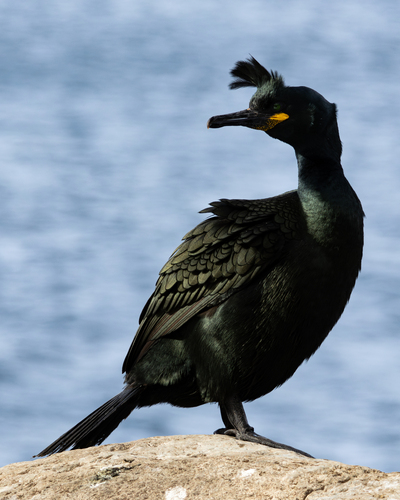
European Shag (Gulosus aristotelis) European Shag
Double-crested Cormorant (Nannopterum auritum) Double-crested Cormorant

Media

Loading…

In short

The European Shag and Double-crested Cormorant are both large, dark waterbirds, but they can be distinguished by their structural features and habitat preferences. The Shag has a more slender build with a thinner bill, while the Double-crested Cormorant is bulkier with a thicker, hooked bill. Observing their behavior and preferred environments can also aid in identification.

Identification tips

  1. Bill Shape: Look for the European Shag's thinner, more pointed bill compared to the thicker, hooked bill of the Double-crested Cormorant. 2. Plumage Gloss: Note the Shag's greenish sheen during breeding season. 3. Habitat: Consider the location; Shags prefer rocky coasts, while Double-crested Cormorants are more adaptable. 4. Behavior: Observe for wing-spreading behavior common in Double-crested Cormorants.

Size

The Double-crested Cormorant is generally larger and bulkier than the European Shag.

Plumage

The European Shag often appears more glossy with a greenish sheen, especially during the breeding season, while the Double-crested Cormorant is more uniformly dark with a less glossy appearance. The Shag lacks the Double-crested Cormorant's distinctive breeding crests.

Behaviour

Both species dive for fish, but the European Shag tends to be more agile and faster underwater. The Double-crested Cormorant often perches with wings spread to dry.

Habitat

European Shags are typically found along rocky coastlines and islands, while Double-crested Cormorants are more versatile, inhabiting both coastal and inland waters, including lakes and rivers.

Voice

Vocalizations are not a reliable distinguishing feature in the field as both species are relatively quiet and have similar guttural calls.

Submit a better description

Use the same sections as the comparison. Your text is published immediately.

The European Shag and Double-crested Cormorant are both large, dark waterbirds, but they can be distinguished by their structural features and habitat preferences. The Shag has a more slender build with a thinner bill, while the Double-crested Cormorant is bulkier with a thicker, hooked bill. Observing their behavior and preferred environments can also aid in identification.

  1. Bill Shape: Look for the European Shag's thinner, more pointed bill compared to the thicker, hooked bill of the Double-crested Cormorant. 2. Plumage Gloss: Note the Shag's greenish sheen during breeding season. 3. Habitat: Consider the location; Shags prefer rocky coasts, while Double-crested Cormorants are more adaptable. 4. Behavior: Observe for wing-spreading behavior common in Double-crested Cormorants.

The Double-crested Cormorant is generally larger and bulkier than the European Shag.

The European Shag often appears more glossy with a greenish sheen, especially during the breeding season, while the Double-crested Cormorant is more uniformly dark with a less glossy appearance. The Shag lacks the Double-crested Cormorant's distinctive breeding crests.

Both species dive for fish, but the European Shag tends to be more agile and faster underwater. The Double-crested Cormorant often perches with wings spread to dry.

European Shags are typically found along rocky coastlines and islands, while Double-crested Cormorants are more versatile, inhabiting both coastal and inland waters, including lakes and rivers.

Vocalizations are not a reliable distinguishing feature in the field as both species are relatively quiet and have similar guttural calls.

Discard your changes?

You have unsaved edits. If you leave now, those changes will be lost.

European Shag · Double-crested Cormorant · My Tricky Birds