
European Stonechat vs Amur Stonechat
Saxicola rubicola versus Saxicola stejnegeri
Play a quiz with European Stonechat and Amur Stonechat
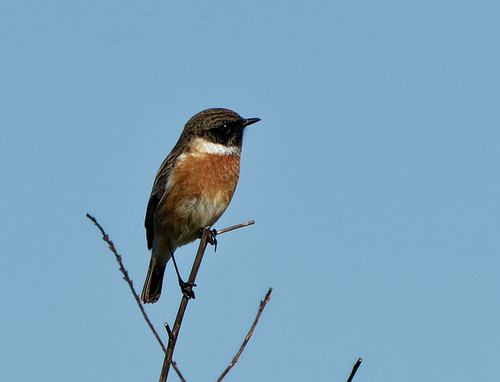 European Stonechat
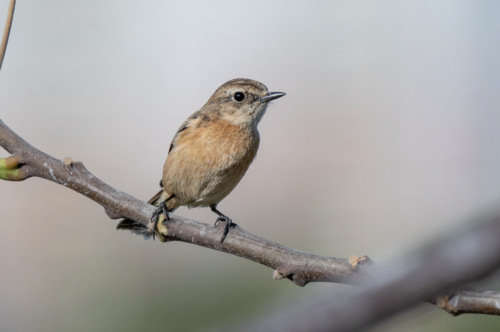 Amur Stonechat
In short
The most reliable field mark between European Stonechat and Amur Stonechat is the rump and underparts coloration: Amur Stonechat (Saxicola stejnegeri) shows a much whiter rump and paler, less orange underparts, especially in males, while European Stonechat (Saxicola rubicola) has a smaller, often streaked white rump and richer orange breast. Juvenile and female plumages are particularly tricky, but Amur females and immatures tend to have paler, unstreaked rumps and at least some white neck patches, unlike the darker, streaked, and less contrasting European birds. In flight, Amur Stonechat can show a more obvious white rump and larger white wing patches, but beware overlap in pale southern European Stonechats. Structure is similar, but European Stonechat is slightly smaller and more compact, with shorter wings. Habitat and range overlap only in rare vagrancy, so context is rarely helpful. Use a combination of rump color, extent of orange on the breast, and presence of white collar patches for the most confident separation.
Identification tips
- Rump color (all ages): Amur Stonechat shows a large, clean white or pale pinkish-yellow rump, especially obvious in flight; European Stonechat has a smaller, often streaked white rump (males) or brown, streaked rump (females/immatures).
- Neck collar (adult males and females): Amur Stonechat males have a full, conspicuous white collar encircling the neck; European Stonechat males show only a half-collar on the sides. Female Amur Stonechats often show some white neck patches, while European females lack any white on the neck.
- Breast color (adult males): European Stonechat males have a richer, more extensive orange breast; Amur Stonechat males have a more restricted, paler orange throat and upper breast, with whiter underparts below.
- Head and upperparts (adult males): Amur Stonechat males are jet-black above, lacking brownish tones; European Stonechat males can show some brown in the black, especially outside peak breeding.
- Scapular and wing patch (all ages): Amur Stonechat tends to have a larger, brighter white scapular patch and more extensive white in the wing, visible both perched and in flight. European Stonechat's wing patch is smaller and can be buffy, especially in females.
- Supercilium (non-breeding males): Amur Stonechat males in winter may show a pale supercilium, resembling Whinchat; European Stonechat males never show a strong supercilium.
- Female/immature plumage: Female and immature Amur Stonechats are paler overall, with paler underparts, unstreaked pale rumps, and at least some white on the neck. European females and immatures are darker, with streaked brown rumps and no white on the neck.
- Flight views (all ages): In flight, Amur Stonechat shows a more obvious white rump and larger white wing patches; European Stonechat's white is less extensive and more likely to be streaked or buffy.
- Size and structure: European Stonechat is slightly smaller and more compact, with shorter wings; Amur Stonechat is marginally longer-winged, but this is subtle and not reliable unless both are together.
- Habitat and range: Use with caution—Amur Stonechat is a rare vagrant in Europe; most stonechats in western Europe are European Stonechat. Context only helps if the bird is far out of range.
- Seasonal changes: Amur Stonechat males retain the white collar in winter and develop a pale supercilium; European Stonechat males become duller but never show a full collar or supercilium.
- Pitfalls with pale European Stonechats: Some southern European Stonechats (S. r. rubicola) can be very pale with large white rumps, resembling Amur Stonechat. In these cases, focus on the extent of orange on the breast, the presence or absence of a full white collar, and the pattern of the rump (streaked vs. clean).
- Juvenile confusion: Juvenile Amur Stonechats are paler and less streaked below, with a pale rump; European juveniles are more heavily streaked and lack any white on the neck or rump.
- Behavior: Both species behave similarly, but Amur Stonechat may appear more restless and is more likely to be seen in open country during migration.
- Voice: Not covered in the provided notes; do not rely on vocalizations for separation based on current information.
Size
European Stonechat is slightly smaller (11.5–13 cm, 13–17 g) than Amur Stonechat, but the difference is subtle and not reliable in the field unless both are side-by-side. Both are small, upright, short-tailed chats, but European Stonechat tends to look a bit more compact with proportionally shorter wings, while Amur Stonechat is marginally longer-winged, reflecting its more migratory habits. Bill and tail proportions are very similar and not diagnostic.
Plumage
Juvenile and first-winter birds: Amur Stonechat (all ages, especially females and immatures) shows a pale, unstreaked pinkish-yellow or white rump and at least some white neck patches, even in females. European Stonechat juveniles and females have a streaked brown rump and lack any white collar or neck patch; the only white is a small, often buffy scapular patch. In adult breeding males, Amur Stonechat is darker above, with a jet-black head and back, a conspicuous full white collar, large white scapular and rump patches, and a more restricted orange throat. European Stonechat males have a black head and upperparts (sometimes with brownish tones), a half-collar, and a smaller, often streaked white rump; their orange on the breast is more extensive and richer. In non-breeding plumage, Amur males develop a pale supercilium and retain the white collar, while European males become duller but never show a full collar or supercilium. Female Amur Stonechats are paler, with a pale unstreaked rump and white neck patches, while female European Stonechats are darker, with a streaked rump and no white on the neck.
Behaviour
Both species perch upright on exposed stems, wires, or shrubs, sallying out for insects and then returning to a prominent perch. European Stonechat is slightly more sedentary and may appear more confiding. Amur Stonechat, being more migratory, can seem more restless and is more likely to be seen in open country during passage. Flight is similar, but Amur may appear longer-winged and show more white in the wing and rump when flushed.
Habitat
European Stonechat favors heathland, coastal dunes, rough grassland, and open scrub with scattered shrubs or bramble, mostly in Europe and North Africa. Amur Stonechat breeds across northern and central Asia in open country, grasslands, and steppe, and winters in the Old World tropics. Overlap is rare and usually only occurs with vagrant Amur Stonechats in Europe. Habitat is not a reliable separator unless the bird is far outside the expected range.