
European Stonechat vs Siberian Stonechat
Saxicola rubicola versus Saxicola maurus
Play a quiz with European Stonechat and Siberian Stonechat
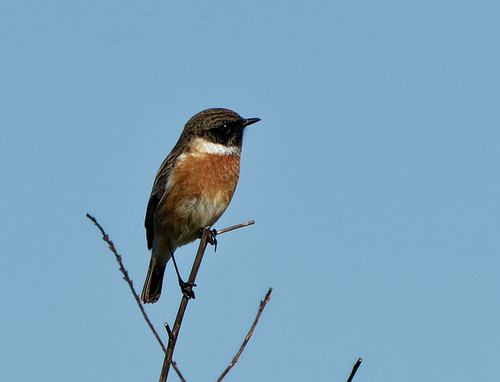 European Stonechat
 Siberian Stonechat
In short
The most reliable field mark between European Stonechat and Siberian Stonechat is the extent and brightness of white on the rump and collar, especially in males and first-winter birds. Siberian Stonechat males show a conspicuous white rump and full white collar, with paler, less orange underparts, while European Stonechat males have a smaller, often streaked white rump and only a half-collar. Females and immatures are trickier: Siberian tends to have a pale, unstreaked rump and some white neck patches, while European females are browner with streaked rumps and lack white on the neck. Structure is similar, but Siberian can look longer-winged. Always consider geographic context and beware pale southern European Stonechats, which can closely mimic Siberian.
Identification tips
- Rump color and pattern (all ages): Siberian Stonechat shows a large, clean white (or pale pinkish-yellow in females/immatures) rump, usually unstreaked. European Stonechat has a smaller, often black-streaked white rump. This is most reliable in flight or when the bird flicks its tail.
- Collar (males, some females): Siberian males show a full, bright white collar encircling the neck; European males have only a white half-collar on the sides. Females Siberian may show some white neck patches, European females lack these.
- Underparts (males): Siberian males have paler, whiter underparts with a restricted orange throat patch. European males are richer orange on the breast and throat, extending further down.
- Upperparts (males): Siberian males are blacker above, lacking the brownish tones often seen in European males.
- Female/immature plumage: Siberian females are paler brown above, with a pale, unstreaked rump and some white on the neck. European females are darker brown, with streaked rumps and no white on the neck.
- Wing pattern (all ages): Both species have a white scapular patch, but in European Stonechat this is often buffy-white and less extensive, especially in females. In Siberian, the patch is brighter and more defined.
- Supercilium (winter males): Siberian Stonechat males in winter can show a pale supercilium, resembling Whinchat, but retain the full white collar. European Stonechat lacks a strong supercilium.
- Primary projection and jizz: Both species have short wings, but Siberian may appear slightly longer-winged and more upright, though this is subtle and not always reliable.
- Geographic context: In western Europe, Siberian Stonechat is a rare vagrant; European Stonechat is common. However, pale southern European Stonechats can mimic Siberian, so use multiple field marks.
- Pitfalls with pale European Stonechats: Birds from southernmost Europe (e.g., Algarve, Sicily) can be very pale with large white rumps, approaching Siberian appearance. Check for streaking on the rump and the extent of the collar.
- Sex differences: Males are easier to separate than females or immatures. Females and young birds require careful attention to rump and collar.
- No reliable size difference: Do not rely on size or bulk to separate these species.
- Habitat overlap: Both use similar open, shrubby habitats; habitat is not diagnostic.
- Voice not diagnostic in these notes: No vocal differences are described here; do not rely on calls for separation.
- Use a combination of marks: No single feature is always diagnostic, especially in pale European Stonechats. Use rump color/pattern, collar extent, underpart color, and context together for best results.
Size
Both species are very similar in size, with European Stonechat measuring 11.5–13 cm in length and weighing 13–17 g [wikipedia]. Siberian Stonechat is not described as differing in size in the provided notes, and both are described as small passerines. In the field, size is not a reliable separator between these two.
Plumage
Juvenile and first-winter birds are often the source of confusion. For these ages, focus on the rump and wing pattern:
-
Siberian Stonechat (all ages, especially males and first-winters): Shows a conspicuous white rump that is clean and unstreaked, and a full white collar (especially in males). The underparts are paler, with less orange on the breast, and the upperparts are darker and blacker, lacking brownish tones. Females and immatures have a pale, pinkish-yellow, unstreaked rump and some white neck patches.
-
European Stonechat (all ages): Rump is smaller, often streaked with black, and the white is less extensive. Males have only a white half-collar, not a full one. Females are browner overall, with streaked rumps and no white on the neck or collar. Southernmost European Stonechats (e.g., from Algarve or Sicily) can be very pale and show more white on the rump, sometimes approaching Siberian, but usually still show streaking and lack the full collar.
In summary, the extent and cleanness of white on the rump and collar, and the presence or absence of streaking, are key for all plumages.
Behaviour
Behavior is not distinctly different in the provided notes. Both species perch upright on shrubs or low vegetation and have similar feeding and nesting behaviors typical of stonechats. Flight style and jizz are not described as reliably different.
Habitat
European Stonechat is found across Europe, favoring heathland, coastal dunes, and rough grassland with scattered shrubs, gorse, or heather. Siberian Stonechat breeds in the East Palearctic and winters in the Old World tropics, with no specific habitat differences described in the notes. In western Europe, Siberian Stonechat is a rare vagrant, so context and range can be helpful but not definitive for identification.