Falcated Duck vs Eurasian Wigeon
Mareca falcata versus Mareca penelope
Play a quiz with Falcated Duck and Eurasian Wigeon
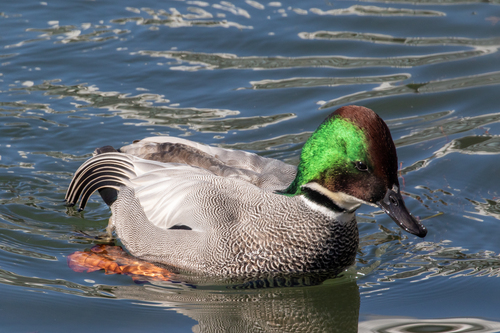
Falcated Duck
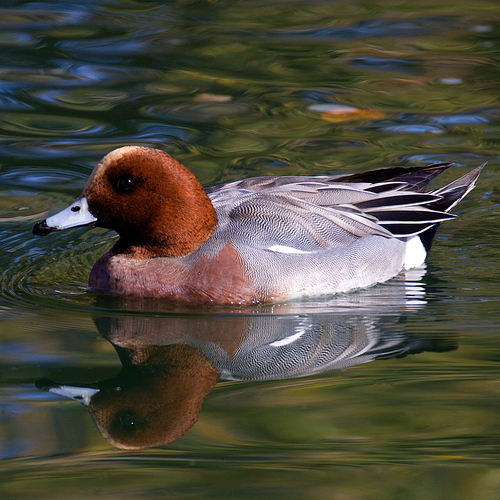
Eurasian Wigeon
In short
The Falcated Duck and Eurasian Wigeon are both medium-sized dabbling ducks, but they can be distinguished by their plumage and head shape. The Falcated Duck has a distinctive iridescent green head and long, sickle-shaped tertials, while the Eurasian Wigeon features a more rounded head with a buffy-cream forehead and crown.
Identification tips
- Look for the iridescent green head and long, sickle-shaped tertials on the Falcated Duck. 2. Note the buffy-cream forehead and crown on the Eurasian Wigeon. 3. Listen for the whistling call of the Eurasian Wigeon. 4. Consider habitat: Falcated Ducks prefer wooded wetlands, while Eurasian Wigeons are often in open water.
Size
Both species are similar in size, but the Falcated Duck may appear slightly more elongated due to its longer tertials.
Plumage
The Falcated Duck has a striking iridescent green head, chestnut breast, and long, curved tertials. In contrast, the Eurasian Wigeon has a grayish body, a buffy-cream forehead and crown, and a more uniform appearance without the elongated tertials.
Behaviour
Both species are dabbling ducks and often seen in similar feeding postures, but the Falcated Duck may be more likely to be seen in smaller flocks or pairs.
Habitat
Both species can be found in wetlands, but the Falcated Duck is more often associated with wooded ponds and marshes, while the Eurasian Wigeon is commonly found in open lakes and coastal lagoons.
Voice
The Eurasian Wigeon is known for its distinctive whistling call, while the Falcated Duck's vocalizations are less prominent and not as well-documented.