Birdr

Far Eastern Curlew vs Bar-tailed Godwit

Numenius madagascariensis versus Limosa lapponica

Play a quiz with Far Eastern Curlew and Bar-tailed Godwit
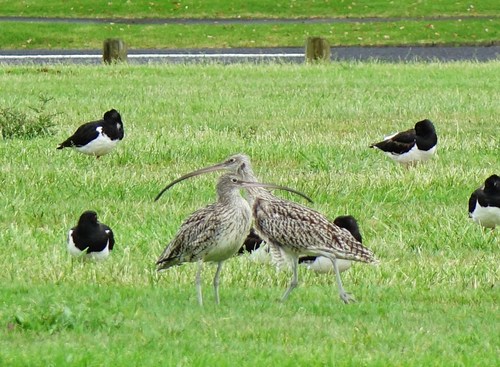
Far Eastern Curlew (Numenius madagascariensis) Far Eastern Curlew
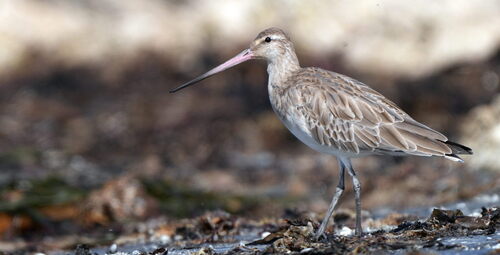
Bar-tailed Godwit (Limosa lapponica) Bar-tailed Godwit

Media

Loading…

In short

The Far Eastern Curlew and Bar-tailed Godwit are large shorebirds with similar habitats, but they can be distinguished by their bill shape and plumage. The Far Eastern Curlew has a notably longer, more decurved bill, while the Bar-tailed Godwit has a straighter, slightly upturned bill. Plumage differences are subtle but notable in the underwing pattern and tail markings.

Identification tips

  1. Bill shape: Look for the longer, more decurved bill of the Far Eastern Curlew compared to the straighter bill of the Bar-tailed Godwit. 2. Size and bulk: The Far Eastern Curlew is larger and bulkier. 3. Underwing pattern: Check for the more pronounced barred pattern on the underwings of the Far Eastern Curlew. 4. Tail markings: The Bar-tailed Godwit has a barred tail, which can be a useful field mark. 5. Habitat and behavior: Observe foraging behavior and habitat use, though these can overlap significantly.

Size

The Far Eastern Curlew is generally larger and bulkier than the Bar-tailed Godwit.

Plumage

The Far Eastern Curlew has a more uniform brown plumage with a distinctive barred pattern on the underwings. In contrast, the Bar-tailed Godwit shows a more varied plumage with a barred tail and a less pronounced underwing pattern.

Behaviour

Both species are often seen in large flocks during migration and non-breeding seasons. They forage in similar coastal habitats but may exhibit different foraging behaviors due to bill shape.

Habitat

Both species frequent coastal mudflats, estuaries, and sandy shores. They share similar migratory routes in the East Asian-Australasian Flyway.

Voice

Vocalizations are not the most reliable distinguishing feature in the field, but the Far Eastern Curlew's call is a loud, clear 'cur-lee' sound, while the Bar-tailed Godwit has a softer, more varied call.

Submit a better description

Use the same sections as the comparison. Your text is published immediately.

The Far Eastern Curlew and Bar-tailed Godwit are large shorebirds with similar habitats, but they can be distinguished by their bill shape and plumage. The Far Eastern Curlew has a notably longer, more decurved bill, while the Bar-tailed Godwit has a straighter, slightly upturned bill. Plumage differences are subtle but notable in the underwing pattern and tail markings.

  1. Bill shape: Look for the longer, more decurved bill of the Far Eastern Curlew compared to the straighter bill of the Bar-tailed Godwit. 2. Size and bulk: The Far Eastern Curlew is larger and bulkier. 3. Underwing pattern: Check for the more pronounced barred pattern on the underwings of the Far Eastern Curlew. 4. Tail markings: The Bar-tailed Godwit has a barred tail, which can be a useful field mark. 5. Habitat and behavior: Observe foraging behavior and habitat use, though these can overlap significantly.

The Far Eastern Curlew is generally larger and bulkier than the Bar-tailed Godwit.

The Far Eastern Curlew has a more uniform brown plumage with a distinctive barred pattern on the underwings. In contrast, the Bar-tailed Godwit shows a more varied plumage with a barred tail and a less pronounced underwing pattern.

Both species are often seen in large flocks during migration and non-breeding seasons. They forage in similar coastal habitats but may exhibit different foraging behaviors due to bill shape.

Both species frequent coastal mudflats, estuaries, and sandy shores. They share similar migratory routes in the East Asian-Australasian Flyway.

Vocalizations are not the most reliable distinguishing feature in the field, but the Far Eastern Curlew's call is a loud, clear 'cur-lee' sound, while the Bar-tailed Godwit has a softer, more varied call.

Discard your changes?

You have unsaved edits. If you leave now, those changes will be lost.

Far Eastern Curlew · Bar-tailed Godwit · My Tricky Birds