
Far Eastern Curlew vs Eurasian Curlew
Numenius madagascariensis versus Numenius arquata
Play a quiz with Far Eastern Curlew and Eurasian Curlew
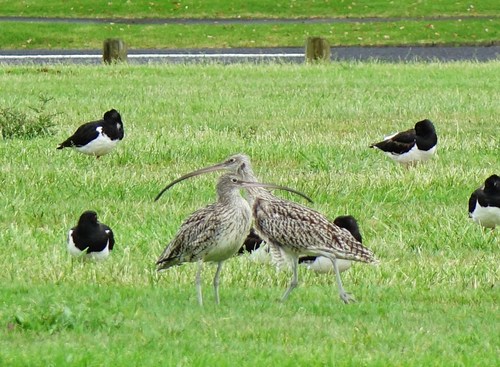 Far Eastern Curlew
 Eurasian Curlew
In short
The most reliable field mark to separate Far Eastern Curlew from Eurasian Curlew is the underwing and rump pattern in flight: Far Eastern Curlew shows a plain, unpatterned brown underwing and a brown rump, while Eurasian Curlew has a white back and rump and lacks the uniform brown underwing. Far Eastern Curlew is also slightly larger overall with a proportionally longer, heavier bill. Both species are large, brownish waders with long decurved bills, and confusion is most likely when viewing distant or flying birds, especially immatures. Structural and plumage differences are subtle but consistent if you focus on the rump and underwing in flight, and bill length and color when perched.
Identification tips
- Rump and lower back in flight: Far Eastern Curlew shows a brown rump and lower back, while Eurasian Curlew has a white back and rump. This is the single most reliable mark in all ages and seasons when birds are flying away or overhead.
- Underwing pattern: Far Eastern Curlew has a plain, unpatterned brown underwing, contrasting with the paler, less uniform underwing of Eurasian Curlew. Check this in flight or when birds stretch their wings.
- Bill length and shape: Far Eastern Curlew has an extremely long, decurved bill (12.8–20.1 cm), often appearing proportionally longer and heavier than Eurasian Curlew. This is most obvious in adult females, but beware overlap and variation.
- Overall coloration: Far Eastern Curlew tends to be more uniformly brown, especially on the upperparts and underwing, while Eurasian Curlew is more greyish-brown with a contrasting white back.
- Leg color: Eurasian Curlew has greyish-blue legs; leg color is less emphasized for Far Eastern Curlew but is not a primary separator.
- Size and structure: Far Eastern Curlew is slightly longer and bulkier, with a longer neck and bill, but this is subtle and not always obvious in the field. Use only as supporting evidence.
- Perched birds: When both are standing, look for the white back of Eurasian Curlew versus the more uniformly brown upperparts of Far Eastern Curlew, but beware that lighting and posture can obscure these marks.
- Flight jizz: Both species have long, decurved bills and long legs trailing in flight, but Far Eastern Curlew may look bulkier and more front-heavy due to its longer bill and neck.
- Voice: Learn the difference between the sharp, clear whistle of Far Eastern Curlew ('cuuue-reee') and the more bubbling, drawn-out call of Eurasian Curlew ('curloo-oo'). Use calls as confirmation, not the primary separator.
- Habitat and context: In East Asia, both species can occur together, so do not rely on location alone. In Europe, only Eurasian Curlew is expected.
- Sex and age: Both species show bill length variation by sex (females longer-billed), but this is not a reliable field mark unless birds are paired. No strong age-specific flight marks are described, so focus on rump and underwing in all ages.
- Flock composition: Large flocks in East Asia may contain both species; scan for the brown rump and plain underwing to pick out Far Eastern Curlew among Eurasian Curlews.
- Pitfalls: Immature birds of both species look similar to adults in structure and plumage, so do not assume a smaller or duller bird is a juvenile of one species; rely on rump and underwing.
- Bill overlap: Some Eurasian Curlews, especially females, can have long bills approaching those of Far Eastern Curlew, so always confirm with rump and underwing pattern.
- Lighting and distance: In poor light or at long range, rump and underwing marks may be hard to see; in these cases, use a combination of structure, bill length, and overall color, but be cautious and note uncertainty.
Size
Both species are among the largest shorebirds, but Far Eastern Curlew is slightly longer (60–66 cm vs. 50–60 cm) and has a broader wingspan (up to 110 cm vs. 106 cm). Despite this, Eurasian Curlew averages a bit heavier (805.5 g vs. 752.6 g), likely due to individual and sex variation. In the field, the size difference is subtle and rarely diagnostic unless both species are side by side, but Far Eastern Curlew often appears bulkier and longer-necked, with a more imposing presence.
Plumage
For all ages, the key difference is in the rump and underwing: Far Eastern Curlew has a plain, unpatterned brown underwing and a brown rump and lower back, visible in flight. Eurasian Curlew, by contrast, has a white back and rump, which stands out in flight, and its underwing is not described as uniformly brown. Both species are mostly brown above and pale below, but Eurasian Curlew is described as more greyish-brown overall, with a white back and greyish-blue legs. No age-specific upperwing patterns are described for either species, so these rump and underwing features apply to both adults and immatures. When perched, the two are very similar, but Far Eastern Curlew tends to look more uniformly brown, while Eurasian Curlew shows more contrast between the brown upperparts and white back.
Behaviour
Both species forage by probing mud or soft ground with their long, decurved bills, often in flocks during migration or at roost. Far Eastern Curlew may feed solitarily but generally gathers in large flocks for migration or roosting, similar to Eurasian Curlew. No major behavioral differences are noted that would reliably separate them in the field.
Habitat
Both species occupy similar open wetland habitats, such as mudflats, estuaries, and coastal marshes, especially on migration and in winter. Eurasian Curlew breeds across temperate Europe and Asia in open grasslands and meadows, while Far Eastern Curlew is more restricted to East Asia and Australasia. In areas of range overlap (e.g., East Asia), habitat is not a reliable separator.
Voice
Far Eastern Curlew gives a sharp, clear whistle, 'cuuue-reee', often repeated. Eurasian Curlew's call is a loud 'curloo-oo'. Both have distinctive, far-carrying calls, but these are not easily confused if heard well. However, in mixed flocks or at distance, calls could be misattributed, so use vocalizations as supporting evidence rather than the sole separator.