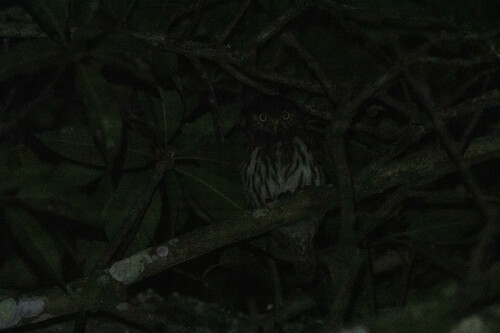
Ferruginous Pygmy-Owl vs Peruvian Pygmy-Owl
Glaucidium brasilianum versus Glaucidium peruanum
Play a quiz with Ferruginous Pygmy-Owl and Peruvian Pygmy-Owl
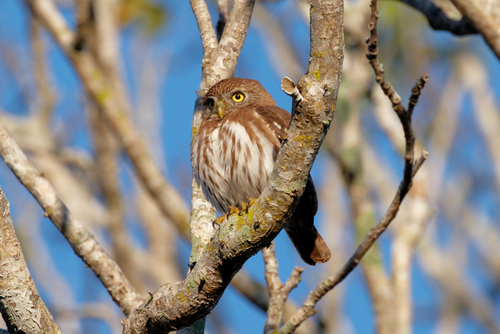
Ferruginous Pygmy-Owl
Peruvian Pygmy-Owl
In short
The Ferruginous Pygmy-Owl and Peruvian Pygmy-Owl are similar small owls, but can be distinguished by their vocalizations and habitat preferences. The Ferruginous Pygmy-Owl has slower toots, whereas the Peruvian Pygmy-Owl has a rapid whistled song. Habitat differences also aid in identification, with the Ferruginous preferring more wooded areas and the Peruvian favoring drier habitats.
Identification tips
- Listen for vocalizations: Slower toots indicate Ferruginous, rapid whistles suggest Peruvian. 2. Check habitat: Wooded areas likely host Ferruginous, drier, more open areas may indicate Peruvian. 3. Observe plumage: Look for more rufous or darker plumage in Peruvian, especially in different elevations. 4. Behavioral cues: Tail movements can suggest Ferruginous if observed.
Size
Both species are small, similar in size, and can be difficult to distinguish based on size alone.
Plumage
Plumage can be variable, but generally, the Peruvian Pygmy-Owl shows more rufous coloration in lowland areas and darker gray or brown with more white spotting at higher elevations. The Ferruginous Pygmy-Owl tends to have a more uniform appearance without such marked variation.
Behaviour
The Ferruginous Pygmy-Owl often perches with its tail cocked and may jerk its tail when agitated. Both species hunt diurnally.
Habitat
Ferruginous Pygmy-Owls are often found in wooded areas, including cottonwood-mesquite woodlands, whereas Peruvian Pygmy-Owls prefer drier forests and scrub, often near settled areas.
Voice
The Ferruginous Pygmy-Owl has slower toots, while the Peruvian Pygmy-Owl produces a rapid whistled song. This is a key distinguishing feature.
Ferruginous Pygmy-Owl · Peruvian Pygmy-Owl · My Tricky Birds