
Fieldfare vs Dusky Thrush
Turdus pilaris versus Turdus eunomus
Play a quiz with Fieldfare and Dusky Thrush
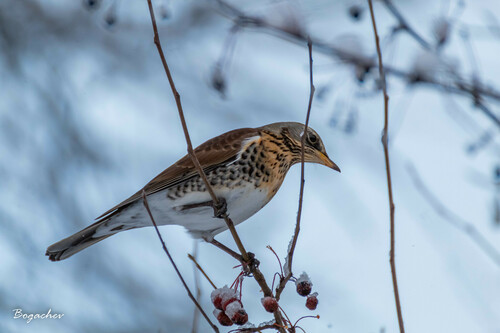
Fieldfare
Dusky Thrush
In short
The most reliable field mark to distinguish a Fieldfare from a Dusky Thrush is the distinctive grey head and rump of the Fieldfare. Both species are thrushes with similar body shapes, but the Fieldfare's plumage is more contrasting, while the Dusky Thrush has a more uniform appearance with a prominent supercilium.
Identification tips
1. Look for the grey head and rump of the Fieldfare. 2. Note the Fieldfare's chestnut back and streaked breast compared to the Dusky Thrush's more uniform brown plumage. 3. Check for the bold white supercilium of the Dusky Thrush. 4. Observe behavior: Fieldfares often form flocks. 5. Consider habitat: Fieldfares in open areas, Dusky Thrushes in forests.
Size
Both species are similar in size, typical of medium-sized thrushes.
Plumage
Fieldfare has a grey head and rump with a chestnut back and heavily streaked breast, while the Dusky Thrush features a more uniform brownish plumage with a bold white supercilium and less contrasting underparts.
Behaviour
Both species exhibit typical thrush behavior, often foraging on the ground. Fieldfares are more likely to be seen in flocks, especially in winter.
Habitat
Fieldfares are often found in open fields and woodland edges, particularly in winter, while Dusky Thrushes prefer forested areas and are more often seen as vagrants in Europe.
Voice
Fieldfare calls are typically harsh and chattering, while Dusky Thrushes have a more subdued call, but vocalizations can be difficult to use for identification without experience.