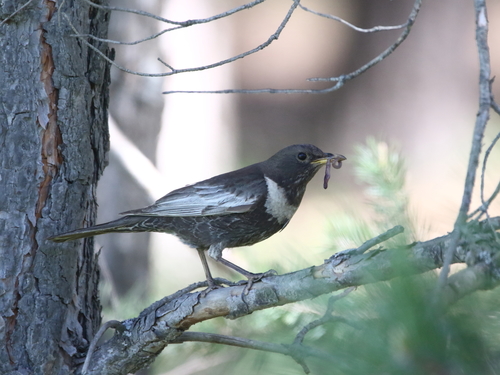
Fieldfare vs Ring Ouzel
Turdus pilaris versus Turdus torquatus
Play a quiz with Fieldfare and Ring Ouzel

Fieldfare
Ring Ouzel
In short
The Fieldfare and Ring Ouzel are both thrushes with similar body shapes, but they can be distinguished by their plumage and habitat preferences. Fieldfares have a more colorful appearance with a grey head and rump, while Ring Ouzels are darker with a distinctive white crescent on the chest. Both species have different vocalizations, aiding in identification.
Identification tips
- Look for the grey head and chestnut back of the Fieldfare versus the dark plumage with a white chest crescent of the Ring Ouzel.
- Fieldfares are more common in lowland areas, especially in winter, while Ring Ouzels are typically found in upland regions.
- Listen for the Fieldfare's 'chack-chack' call compared to the Ring Ouzel's fluting song.
Size
Both species are similar in size, typical of medium-sized thrushes.
Plumage
Fieldfares have a grey head, chestnut back, and a spotted breast, while Ring Ouzels are predominantly dark with a striking white crescent on the chest. Fieldfares appear more colorful overall compared to the more uniform dark plumage of the Ring Ouzel.
Behaviour
Both species exhibit typical thrush behavior, foraging on the ground for invertebrates and berries. However, Ring Ouzels are more likely to be seen in upland areas during breeding season.
Habitat
Fieldfares are often found in open fields and parks, especially in winter, while Ring Ouzels prefer upland and mountainous regions during their breeding season.
Voice
Fieldfares have a distinctive 'chack-chack' call, while Ring Ouzels have a more melodious song with fluting notes. The calls are quite different and can be a reliable identification feature.