Fieldfare vs White-rumped Shama
Turdus pilaris versus Copsychus malabaricus
Play a quiz with Fieldfare and White-rumped Shama

Fieldfare
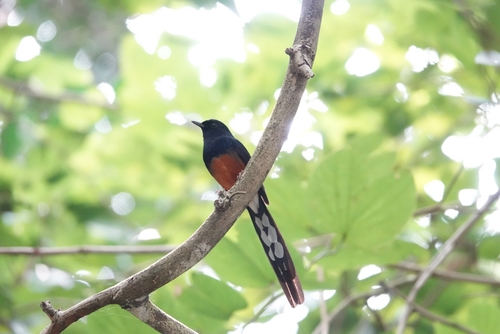
White-rumped Shama
In short
Fieldfare and White-rumped Shama are distinct in both appearance and behavior. The Fieldfare is a large thrush with a distinctive grey head and rump, while the White-rumped Shama is a smaller, more colorful bird with a striking white rump and long tail. Both species have melodious songs, but the Shama is known for its mimicry.
Identification tips
- Size and Shape: Fieldfare is larger and more robust; Shama is smaller with a long tail. 2. Plumage: Look for the Fieldfare's grey head and speckled breast versus the Shama's glossy black and white rump. 3. Habitat: Fieldfare in open areas; Shama in dense forests. 4. Song: Listen for Shama's mimicry, which is more varied than Fieldfare's song.
Size
The Fieldfare is larger and more robust compared to the smaller, slender White-rumped Shama.
Plumage
Fieldfare has a grey head, nape, and rump with a brown back and speckled breast. The White-rumped Shama is glossy black with a white rump and outer tail feathers, and a rich chestnut belly.
Behaviour
Fieldfare is often seen in flocks, especially in winter, foraging on the ground. The White-rumped Shama is more solitary, often found in dense undergrowth, and is known for its acrobatic movements.
Habitat
Fieldfare typically inhabits open fields, woodlands, and gardens in Europe. The White-rumped Shama prefers dense forests and undergrowth in Southeast Asia and introduced regions like Hawaii.
Voice
Both species have melodious songs, but the White-rumped Shama is notable for its ability to mimic other bird species, making its vocalizations more varied.