Birdr

Flesh-footed Shearwater vs Great Shearwater

Ardenna carneipes versus Ardenna gravis

Play a quiz with Flesh-footed Shearwater and Great Shearwater
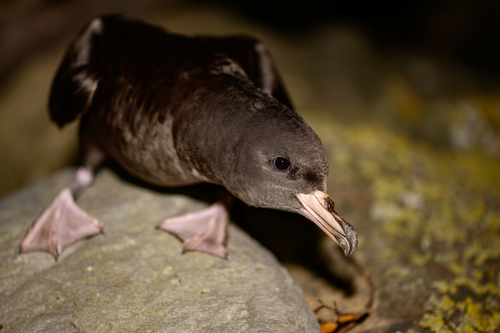
Flesh-footed Shearwater (Ardenna carneipes) Flesh-footed Shearwater
Great Shearwater (Ardenna gravis) Great Shearwater

Media

Loading…

In short

The Flesh-footed Shearwater and Great Shearwater can be distinguished primarily by their plumage and bill color. The Flesh-footed Shearwater has a uniform dark plumage with a pale pinkish bill, while the Great Shearwater features a distinctive dark cap, white underparts with a brown belly patch, and a dark bill.

Identification tips

1. Bill Color: Look for the pale pinkish bill of the Flesh-footed Shearwater versus the dark bill of the Great Shearwater. 2. Plumage Pattern: Note the uniform dark plumage of the Flesh-footed Shearwater compared to the Great Shearwater's dark cap and brown belly patch. 3. Underwing: The Great Shearwater has a white underwing with brown markings, unlike the more uniform underwing of the Flesh-footed Shearwater.

Size

Both species are similar in size, but the Great Shearwater may appear slightly larger due to its more robust build.

Plumage

Flesh-footed Shearwater is uniformly dark with a pale pinkish bill, lacking any significant markings. In contrast, the Great Shearwater has a dark cap, white underparts with a brown belly patch, and a white underwing with variable brown markings.

Behaviour

Both species exhibit similar flight patterns typical of shearwaters, with long glides and few wingbeats, but the Great Shearwater may be seen in larger flocks.

Habitat

Both species are pelagic, but the Great Shearwater is more likely to be found in the North Atlantic during its non-breeding season, while the Flesh-footed Shearwater is more common in the Pacific and Indian Oceans.

Voice

Vocalizations are not a reliable field mark for distinguishing these species, as they are rarely heard at sea.

Submit a better description

Use the same sections as the comparison. Your text is published immediately.

The Flesh-footed Shearwater and Great Shearwater can be distinguished primarily by their plumage and bill color. The Flesh-footed Shearwater has a uniform dark plumage with a pale pinkish bill, while the Great Shearwater features a distinctive dark cap, white underparts with a brown belly patch, and a dark bill.

1. Bill Color: Look for the pale pinkish bill of the Flesh-footed Shearwater versus the dark bill of the Great Shearwater. 2. Plumage Pattern: Note the uniform dark plumage of the Flesh-footed Shearwater compared to the Great Shearwater's dark cap and brown belly patch. 3. Underwing: The Great Shearwater has a white underwing with brown markings, unlike the more uniform underwing of the Flesh-footed Shearwater.

Both species are similar in size, but the Great Shearwater may appear slightly larger due to its more robust build.

Flesh-footed Shearwater is uniformly dark with a pale pinkish bill, lacking any significant markings. In contrast, the Great Shearwater has a dark cap, white underparts with a brown belly patch, and a white underwing with variable brown markings.

Both species exhibit similar flight patterns typical of shearwaters, with long glides and few wingbeats, but the Great Shearwater may be seen in larger flocks.

Both species are pelagic, but the Great Shearwater is more likely to be found in the North Atlantic during its non-breeding season, while the Flesh-footed Shearwater is more common in the Pacific and Indian Oceans.

Vocalizations are not a reliable field mark for distinguishing these species, as they are rarely heard at sea.

Discard your changes?

You have unsaved edits. If you leave now, those changes will be lost.

Flesh-footed Shearwater · Great Shearwater · My Tricky Birds