Birdr

Forest Owlet vs Brown Wood-Owl

Athene blewitti versus Strix leptogrammica

Play a quiz with Forest Owlet and Brown Wood-Owl
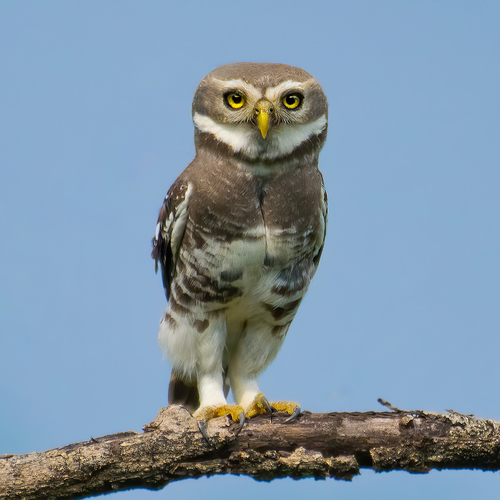
Forest Owlet (Athene blewitti) Forest Owlet
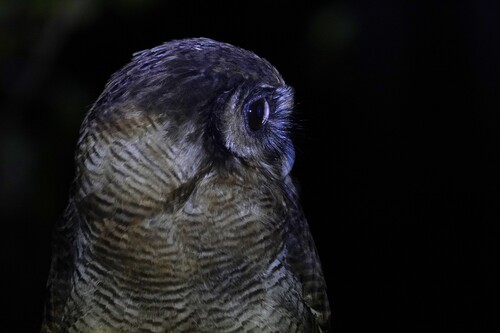
Brown Wood-Owl (Strix leptogrammica) Brown Wood-Owl

Media

Loading…

In short

The Forest Owlet and Brown Wood-Owl are distinct in size and plumage. The Forest Owlet is smaller with a bold chest band, while the Brown Wood-Owl is larger with a more uniform brown appearance. Both species lack ear tufts, but their facial markings and overall size are key differentiators.

Identification tips

  1. Size: Use size as a primary indicator; the Forest Owlet is much smaller. 2. Chest Band: Look for the bold chest band on the Forest Owlet. 3. Facial Markings: The Forest Owlet has a brownish mask with white eyebrows, while the Brown Wood-Owl has a more uniform face. 4. Habitat: Consider the habitat; dry forests suggest Forest Owlet, dense moist forests suggest Brown Wood-Owl.

Size

The Forest Owlet is significantly smaller, measuring about 19–20 cm in length, whereas the Brown Wood-Owl is much larger, typically around 45–57 cm.

Plumage

The Forest Owlet has a brown back with limited spotting, a bold dark chest band, and a white belly with heavy barring on the sides. In contrast, the Brown Wood-Owl has a more uniform brown plumage with less distinct barring and no bold chest band.

Behaviour

Behavioral differences are not well-documented in the sources, but the Forest Owlet is known to be more elusive and less frequently observed.

Habitat

The Forest Owlet is typically found in dry deciduous forests, while the Brown Wood-Owl prefers dense, moist forests. These habitat preferences can help in distinguishing them when birdwatching.

Voice

Vocalizations are not detailed in the sources, but generally, owls in the Strix genus, like the Brown Wood-Owl, have deeper and more resonant calls compared to the Athene genus.

Submit a better description

Use the same sections as the comparison. Your text is published immediately.

The Forest Owlet and Brown Wood-Owl are distinct in size and plumage. The Forest Owlet is smaller with a bold chest band, while the Brown Wood-Owl is larger with a more uniform brown appearance. Both species lack ear tufts, but their facial markings and overall size are key differentiators.

  1. Size: Use size as a primary indicator; the Forest Owlet is much smaller. 2. Chest Band: Look for the bold chest band on the Forest Owlet. 3. Facial Markings: The Forest Owlet has a brownish mask with white eyebrows, while the Brown Wood-Owl has a more uniform face. 4. Habitat: Consider the habitat; dry forests suggest Forest Owlet, dense moist forests suggest Brown Wood-Owl.

The Forest Owlet is significantly smaller, measuring about 19–20 cm in length, whereas the Brown Wood-Owl is much larger, typically around 45–57 cm.

The Forest Owlet has a brown back with limited spotting, a bold dark chest band, and a white belly with heavy barring on the sides. In contrast, the Brown Wood-Owl has a more uniform brown plumage with less distinct barring and no bold chest band.

Behavioral differences are not well-documented in the sources, but the Forest Owlet is known to be more elusive and less frequently observed.

The Forest Owlet is typically found in dry deciduous forests, while the Brown Wood-Owl prefers dense, moist forests. These habitat preferences can help in distinguishing them when birdwatching.

Vocalizations are not detailed in the sources, but generally, owls in the Strix genus, like the Brown Wood-Owl, have deeper and more resonant calls compared to the Athene genus.

Discard your changes?

You have unsaved edits. If you leave now, those changes will be lost.

Forest Owlet · Brown Wood-Owl · My Tricky Birds