
Forster's Tern vs Common Tern
Sterna forsteri versus Sterna hirundo
Play a quiz with Forster's Tern and Common Tern
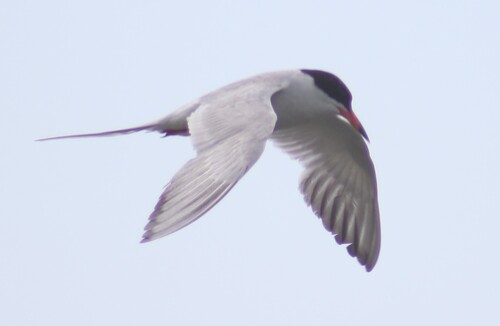 Forster's Tern
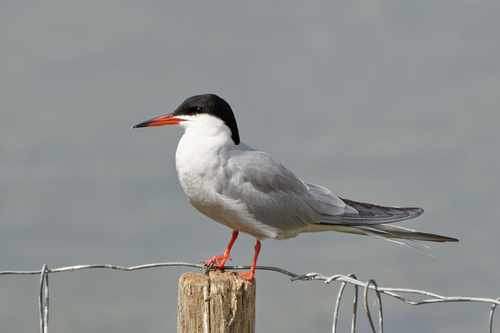 Common Tern
In short
The most reliable field mark for separating Forster's Tern from Common Tern is the winter (non-breeding) head pattern: Forster's shows a sharp black eye-mask on a white head, while Common Tern has a dusky or smudgy cap without a distinct mask. In flight, especially among juveniles and non-breeding birds, Forster's Tern has paler upperwings lacking the dark wedge on the primaries seen in Common Tern, and a pale gray center to the tail. Structure also helps: Forster's is slightly larger, with a longer, more deeply forked tail and a heavier head. Breeding adults can be very similar, so focus on wing and tail pattern, bill color, and head pattern outside the breeding season.
Identification tips
- Non-breeding head pattern: Forster's Tern shows a sharp black eye-mask on a white head; Common Tern has a dusky or smudgy cap, lacking a distinct mask. This is the single best mark in winter or among immatures.
- Upperwing pattern in flight (all ages, especially juveniles and non-breeding): Forster's Tern has paler upperwings without the dark wedge on the primaries; Common Tern shows a dark wedge on the primaries, creating a more contrasting look.
- Tail pattern: Forster's Tern has a gray center to its otherwise white tail; Common Tern's tail is more uniformly white. This is subtle but visible in good light, especially on perched birds.
- Juvenile back and wing coverts: Juvenile Forster's Tern has a scaly, gingery-brown pattern; Common Tern juveniles show a more uniform gray-brown with a marked dark carpal bar.
- Bill color (breeding plumage): Forster's Tern has a black-tipped orange bill; Common Tern's bill is orange-red with a black tip (except in the black-billed Asian subspecies). In poor light, this can be hard to judge.
- Leg color (breeding plumage): Forster's Tern has bright orange legs; Common Tern's legs are bright red. This is only reliable at close range.
- Structure: Forster's Tern is slightly larger, with a heavier head, longer legs, and a longer, more deeply forked tail. Common Tern is more compact, with a shorter tail and less pronounced fork.
- Flight style: Forster's Tern often appears more buoyant and shows longer tail streamers; Common Tern's flight is more direct and powerful.
- Habitat context: In North America, Forster's Tern is more likely in freshwater marshes, especially inland; Common Tern is more coastal or on large lakes, but both can overlap during migration.
- Breeding plumage head pattern: Both have full black caps, so this is not helpful in summer.
- Voice: Both have high-pitched calls, but Forster's can sound slightly harsher or more gull-like. Use with caution.
- Perched posture: Forster's Tern often appears longer-legged and longer-tailed when perched, with the tail extending well beyond the wingtips.
- Seasonal context: Forster's Tern is rare but regular in western Europe in winter; Common Tern is expected in Europe in summer, but rare in winter.
- Pitfalls: Breeding adults are very similar; focus on tail and wing pattern, and bill/leg color if visible. In winter or among immatures, the head pattern and upperwing contrast are most reliable.
- When in doubt: If you see a tern with a sharp black eye-mask in winter, it's Forster's. If the upperwing shows a strong dark wedge in flight, it's Common Tern.
Size
Forster's Tern is marginally larger (33–36 cm length, 78–80 cm wingspan, 130–190 g) than Common Tern (measurements not directly cited here, but Forster's is described as 'obviously larger' in North America [wikipedia]). Forster's also has relatively longer legs and a heavier head. In the field, this size difference is subtle and often masked by posture or distance, so structural and plumage marks are more reliable.
Plumage
- Juvenile and non-breeding plumage: Forster's Tern shows a distinctive black eye-mask on a white head, while Common Tern has a dusky or smudgy cap without a clear mask. Juvenile Forster's Tern has a scaly, gingery-brown pattern on the back and wing coverts, but the upperwings remain pale and lack the dark wedge on the primaries that is typical of Common Tern. Juvenile Common Terns have a more marked dark carpal bar and a dark wedge on the primaries, giving the upperwing a more contrasting look in flight.
- Breeding plumage: Both species have black caps, pale gray upperparts, and white underparts. Forster's Tern in breeding plumage has a black-tipped orange bill and bright orange legs, while Common Tern's bill is orange-red with a black tip and the legs are bright red. Forster's Tern has a gray center to its white tail, while Common Tern's tail is more uniformly white.
- Wings: Forster's Tern's upperwings are whiter and lack the dark primary wedge seen in Common Tern, especially obvious in flight and among immatures and non-breeding birds.
Behaviour
Both species are plunge-divers, but Forster's Tern typically hunts by hovering briefly before diving directly, whereas Common Tern may show more varied feeding behavior. Forster's Tern is also noted to hawk insects over marshes, especially in breeding areas. Both are colonial nesters and fiercely defend their nests, but Forster's is more likely to be seen in inland marshes, while Common Tern is more coastal or found on large lakes.
Habitat
Forster's Tern breeds mainly in inland marshes in North America, especially in the northern US and southern Canada, and winters in southern US, Mexico, and the Caribbean. Common Tern has a much broader, circumpolar distribution, breeding in temperate and subarctic regions of Europe, Asia, and North America, and winters in tropical and subtropical coastal regions. In North America, Forster's is more likely in freshwater marshes, while Common Tern is more often found along coasts and large lakes, but there is overlap, especially during migration.
Voice
Forster's Tern's call is similar to Common Tern but includes some harsher, gull-like notes. Both have sharp, high-pitched calls, but voice is not a reliable field separator unless you are very familiar with both species' repertoires.