Birdr

Gadwall vs Eurasian Wigeon

Mareca strepera versus Mareca penelope

Play a quiz with Gadwall and Eurasian Wigeon

Gadwall (Mareca strepera) Gadwall
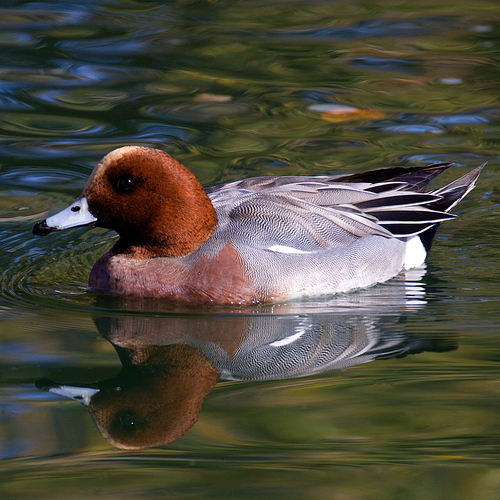
Eurasian Wigeon (Mareca penelope) Eurasian Wigeon

Media

Loading…

In short

The Gadwall and Eurasian Wigeon are both dabbling ducks with subtle differences. The Gadwall is more uniformly gray with a distinctive black rear, while the Eurasian Wigeon features a striking rufous head and creamy forehead. Both species can be found in similar wetland habitats, but their plumage and vocalizations offer reliable identification cues.

Identification tips

  1. Look for the black rear and white wing patch in Gadwalls. 2. Note the rufous head and creamy forehead of male Eurasian Wigeons. 3. Listen for the whistling call of the Eurasian Wigeon, contrasting with the Gadwall's softer quack. 4. Observe the plumage differences in females: Gadwall females are browner with a white belly, while Eurasian Wigeon females are more uniformly brown.

Size

Both species are similar in size, but the Gadwall is slightly larger and bulkier than the Eurasian Wigeon.

Plumage

The male Gadwall has a mostly gray body with a black rear and white wing patch visible in flight. The male Eurasian Wigeon has a rufous head, creamy forehead, and a pinkish breast. Females of both species are more subdued, but the Gadwall female is browner with a white belly, while the Eurasian Wigeon female has a more uniform brown plumage.

Behaviour

Both species are dabbling ducks, often seen tipping forward in the water to feed. They can be found in mixed flocks, especially during migration and winter.

Habitat

Gadwalls and Eurasian Wigeons both inhabit wetlands, including lakes, ponds, and marshes. They are often found in similar environments, particularly during migration and winter.

Voice

The Gadwall's call is a soft, nasal quack, while the Eurasian Wigeon is known for its distinctive whistling call, which can be a useful identification feature.

Submit a better description

Use the same sections as the comparison. Your text is published immediately.

The Gadwall and Eurasian Wigeon are both dabbling ducks with subtle differences. The Gadwall is more uniformly gray with a distinctive black rear, while the Eurasian Wigeon features a striking rufous head and creamy forehead. Both species can be found in similar wetland habitats, but their plumage and vocalizations offer reliable identification cues.

  1. Look for the black rear and white wing patch in Gadwalls. 2. Note the rufous head and creamy forehead of male Eurasian Wigeons. 3. Listen for the whistling call of the Eurasian Wigeon, contrasting with the Gadwall's softer quack. 4. Observe the plumage differences in females: Gadwall females are browner with a white belly, while Eurasian Wigeon females are more uniformly brown.

Both species are similar in size, but the Gadwall is slightly larger and bulkier than the Eurasian Wigeon.

The male Gadwall has a mostly gray body with a black rear and white wing patch visible in flight. The male Eurasian Wigeon has a rufous head, creamy forehead, and a pinkish breast. Females of both species are more subdued, but the Gadwall female is browner with a white belly, while the Eurasian Wigeon female has a more uniform brown plumage.

Both species are dabbling ducks, often seen tipping forward in the water to feed. They can be found in mixed flocks, especially during migration and winter.

Gadwalls and Eurasian Wigeons both inhabit wetlands, including lakes, ponds, and marshes. They are often found in similar environments, particularly during migration and winter.

The Gadwall's call is a soft, nasal quack, while the Eurasian Wigeon is known for its distinctive whistling call, which can be a useful identification feature.

Discard your changes?

You have unsaved edits. If you leave now, those changes will be lost.

Gadwall · Eurasian Wigeon · My Tricky Birds