Gadwall vs Mallard
Mareca strepera versus Anas platyrhynchos
Play a quiz with Gadwall and Mallard

Gadwall
Mallard
In short
The Gadwall and Mallard are both dabbling ducks, but they can be distinguished by their bill shape and plumage patterns. Gadwalls have a more slender, all-black bill, while Mallards have a broader, orange bill with a black tip. Male Gadwalls are more subtly patterned with gray and brown, whereas male Mallards have a distinctive iridescent green head.
Identification tips
- Look for the bill shape and color: Gadwalls have a slender, all-black bill, while Mallards have a broader, orange bill with a black tip. 2. Observe the plumage: Male Gadwalls are gray and brown with a black rump, while male Mallards have a green head and chestnut chest. 3. Note the wing pattern in flight: Gadwalls show a white wing patch, whereas Mallards have a blue speculum bordered with white. 4. Listen for vocalizations: Gadwalls have a quieter, nasal quack compared to the louder quack of Mallards.
Size
Both species are similar in size, though the Mallard is slightly larger and bulkier than the Gadwall.
Plumage
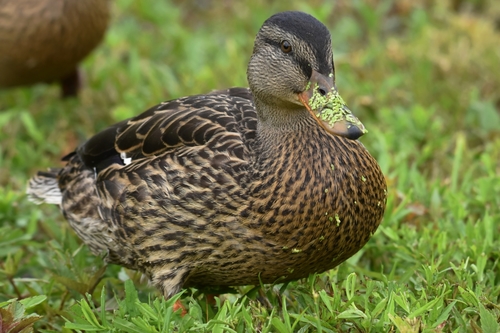
Male Gadwalls are mostly gray with a black rump and a white wing patch visible in flight. Female Gadwalls are mottled brown but lack the distinctive orange bill of female Mallards. Male Mallards have a bright green head, chestnut-brown chest, and gray body, while females are mottled brown with an orange bill marked with black.
Behaviour
Both species are dabbling ducks, often seen tipping forward in the water to feed. Gadwalls may be slightly more reserved, often seen in smaller groups compared to the more social Mallard.
Habitat
Both species inhabit wetlands, but Mallards are more adaptable and can be found in urban parks and a wider range of habitats. Gadwalls prefer more natural wetland environments.
Voice
Gadwalls have a quieter, more nasal quack compared to the louder, more classic quack of the Mallard.