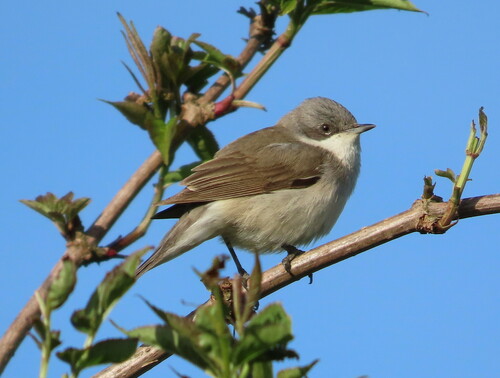
Garden Warbler vs Lesser Whitethroat
Sylvia borin versus Curruca curruca
Play a quiz with Garden Warbler and Lesser Whitethroat
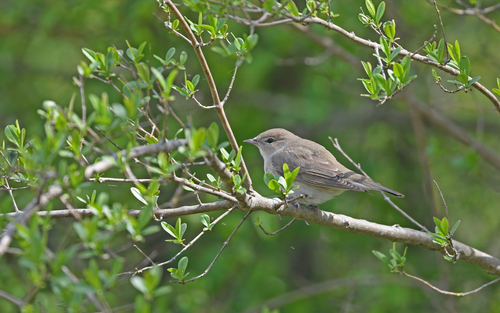
Garden Warbler
Lesser Whitethroat
In short
The Lesser Whitethroat (Curruca curruca) and the Garden Warbler (Sylvia borin) are two distinct species that can be differentiated by their size, plumage, vocalizations, and habitat preferences. The Lesser Whitethroat is generally smaller with a more notable grayish-brown upper body and a distinctive whitish throat, while the Garden Warbler features a more robust body and olive-brown plumage with a less pronounced throat. Notably, their vocalizations differ, with the Lesser Whitethroat producing a more varied set of calls compared to the Garden Warbler's simpler song.
Identification tips
- Birds of the World Similar-Species Diagnostics:
-
The Lesser Whitethroat is described as having “a distinctive whitish throat and a grayish-brown upper body,” which sets it apart from the more uniformly “olive-brown” coloration of the Garden Warbler. As mentioned in the Birds of the World, "the Lesser Whitethroat has a more distinctive, paler face and throat compared to the more uniform coloration of the Garden Warbler."
-
AI Field Diagnostics:
- Size & Shape: Pay attention to the overall size—Lesser Whitethroat is smaller and lighter than the Garden Warbler. The Lesser Whitethroat’s more pronounced grayish coloration and white throat make it easier to identify in the field.
- Plumage Patterns: Look for the grayish upperparts and contrasting white throat of the Lesser Whitethroat, which are key identifiers. In contrast, the uniformly olive-brown upperparts of the Garden Warbler can appear more drab.
- Behavior: Note foraging behavior; if you observe a small warbler flitting actively through shrubs and bushes, it’s likely a Lesser Whitethroat. The Garden Warbler tends to be more reserved and prefers denser foliage.
- Vocalization: Listen for vocal differences. The complex song of the Lesser Whitethroat should contrast with the smoother, more melodic notes of the Garden Warbler. If you hear a harsh “chack” or varied song patterns, you’re likely hearing the Lesser Whitethroat.
- Habitat: Consider the habitat—if you are in a scrubby area or hedgerow, look for the Lesser Whitethroat; if in a denser woodland or garden environment, it is more likely to be the Garden Warbler.
By focusing on these key identifiers, birdwatchers can confidently distinguish between the Lesser Whitethroat and the Garden Warbler in their natural habitats.
Size
- Lesser Whitethroat: Typically measures about 12-14 cm in length, with a wingspan of 20-23 cm. It has a lighter build compared to the Garden Warbler.
- Garden Warbler: Slightly larger, measuring approximately 13-15.5 cm in length, with a broader wingspan of 23-26 cm. This species has a more robust body structure.
Plumage
- Lesser Whitethroat: Exhibits a grayish-brown upper body, with a notably pale, whitish throat and underparts. The tail is dark with white edges, which can be a distinguishing feature in flight.
- Garden Warbler: Displays a more uniform olive-brown coloration on the upperparts, with paler underparts. Its throat is less defined compared to the Lesser Whitethroat, lacking the bright white contrast.
Behaviour
- Lesser Whitethroat: Known for its active foraging behavior, often seen flitting through shrubs and bushes, and sometimes hovering to catch insects. It tends to be more secretive and less conspicuous.
- Garden Warbler: Generally more subdued in behavior, often foraging low in the undergrowth or within dense foliage. It is less likely to be seen in open spaces compared to the Lesser Whitethroat.
Habitat
- Lesser Whitethroat: Prefers scrubby areas, hedgerows, and open woodland edges. Typically found in more arid environments, it favors areas with abundant shrubs.
- Garden Warbler: Often inhabits denser woodlands, gardens, and areas with thick undergrowth. It is more associated with humid environments compared to the Lesser Whitethroat.
Voice
- Lesser Whitethroat: Features a varied repertoire of calls, including a distinct, harsh "chack" and a series of melodic phrases that are more complex and varied.
- Garden Warbler: Known for its rich, melodious song that is more fluid and less variable than that of the Lesser Whitethroat. The Garden Warbler’s song is often described as a series of notes that can be reminiscent of a soft, sweet trill.