
Garganey vs Northern Pintail
Spatula querquedula versus Anas acuta
Play a quiz with Garganey and Northern Pintail
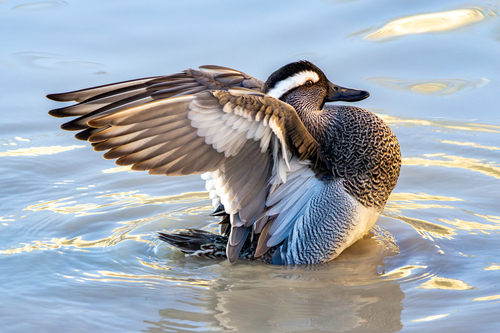 Garganey
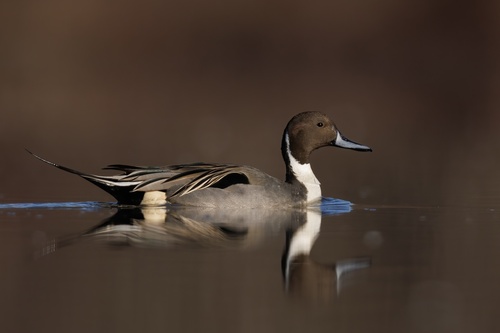 Northern Pintail
In short
The most reliable field mark is size and structure: Northern Pintail is a much larger, more elongated duck with a notably long neck and, in males, a long pointed tail, while Garganey is compact with a short neck and tail. In flight, both species show a pale-bordered speculum, but the colors and borders differ by age and sex. Female and juvenile Garganey can be confused with female pintail, but Garganey shows a stronger facial pattern with a bold pale eyebrow and dark eye-line, while female pintail is more uniformly brown and lacks strong face markings. Male Garganey in breeding plumage is unmistakable with its white supercilium and brown head, while male pintail has a chocolate head and striking white neck stripe. Always consider size, structure, and facial pattern first, especially for birds on water or at a distance.
Identification tips
- Size and structure: Northern Pintail is much larger and more elongated than Garganey. Look for the long neck and, in males, the long pointed tail. Garganey is compact with a short neck and tail. This is often the quickest way to separate them at a distance or in flight.
- Facial pattern (female/juvenile): Female and juvenile Garganey have a bold pale eyebrow, dark eye-line, and a pale lore spot bordered by a second dark line. Female pintail is more uniformly brown with a plain grey-brown head and lacks strong face markings. Use this mark for all ages except adult male Garganey.
- Adult male plumage: Breeding male Garganey has a broad white supercilium (crescent) over the eye and a brown head—unique among dabbling ducks. Male pintail has a chocolate-brown head, white breast, and a thin white neck stripe, plus a very long pointed tail. These are unmistakable when seen well.
- Wing pattern in flight: Garganey (all ages/sexes) shows a pale blue speculum with a white border. Male pintail has a black speculum with a white border at the rear and pale rufous at the front; female pintail's speculum is dark brown with a prominent white border at the back. Juvenile pintail has a duller brown speculum with a narrower trailing edge. Check wing panels in flight or on the water with wings raised.
- Tertial edges: Garganey shows prominent white edges on its tertials when swimming—look for this in close views. Pintail tertials are not as distinctly edged.
- Bill and leg color: Garganey has a grey bill and legs; pintail has blue-grey bill and legs. This is subtle and best used at close range.
- Swimming posture: Pintail often swims with a forward-leaning posture and extended neck, while Garganey is more compact and horizontal.
- Tail shape: Male pintail's long, pointed tail is diagnostic in breeding plumage. Female pintail's tail is shorter but still more pointed than Garganey's. Garganey's tail is always short and rounded.
- Behavior: Female Garganey often shows frequent head-shaking while dabbling, which is less common in pintail.
- Voice: If heard, male Garganey gives a crackling call, while male pintail gives a flute-like whistle. Females are less vocal, but pintail hens have a rougher quack than Garganey females.
- Habitat context: Garganey is much rarer in Western Europe and prefers quiet, vegetated marshes. Pintail is common in a wide range of open wetlands and often seen in larger numbers.
- Seasonal context: Male Garganey is only in full breeding plumage in spring and early summer; eclipse males and females are more similar, so rely on structure and facial pattern then. Pintail males retain some distinctive features even in eclipse plumage (upper wing pattern, long tail).
- Flock composition: In mixed flocks, use relative size and structure to pick out pintail; Garganey will be among the smallest ducks present.
- Common pitfalls: Female Garganey and female pintail are the most likely confusion pair—always check for the strong facial pattern of Garganey and the plain face of pintail. Juvenile pintail can look especially dull and may lack clear scalloping, but still lacks Garganey's face pattern.
- Leg color confusion: Only relevant if blue-winged teal is present (not in this comparison), as they have yellow legs; both Garganey and pintail have grey to blue-grey legs.
Size
Northern Pintail is substantially larger than Garganey, with an average adult body mass around 945.5 g [wikidata], compared to the much smaller Garganey (no direct mass given, but known to be one of the smallest dabbling ducks). Pintail has a noticeably longer neck and, in males, a very long, pointed tail that is diagnostic. Garganey is compact, with a short neck and tail. Even at a distance, the size and proportions should stand out, especially in mixed flocks.
Plumage
- Juvenile and female plumage: Female and juvenile Garganey are brown and can be confused with female pintail, but Garganey always shows a bold pale eyebrow, dark eye-line, and a pale lore spot bordered by a second dark line. Female pintail is more uniformly scalloped brown, with a plain grey-brown head and no strong facial markings. Juvenile pintail is even duller and less neatly scalloped than adult female, with a dull brown speculum and narrower trailing edge.
- Adult male plumage: Male Garganey is unmistakable in breeding plumage, with a broad white crescent over the eye, brown head, and grey body. Male pintail has a chocolate-brown head, white breast, and a thin white stripe running up the neck, with a long pointed tail and grey, brown, and black patterned back.
- Wing pattern in flight: Garganey shows a pale blue speculum with a white border (all ages/sexes), while male pintail has a black speculum with a white border at the rear and pale rufous at the front; female pintail has a dark brown speculum with a white border, narrow at the front but very prominent at the back. Garganey's tertials have prominent white edges when swimming, which is not seen in pintail.
- Leg and bill color: Garganey has grey bill and legs; pintail has blue-grey bill and legs (both sexes). Blue-winged teal (not in this comparison) would show yellow legs.
Behaviour
Pintail is more elongated and walks well on land, often seen with a forward-leaning swimming posture and neck extended. Garganey is more compact and often shows frequent head-shaking while dabbling, especially females. In flight, pintail is fast with slightly swept-back wings, while Garganey's flight is typical for a small dabbling duck. Pintail's long neck and tail are often obvious in all postures.
Habitat
Both species are migratory dabbling ducks breeding across the Palearctic, but Garganey is much rarer in Western Europe and breeds in quiet marshes, especially in the British Isles. Pintail is widespread and common in suitable wetland habitats across Europe, Asia, and North America. In winter, both can be found in large flocks on open water, but Garganey is more likely in shallow, vegetated wetlands, while pintail can be found in a wider range of open wetlands.
Voice
Male Garganey has a distinctive crackling mating call, while the female is mostly silent with a weak quack. Pintail drakes give a flute-like whistle, and hens make a rough quacking sound. Vocalizations are rarely diagnostic in the field unless the birds are calling, but the pintail's flute-like whistle is quite different from Garganey's crackling call.