
Goldcrest vs Common Firecrest
Regulus regulus versus Regulus ignicapilla
Play a quiz with Goldcrest and Common Firecrest
 Goldcrest
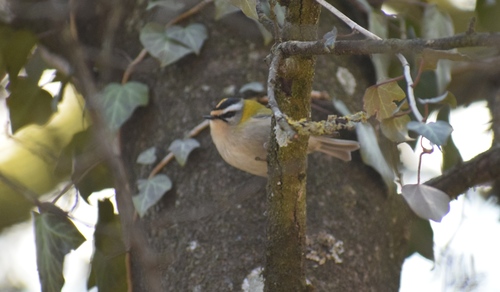 Common Firecrest
In short
The most reliable way to separate Goldcrest from Common Firecrest is by their head pattern: Firecrest always shows a bold white supercilium (eyebrow) and a black eye-stripe, while Goldcrest has a plain face with no strong markings. This difference is present even in juveniles, though the Firecrest's face pattern is duller in young birds. Both species have two white wingbars and similar size, but Firecrest also shows a bronze shoulder patch that Goldcrest lacks. In poor views, especially of immature birds, focus on the face pattern first, then look for the bronze shoulder and overall jizz.
Identification tips
- Face pattern is key: Firecrest always shows a bold white supercilium and black eye-stripe, even in juveniles (though duller), while Goldcrest has a plain face at all ages. If you see a strong face pattern, it's Firecrest; a plain face points to Goldcrest.
- Crest color and display: Both species have a colored crest (orange in males, yellow in females), but this is only visible when raised. Crest color alone is not diagnostic unless seen very well, but the presence of black bordering the crest is more prominent in Goldcrest.
- Bronze shoulder patch: Only Firecrest shows a bronze patch on the shoulder (scapulars), visible in good light. Goldcrest lacks this feature.
- Juvenile separation: Juvenile Goldcrest is very plain-faced and lacks any colored crown or strong face pattern. Juvenile Firecrest lacks the colored crown but retains a faint supercilium and eye-stripe, so even young birds can be separated by face.
- Wingbars: Both species have two white wingbars; this is not a useful separator.
- Upperparts and underparts: Both are olive-green above and whitish below, but Firecrest may show a brownish-grey wash on the flanks. This is subtle and not always visible.
- Flight and movement: Both are hyperactive, but Goldcrest may show more hovering and erratic, dashing flight. Firecrest tends to hop with a more horizontal posture.
- Display posture: If you see a bird displaying, Goldcrest bows its head to show the crest, while Firecrest points its bill and raises its crest, emphasizing the face pattern.
- Size: Both are tiny and nearly identical in size; do not rely on this for separation.
- Context: Both species can occur together in the same habitat. If you see both, compare face patterns directly.
- Sex differences: Crest color varies by sex (orange in males, yellow in females), but this is not a reliable field mark unless the crest is fully raised and seen well.
- First-winter birds: By first winter, both species are nearly adult-like, but the face pattern difference persists and remains the best separator.
- Potential confusion species: If you suspect a different species (e.g., Yellow-browed Warbler or Ruby-crowned Kinglet), check for supercilium color and crown pattern: neither Goldcrest nor Firecrest has a pale lemon crown stripe or a strong eyering.
- When in doubt: Always prioritize the face pattern. Even in poor light or quick views, the presence or absence of a white supercilium and black eye-stripe is the most reliable clue.
- Pitfalls: Beware of poor views where the face pattern is obscured or the crest is flattened; in such cases, try to observe the bird from multiple angles or wait for a better look.
Size
Both Goldcrest and Firecrest are extremely small birds, with Goldcrest averaging 8.5–9.5 cm in length and Firecrest about 9 cm. Their wingspans overlap (Goldcrest: 13.5–15.5 cm; Firecrest: 13–16 cm) and weights are similar (Goldcrest: 4.5–7.0 g; Firecrest: 4–7 g) [wikipedia][avonet]. In the field, size is not a reliable separator, as both appear tiny and delicate. Any perceived difference is usually due to posture or context rather than actual size.
Plumage
- Juveniles/First-winter: Both species' juveniles lack the colored crown, but Firecrest juveniles retain a dull version of the adult's face pattern (weak white supercilium and black eye-stripe), while Goldcrest juveniles have a plain face. By first winter, both are almost adult-like, but the face pattern difference remains the best mark. Wing pattern is not diagnostic between the two: both show two white wingbars, and no mention of a distinctive panel or triangle in either species at any age.
- Adults: Goldcrest adults have a plain face with a bright yellow (female) or orange-yellow (male) crest bordered by black, but no supercilium or eye-stripe. Firecrest adults have a striking head: black eye-stripe, long white supercilium, and a crest that is orange (male) or yellow (female), plus a bronze patch on each shoulder. Underparts are similar, though Firecrest may show a brownish-grey wash on the flanks. Both species have olive-green upperparts, but only Firecrest has the bronze shoulder patch.
Behaviour
Both species are extremely active, moving restlessly through foliage and often hovering or creeping along branches. Goldcrest is noted for its whirring, darting flight with sudden changes of direction and frequent hovering. Firecrest also has a weak, whirring flight with quick evasive turns, but tends to hold its body more horizontally when hopping. In display, Goldcrest bows its head to show the crest, while Firecrest points its bill and raises its crest, emphasizing the strong face pattern. These subtle behavioral differences are rarely diagnostic in the field, but the display posture can help if seen well.
Habitat
Both species overlap widely in Europe and share similar habitats, typically coniferous or mixed woodland. There is no strong habitat separation in areas of overlap, and both may be found together, sometimes even defending adjacent territories. Habitat is not a reliable separator, though local abundance may differ regionally [wikipedia][ebird].