
Golden Eagle vs Western Marsh Harrier
Aquila chrysaetos versus Circus aeruginosus
Play a quiz with Golden Eagle and Western Marsh Harrier
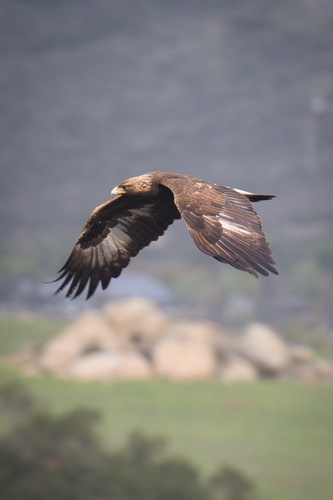 Golden Eagle
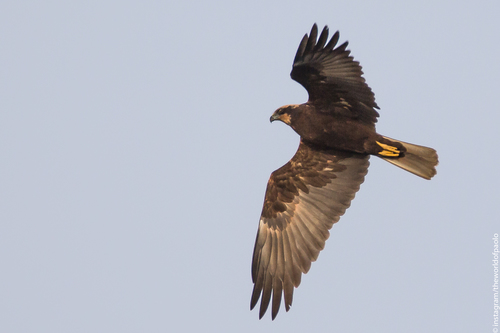 Western Marsh Harrier
In short
The most reliable field mark between Golden Eagle and Western Marsh Harrier is sheer size: Golden Eagle is vastly larger and heavier, with a bulkier build and much longer wingspan. For birds in flight, juvenile Golden Eagles show large, sharply defined white patches at the base of the primaries and tail, while Marsh Harrier juveniles are dark overall with little to no white. Golden Eagles soar with broad, slightly upturned wings and a long tail, while Marsh Harriers have narrower wings held in a shallow V and often dangle their legs. Adult plumage is also distinct: Golden Eagles are dark brown with a golden nape, while Marsh Harrier males show a tricolored wing and females are chocolate-brown with a pale head and shoulders. Confusion is most likely with distant or immature birds in flight, but attention to size, wing posture, and age-specific plumage patterns will resolve most cases.
Identification tips
- Size is the first check: If you see a bird of prey that looks eagle-sized (massive, with a huge wingspan and thick body), it's a Golden Eagle; Marsh Harrier is never close in size, even to a small eagle.
- Juvenile wing/tail pattern: Juvenile Golden Eagles show large, crisp white patches at the base of the primaries and tail, with a dark trailing edge and terminal band—this is never seen in Marsh Harrier of any age.
- Juvenile Marsh Harrier: Uniformly dark brown to blackish, sometimes with a little yellowish on the head/shoulders, but no white wing or tail patches. Hypermelanic morphs may be all dark.
- Adult plumage: Golden Eagle adults are dark brown with a golden or rufous nape; Marsh Harrier males are brown with grey secondaries/tail and black wingtips, females are chocolate-brown with a pale yellowish head and shoulders.
- Head and bill: Golden Eagle has a large, protruding head and heavy bill; Marsh Harrier's head is small and bill is fine, even in females.
- Tail shape and length: Golden Eagle's tail is long and broad, often appearing 2–3 times the length of the head in flight; Marsh Harrier's tail is shorter and less prominent.
- Wing shape and posture: Golden Eagle's wings are broad, slightly upturned (dihedral), and powerful; Marsh Harrier's wings are narrower, held in a shallow V, and appear more flexible in flight.
- Flight style: Golden Eagle soars high, with steady, powerful wingbeats and rarely quarters low; Marsh Harrier glides low over marshes, often with dangling legs and a buoyant, tilting flight.
- Perched jizz: Golden Eagle appears massive and upright, with a thick neck and large talons; Marsh Harrier is slimmer, with long legs and a more delicate posture.
- Sexual dimorphism: Marsh Harrier shows strong sexual dimorphism (males tricolored, females chocolate-brown with pale head); Golden Eagle sexes are similar, both dark brown with golden nape.
- Habitat: Golden Eagles are found in uplands, mountains, and open wild country; Marsh Harriers are tied to wetlands, reedbeds, and marshes.
- Head pattern: Marsh Harrier females and juveniles have a pale yellowish head and shoulders with a dark eye mask; Golden Eagle never shows this pattern.
- White on wings/tail: Only juvenile Golden Eagle shows large, sharply defined white patches on wings and tail; Marsh Harrier never shows this, regardless of age.
- Behavior around water: Marsh Harrier is likely if the bird is hunting low over marsh or reedbed; Golden Eagle is unlikely in such habitat.
- Confusion risk: At great distance, a Marsh Harrier may look larger than it is, but will never match the bulk or proportions of a Golden Eagle. Always check for white wing/tail patches in juveniles and overall size.
Size
Golden Eagle is in a completely different size class: adult body mass averages over 4 kg (4383 g) [wikidata], while Marsh Harrier females (the larger sex) top out at 800 g. In the field, a Golden Eagle appears massive, with a wingspan roughly double that of a Marsh Harrier (Golden Eagle: up to 2.3 m, Marsh Harrier: up to 1.3 m [wikipedia]). Even at a distance, the eagle's bulk, heavy bill, and long tail are obvious. Marsh Harrier is a large harrier but looks slender and lightweight by comparison, with a much smaller head and body.
Plumage
Juvenile Golden Eagles are best separated from Marsh Harriers by their distinctive white patches at the base of the primaries (forming a strong 'window' on the underwing) and a broad white tail base with a dark terminal band. These white areas are sharply defined and contrast with the otherwise dark brown plumage. Juvenile Marsh Harriers, by contrast, are uniformly dark brown to blackish, sometimes with a little yellowish on the head and shoulders, but never with large white patches on the wings or tail. Adult Golden Eagles are rich dark brown overall with a golden to rufous nape; adults lack the white wing and tail patches of juveniles. Adult male Marsh Harriers are tricolored: brown forewing, grey secondaries and tail, and black wingtips, with a pale head and shoulders; females are chocolate-brown with a paler yellowish head and shoulders, and a dark mask around the eye. No age or sex of Marsh Harrier shows the golden nape or the white wing/tail patches of young Golden Eagle. Hypermelanic Marsh Harriers may look very dark but still lack the eagle's size and structure.
Behaviour
Golden Eagles soar with slow, powerful wingbeats and often hold their wings in a slight dihedral (upward angle), but with a steadier, more controlled flight than Marsh Harrier. They rarely hunt low over the ground. Marsh Harriers hunt by gliding low over open ground or wetlands, wings held in a shallow V, often with legs dangling. Their flight is lighter, more buoyant, and they frequently quarter back and forth. Perched, Golden Eagles appear massive and upright, while Marsh Harriers look slimmer and more elongated.
Habitat
Golden Eagles favor open mountains, uplands, and large tracts of wild country, often far from water. Marsh Harriers are birds of wetlands, reedbeds, and marshy lowlands, rarely found far from water. While both may be seen flying over open country, the presence of extensive marsh or reedbed habitat strongly favors Marsh Harrier.