Birdr

Golden-winged Cacique vs Orange-backed Troupial

Cacicus chrysopterus versus Icterus croconotus

Play a quiz with Golden-winged Cacique and Orange-backed Troupial
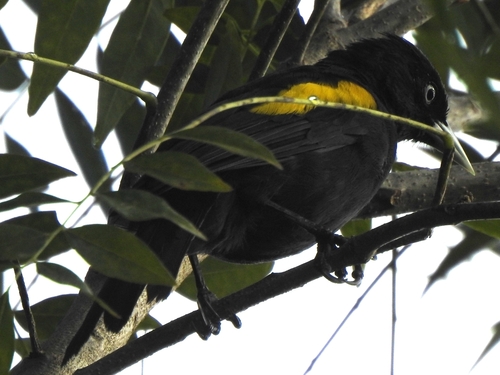
Golden-winged Cacique (Cacicus chrysopterus) Golden-winged Cacique
Orange-backed Troupial (Icterus croconotus) Orange-backed Troupial

Media

Loading…

In short

The Golden-winged Cacique and the Orange-backed Troupial are both members of the Icteridae family but can be distinguished by their plumage and nesting behavior. The cacique is solitary and has distinctive golden wing patches, while the troupial is more social and features a prominent orange back.

Identification tips

  1. Look for golden wing patches on the Golden-winged Cacique. 2. Note the bright orange back of the Orange-backed Troupial. 3. Observe nesting behavior: solitary for the cacique, more social for the troupial. 4. Check habitat: forested areas for the cacique, near water for the troupial.

Size

Both species are similar in size, typical of medium-sized icterids.

Plumage

The Golden-winged Cacique is primarily black with golden-yellow wing patches. In contrast, the Orange-backed Troupial has a bright orange back and underparts with a black head and wings, lacking the golden wing patches of the cacique.

Behaviour

The Golden-winged Cacique is a solitary nester, building long hanging basket nests, while the Orange-backed Troupial is more social and often found in pairs or small groups.

Habitat

The cacique inhabits forested regions in the Yungas and southern South America, while the troupial is found in lowland areas near water across northern and western Amazonia, extending to Paraguay and northeastern Argentina.

Voice

Vocalizations are not detailed in the sources, but both species are known for their varied and melodious calls typical of icterids.

Submit a better description

Use the same sections as the comparison. Your text is published immediately.

The Golden-winged Cacique and the Orange-backed Troupial are both members of the Icteridae family but can be distinguished by their plumage and nesting behavior. The cacique is solitary and has distinctive golden wing patches, while the troupial is more social and features a prominent orange back.

  1. Look for golden wing patches on the Golden-winged Cacique. 2. Note the bright orange back of the Orange-backed Troupial. 3. Observe nesting behavior: solitary for the cacique, more social for the troupial. 4. Check habitat: forested areas for the cacique, near water for the troupial.

Both species are similar in size, typical of medium-sized icterids.

The Golden-winged Cacique is primarily black with golden-yellow wing patches. In contrast, the Orange-backed Troupial has a bright orange back and underparts with a black head and wings, lacking the golden wing patches of the cacique.

The Golden-winged Cacique is a solitary nester, building long hanging basket nests, while the Orange-backed Troupial is more social and often found in pairs or small groups.

The cacique inhabits forested regions in the Yungas and southern South America, while the troupial is found in lowland areas near water across northern and western Amazonia, extending to Paraguay and northeastern Argentina.

Vocalizations are not detailed in the sources, but both species are known for their varied and melodious calls typical of icterids.

Discard your changes?

You have unsaved edits. If you leave now, those changes will be lost.

Golden-winged Cacique · Orange-backed Troupial · My Tricky Birds