Birdr

Great Bustard vs Little Bustard

Otis tarda versus Tetrax tetrax

Play a quiz with Great Bustard and Little Bustard
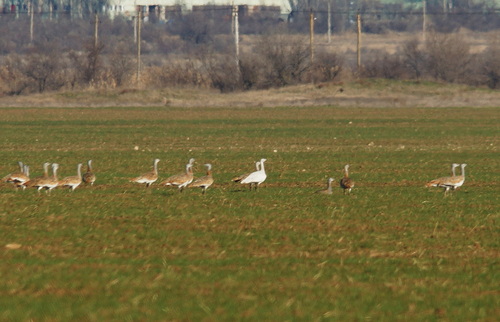
Great Bustard (Otis tarda) Great Bustard
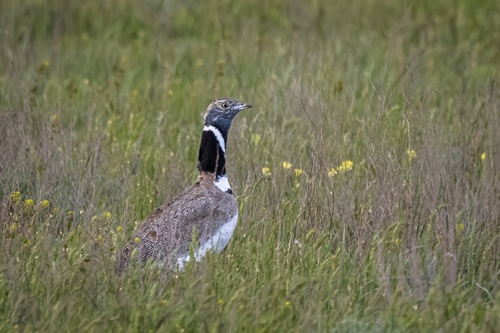
Little Bustard (Tetrax tetrax) Little Bustard

Media

Loading…

In short

The Great Bustard and Little Bustard are both large, ground-dwelling birds but differ significantly in size and plumage. The Great Bustard is much larger and more robust, while the Little Bustard is smaller and more slender. Observing their size and plumage patterns is key to distinguishing them in the field.

Identification tips

1. Size: The Great Bustard's large size is a key identifier. 2. Plumage: Look for the Great Bustard's bold plumage and male's whisker-like neck feathers. 3. Grouping: Great Bustards often in larger groups; Little Bustards more solitary. 4. Habitat: Note the habitat type; Great Bustards in open grasslands, Little Bustards in agricultural areas. 5. Calls: Listen for the Little Bustard's raspy call in breeding season.

Size

The Great Bustard is significantly larger, often described as one of the heaviest flying birds, while the Little Bustard is much smaller and more compact.

Plumage

The Great Bustard has a striking plumage with a mix of brown, white, and black, and males have distinctive whisker-like feathers on the neck during the breeding season. The Little Bustard is more uniformly brown with a less conspicuous pattern and lacks the whisker-like feathers.

Behaviour

Both species are ground-dwelling and can be seen walking through open fields. The Great Bustard often moves in small groups, while the Little Bustard is more solitary or in smaller groups.

Habitat

Both species prefer open landscapes, but the Great Bustard is more often found in steppe and grassland areas, while the Little Bustard favors agricultural fields and semi-arid regions.

Voice

Vocalizations are not the most reliable field marks, but the Great Bustard is generally quieter, while the Little Bustard has a distinctive, raspy call during the breeding season.

Submit a better description

Use the same sections as the comparison. Your text is published immediately.

The Great Bustard and Little Bustard are both large, ground-dwelling birds but differ significantly in size and plumage. The Great Bustard is much larger and more robust, while the Little Bustard is smaller and more slender. Observing their size and plumage patterns is key to distinguishing them in the field.

1. Size: The Great Bustard's large size is a key identifier. 2. Plumage: Look for the Great Bustard's bold plumage and male's whisker-like neck feathers. 3. Grouping: Great Bustards often in larger groups; Little Bustards more solitary. 4. Habitat: Note the habitat type; Great Bustards in open grasslands, Little Bustards in agricultural areas. 5. Calls: Listen for the Little Bustard's raspy call in breeding season.

The Great Bustard is significantly larger, often described as one of the heaviest flying birds, while the Little Bustard is much smaller and more compact.

The Great Bustard has a striking plumage with a mix of brown, white, and black, and males have distinctive whisker-like feathers on the neck during the breeding season. The Little Bustard is more uniformly brown with a less conspicuous pattern and lacks the whisker-like feathers.

Both species are ground-dwelling and can be seen walking through open fields. The Great Bustard often moves in small groups, while the Little Bustard is more solitary or in smaller groups.

Both species prefer open landscapes, but the Great Bustard is more often found in steppe and grassland areas, while the Little Bustard favors agricultural fields and semi-arid regions.

Vocalizations are not the most reliable field marks, but the Great Bustard is generally quieter, while the Little Bustard has a distinctive, raspy call during the breeding season.

Discard your changes?

You have unsaved edits. If you leave now, those changes will be lost.

Great Bustard · Little Bustard · My Tricky Birds