
Birdr

Great Crested Flycatcher vs Brown-crested Flycatcher

Myiarchus crinitus versus Myiarchus tyrannulus

Play a quiz with Great Crested Flycatcher and Brown-crested Flycatcher
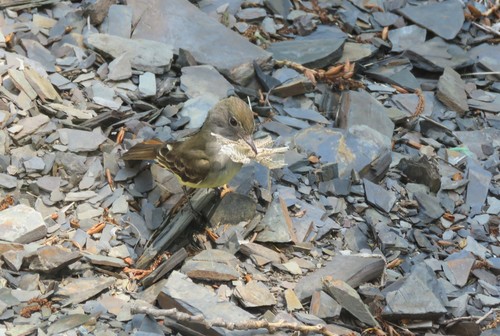
Great Crested Flycatcher (Myiarchus crinitus) Great Crested Flycatcher
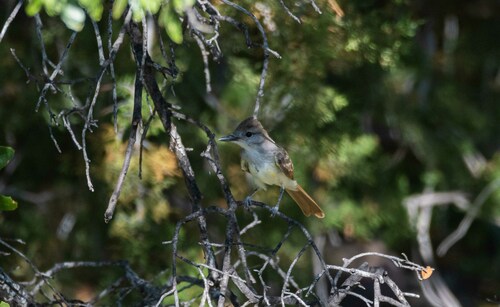
Brown-crested Flycatcher (Myiarchus tyrannulus) Brown-crested Flycatcher

Media

Loading…

In short

The Great Crested Flycatcher and Brown-crested Flycatcher are similar in appearance but can be distinguished by subtle differences in plumage and vocalizations. Both are cavity-nesting, canopy-dwelling birds, making their behavior and habitat preferences quite similar.

Identification tips

1. Listen for the Great Crested Flycatcher's sharp "whee-eep" call. 2. Look for the rufous tint on the wings and tail of the Great Crested Flycatcher. 3. Consider location: Great Crested in the east, Brown-crested in the southwest. 4. Note any size differences, especially if observing the larger Pacific-slope Brown-crested subspecies.

Size

Both species are similar in size, but the Brown-crested Flycatcher can be slightly larger, especially the Pacific-slope subspecies.

Plumage

Both have olive-brown upperparts and yellow underparts, but the Great Crested Flycatcher typically shows a more pronounced rufous tint on the wings and tail. The Brown-crested Flycatcher may have a paler throat and less contrast between the head and back.

Behaviour

Both species are canopy dwellers and forage by sallying for insects. They are cavity nesters, often using woodpecker holes.

Habitat

Both species favor open woodlands and edges. The Great Crested Flycatcher is more common in eastern North America, while the Brown-crested Flycatcher is found in the southwestern U.S. and Mexico.

Voice

The Great Crested Flycatcher has a distinctive "whee-eep" call, while the Brown-crested Flycatcher's call is less sharp and more varied. Vocalizations are crucial for identification.

Submit a better description

Use the same sections as the comparison. Your text is published immediately.

The Great Crested Flycatcher and Brown-crested Flycatcher are similar in appearance but can be distinguished by subtle differences in plumage and vocalizations. Both are cavity-nesting, canopy-dwelling birds, making their behavior and habitat preferences quite similar.

1. Listen for the Great Crested Flycatcher's sharp "whee-eep" call. 2. Look for the rufous tint on the wings and tail of the Great Crested Flycatcher. 3. Consider location: Great Crested in the east, Brown-crested in the southwest. 4. Note any size differences, especially if observing the larger Pacific-slope Brown-crested subspecies.

Both species are similar in size, but the Brown-crested Flycatcher can be slightly larger, especially the Pacific-slope subspecies.

Both have olive-brown upperparts and yellow underparts, but the Great Crested Flycatcher typically shows a more pronounced rufous tint on the wings and tail. The Brown-crested Flycatcher may have a paler throat and less contrast between the head and back.

Both species are canopy dwellers and forage by sallying for insects. They are cavity nesters, often using woodpecker holes.

Both species favor open woodlands and edges. The Great Crested Flycatcher is more common in eastern North America, while the Brown-crested Flycatcher is found in the southwestern U.S. and Mexico.

The Great Crested Flycatcher has a distinctive "whee-eep" call, while the Brown-crested Flycatcher's call is less sharp and more varied. Vocalizations are crucial for identification.

Discard your changes?

You have unsaved edits. If you leave now, those changes will be lost.

Great Crested Flycatcher · Brown-crested Flycatcher · My Tricky Birds