Birdr

Great Crested Tern vs Polynesian Storm-Petrel

Thalasseus bergii versus Nesofregetta fuliginosa

Play a quiz with Great Crested Tern and Polynesian Storm-Petrel
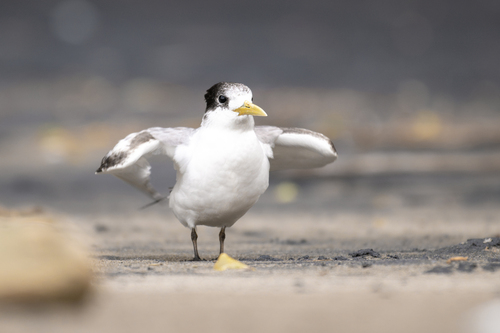
Great Crested Tern (Thalasseus bergii) Great Crested Tern
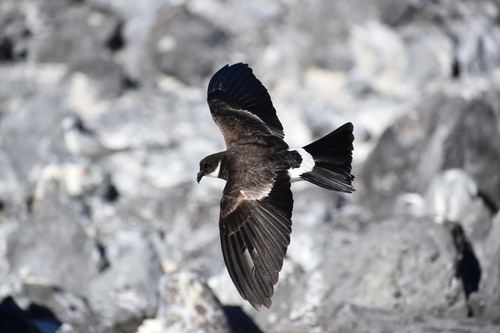
Polynesian Storm-Petrel (Nesofregetta fuliginosa) Polynesian Storm-Petrel

Media

Loading…

In short

The Great Crested Tern and the Polynesian Storm-Petrel are distinct in size, plumage, and behavior. The tern is much larger with a distinctive black cap and a yellow bill, while the storm-petrel is smaller, with a dark plumage and a more erratic flight pattern. Observing their habitat can also help, as terns are often seen in coastal areas, whereas storm-petrels are pelagic.

Identification tips

Look for the large size, black cap, and yellow bill of the Great Crested Tern, especially in coastal areas. The Polynesian Storm-Petrel is smaller, dark with a white rump, and usually seen over open ocean. Their flight patterns also differ, with terns diving and storm-petrels fluttering erratically.

Size

The Great Crested Tern is significantly larger than the Polynesian Storm-Petrel.

Plumage

The Great Crested Tern has a black cap and a yellow bill, with grey upperparts and white underparts. The Polynesian Storm-Petrel is mostly dark with a white rump, lacking the distinct black cap and yellow bill of the tern.

Behaviour

Great Crested Terns often hover and dive for fish, while Polynesian Storm-Petrels have a fluttering, erratic flight pattern over open ocean.

Habitat

Great Crested Terns are typically found in coastal regions, often near sandy beaches and estuaries. Polynesian Storm-Petrels are pelagic, spending most of their time over open ocean.

Voice

Great Crested Terns are known for their loud, harsh calls, while Polynesian Storm-Petrels are generally silent at sea.

Submit a better description

Use the same sections as the comparison. Your text is published immediately.

The Great Crested Tern and the Polynesian Storm-Petrel are distinct in size, plumage, and behavior. The tern is much larger with a distinctive black cap and a yellow bill, while the storm-petrel is smaller, with a dark plumage and a more erratic flight pattern. Observing their habitat can also help, as terns are often seen in coastal areas, whereas storm-petrels are pelagic.

Look for the large size, black cap, and yellow bill of the Great Crested Tern, especially in coastal areas. The Polynesian Storm-Petrel is smaller, dark with a white rump, and usually seen over open ocean. Their flight patterns also differ, with terns diving and storm-petrels fluttering erratically.

The Great Crested Tern is significantly larger than the Polynesian Storm-Petrel.

The Great Crested Tern has a black cap and a yellow bill, with grey upperparts and white underparts. The Polynesian Storm-Petrel is mostly dark with a white rump, lacking the distinct black cap and yellow bill of the tern.

Great Crested Terns often hover and dive for fish, while Polynesian Storm-Petrels have a fluttering, erratic flight pattern over open ocean.

Great Crested Terns are typically found in coastal regions, often near sandy beaches and estuaries. Polynesian Storm-Petrels are pelagic, spending most of their time over open ocean.

Great Crested Terns are known for their loud, harsh calls, while Polynesian Storm-Petrels are generally silent at sea.

Discard your changes?

You have unsaved edits. If you leave now, those changes will be lost.

Great Crested Tern · Polynesian Storm-Petrel · My Tricky Birds