Great Frigatebird vs Cape Gannet
Fregata minor versus Morus capensis
Play a quiz with Great Frigatebird and Cape Gannet
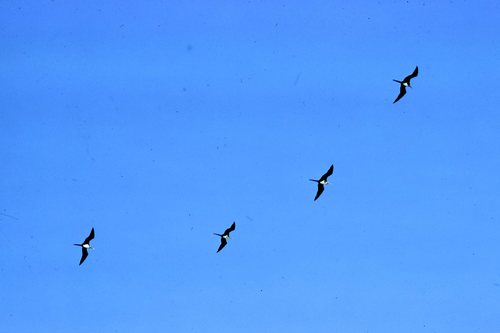
Great Frigatebird
Cape Gannet
In short
The Great Frigatebird and Cape Gannet are distinct in both appearance and behavior. The Great Frigatebird is known for its long wings and deeply forked tail, while the Cape Gannet has a more robust body and pointed bill. Frigatebirds are often seen soaring high above the ocean, whereas gannets are more likely to be observed diving into the water.
Identification tips
1. Wing Shape and Tail: Look for the Great Frigatebird's long wings and deeply forked tail. 2. Plumage and Gular Sac: Note the Great Frigatebird's black plumage and the male's red gular sac. 3. Diving Behavior: Observe if the bird is diving; this is characteristic of the Cape Gannet. 4. Head and Bill: Check for the Cape Gannet's golden-yellow head and pointed bill. 5. Location: Consider the habitat; Great Frigatebirds are more likely over tropical waters, while Cape Gannets are coastal in southern Africa.
Size
The Great Frigatebird is larger with a wingspan that can exceed 2 meters, while the Cape Gannet is more compact with a wingspan around 1.8 meters.
Plumage
Great Frigatebirds have predominantly black plumage with males displaying a bright red gular sac during courtship. Cape Gannets have striking white plumage with black wingtips and a golden-yellow head.
Behaviour
Great Frigatebirds are known for their aerial prowess and kleptoparasitic behavior, often harassing other birds for food. Cape Gannets are expert divers, plunging into the sea to catch fish.
Habitat
Great Frigatebirds are found over tropical oceans, often near islands. Cape Gannets are typically seen along the coasts of southern Africa, favoring cooler waters.
Voice
Great Frigatebirds produce a variety of calls, especially during courtship, while Cape Gannets are generally quieter, with occasional calls heard at colonies.