Birdr

Great Horned Owl vs Subtropical Pygmy-Owl

Bubo virginianus versus Glaucidium parkeri

Play a quiz with Great Horned Owl and Subtropical Pygmy-Owl

Great Horned Owl (Bubo virginianus) Great Horned Owl
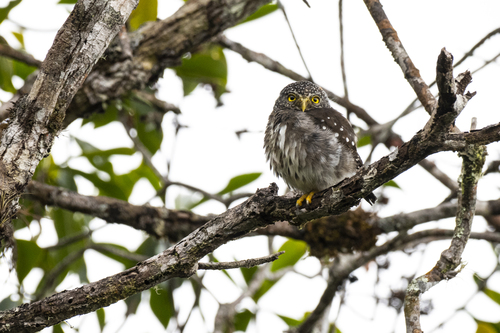
Subtropical Pygmy-Owl (Glaucidium parkeri) Subtropical Pygmy-Owl

Media

Loading…

In short

The Great Horned Owl is a large, powerful owl with prominent ear tufts, while the Subtropical Pygmy-Owl is small and lacks such tufts. These species differ significantly in size and habitat preference, making them unlikely to be confused in the field.

Identification tips

  1. Size and Ear Tufts: Note the significant size difference and the presence of ear tufts on the Great Horned Owl. 2. Plumage Patterns: Look for the white throat patch on the Great Horned Owl. 3. Activity Time: Consider the time of day; Great Horned Owls are nocturnal, while Subtropical Pygmy-Owls can be seen during the day. 4. Habitat: Check the habitat; Great Horned Owls are more adaptable to various environments compared to the forest-restricted Subtropical Pygmy-Owl.

Size

The Great Horned Owl is much larger, about 46-63 cm in length, compared to the Subtropical Pygmy-Owl, which is only about 16-18 cm.

Plumage

Great Horned Owls have mottled gray-brown plumage with a distinctive white throat patch, while Subtropical Pygmy-Owls are more uniformly brown with fine streaks and lack the white throat patch.

Behaviour

Great Horned Owls are primarily nocturnal and perch-and-pounce hunters, whereas Subtropical Pygmy-Owls are more active during the day and hunt by watching from a perch.

Habitat

Great Horned Owls inhabit a wide range of environments including forests, deserts, and urban areas, while Subtropical Pygmy-Owls are found in subtropical and tropical forests, often at higher elevations.

Voice

The Great Horned Owl has a deep, resonant hoot, while the Subtropical Pygmy-Owl is known for its unique three-noted call.

Submit a better description

Use the same sections as the comparison. Your text is published immediately.

The Great Horned Owl is a large, powerful owl with prominent ear tufts, while the Subtropical Pygmy-Owl is small and lacks such tufts. These species differ significantly in size and habitat preference, making them unlikely to be confused in the field.

  1. Size and Ear Tufts: Note the significant size difference and the presence of ear tufts on the Great Horned Owl. 2. Plumage Patterns: Look for the white throat patch on the Great Horned Owl. 3. Activity Time: Consider the time of day; Great Horned Owls are nocturnal, while Subtropical Pygmy-Owls can be seen during the day. 4. Habitat: Check the habitat; Great Horned Owls are more adaptable to various environments compared to the forest-restricted Subtropical Pygmy-Owl.

The Great Horned Owl is much larger, about 46-63 cm in length, compared to the Subtropical Pygmy-Owl, which is only about 16-18 cm.

Great Horned Owls have mottled gray-brown plumage with a distinctive white throat patch, while Subtropical Pygmy-Owls are more uniformly brown with fine streaks and lack the white throat patch.

Great Horned Owls are primarily nocturnal and perch-and-pounce hunters, whereas Subtropical Pygmy-Owls are more active during the day and hunt by watching from a perch.

Great Horned Owls inhabit a wide range of environments including forests, deserts, and urban areas, while Subtropical Pygmy-Owls are found in subtropical and tropical forests, often at higher elevations.

The Great Horned Owl has a deep, resonant hoot, while the Subtropical Pygmy-Owl is known for its unique three-noted call.

Discard your changes?

You have unsaved edits. If you leave now, those changes will be lost.

Great Horned Owl · Subtropical Pygmy-Owl · My Tricky Birds