Birdr

Great Knot vs Red Knot

Calidris tenuirostris versus Calidris canutus

Play a quiz with Great Knot and Red Knot

Great Knot (Calidris tenuirostris) Great Knot
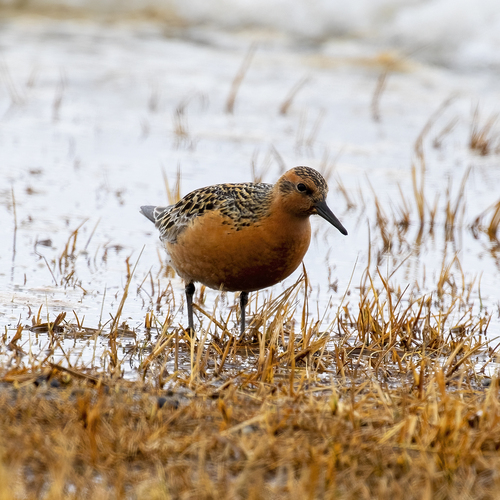
Red Knot (Calidris canutus) Red Knot

Media

Loading…

In short

The Great Knot and Red Knot are similar shorebirds, but can be distinguished by their size, bill shape, and plumage patterns. Great Knots are slightly larger with a longer, more slender bill, while Red Knots have a shorter, straighter bill. In breeding plumage, Great Knots show a more heavily spotted and streaked appearance compared to the more uniform reddish tones of the Red Knot.

Identification tips

  1. Size and Bill Shape: Great Knots are slightly larger with a longer, more slender bill compared to the shorter, straighter bill of Red Knots. 2. Breeding Plumage: Look for the heavily spotted and streaked breast of Great Knots versus the more uniform reddish tones of Red Knots. 3. Non-breeding Plumage: Both species are gray, but Great Knots have more distinct streaking on the breast. 4. Habitat: Consider the location and habitat; both species prefer coastal areas, but Red Knots have a wider range, including marine environments.

Size

Great Knots are slightly larger than Red Knots, with a longer, more slender bill.

Plumage

In breeding plumage, Great Knots have a heavily spotted and streaked appearance on the breast and flanks, while Red Knots display a more uniform reddish-orange color. In non-breeding plumage, both species are grayish, but Great Knots retain more distinct streaking on the breast.

Behaviour

Both species are migratory shorebirds, but Red Knots are known for their extraordinary long-distance migrations, sometimes traveling up to 15,000 km.

Habitat

Great Knots are typically found in coastal mudflats and estuaries during migration and winter, while Red Knots also frequent similar habitats but have a broader range, including marine environments.

Voice

Vocalizations are not a primary distinguishing feature between these species in the field.

Submit a better description

Use the same sections as the comparison. Your text is published immediately.

The Great Knot and Red Knot are similar shorebirds, but can be distinguished by their size, bill shape, and plumage patterns. Great Knots are slightly larger with a longer, more slender bill, while Red Knots have a shorter, straighter bill. In breeding plumage, Great Knots show a more heavily spotted and streaked appearance compared to the more uniform reddish tones of the Red Knot.

  1. Size and Bill Shape: Great Knots are slightly larger with a longer, more slender bill compared to the shorter, straighter bill of Red Knots. 2. Breeding Plumage: Look for the heavily spotted and streaked breast of Great Knots versus the more uniform reddish tones of Red Knots. 3. Non-breeding Plumage: Both species are gray, but Great Knots have more distinct streaking on the breast. 4. Habitat: Consider the location and habitat; both species prefer coastal areas, but Red Knots have a wider range, including marine environments.

Great Knots are slightly larger than Red Knots, with a longer, more slender bill.

In breeding plumage, Great Knots have a heavily spotted and streaked appearance on the breast and flanks, while Red Knots display a more uniform reddish-orange color. In non-breeding plumage, both species are grayish, but Great Knots retain more distinct streaking on the breast.

Both species are migratory shorebirds, but Red Knots are known for their extraordinary long-distance migrations, sometimes traveling up to 15,000 km.

Great Knots are typically found in coastal mudflats and estuaries during migration and winter, while Red Knots also frequent similar habitats but have a broader range, including marine environments.

Vocalizations are not a primary distinguishing feature between these species in the field.

Discard your changes?

You have unsaved edits. If you leave now, those changes will be lost.

Great Knot · Red Knot · My Tricky Birds