
Great Knot vs Ruff
Calidris tenuirostris versus Calidris pugnax
Play a quiz with Great Knot and Ruff
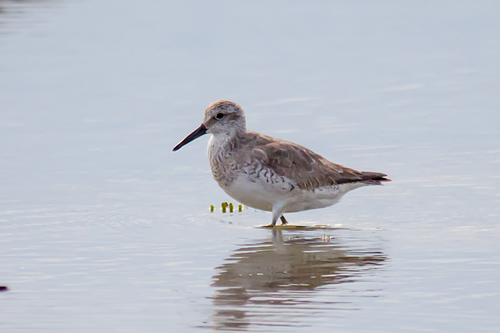 Great Knot
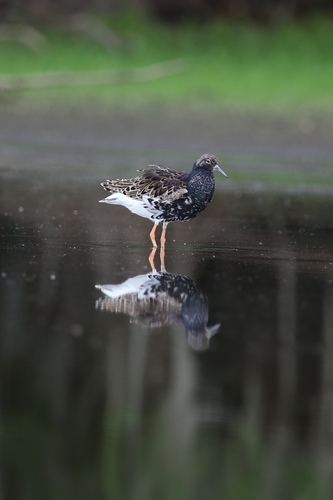 Ruff
Ruff
In short
The most reliable field mark between Great Knot and Ruff is overall structure: Great Knot is bulkier with a deeper chest, shorter legs, and a medium-length, straight, dark bill, while Ruff is more pot-bellied with a small head, longer neck, and distinctly long legs (especially in females and non-breeding males). In flight, Ruff shows a thin, indistinct white wing bar and white ovals at the tail sides, features not present in Great Knot. Juvenile and non-breeding plumages can be confusing, but Great Knot is always larger and heavier-bodied, with a more uniform grey upperpart in winter, while Ruff (especially females and juveniles) shows a scaly upperpart pattern and a strong buff tinge below. Leg color is variable in Ruff but always dark in Great Knot. Use body shape, leg length, and flight pattern for the most reliable separation, especially outside of breeding plumage.
Identification tips
- Size and Bulk: Great Knot is larger and heavier-bodied than all but the largest male Ruffs. If the bird appears especially robust with a deep chest, favor Great Knot.
- Leg Length and Color: Great Knot always has short, dark legs. Ruff has distinctly longer legs, which are greenish in juveniles and pink/orange in adults (especially breeding males). Leg color is a quick separator at close range.
- Bill Shape: Great Knot's bill is medium-length, straight, and dark, matching its robust head. Ruff's bill is also medium-length but appears finer relative to the head, especially in females.
- Head and Neck: Ruff has a small head, long neck, and pot-bellied look, while Great Knot has a more compact, deep-chested, and less elongated profile.
- Upperpart Pattern (Juvenile/Non-breeding): Juvenile and non-breeding Ruff show neat, scale-like upperpart patterning with dark feather centers and a buffy wash below. Great Knot in similar plumage is more uniformly pale grey above, lacking neat scaling.
- Breeding Plumage: Great Knot adults have a rufous scapular band and heavy black spotting on the face, throat, and breast. Ruff males develop elaborate ruffs and tufts in various colors; females are plainer but still show more patterning than Great Knot.
- Flight Pattern and Wing Markings: In flight, Ruff shows a thin, indistinct white wing bar and white ovals at the tail sides. Great Knot lacks these features and appears more uniform above.
- Behavior and Posture: Ruff often stands tall on long legs with a pot-bellied appearance, feeding in a more upright posture. Great Knot is more compact and horizontal when feeding.
- Flock Structure: Great Knot tends to form tight, coordinated flocks on mudflats. Ruff flocks are often larger, looser, and more variable in structure, especially in non-breeding areas.
- Habitat: If seen inland in marshes or wet meadows, Ruff is much more likely. Great Knot is almost always coastal.
- Sexual Dimorphism: Ruff shows strong sexual dimorphism—males can be much larger and develop ornate ruffs, while females (reeves) are smaller and plainer. Great Knot shows little sexual dimorphism.
- Leg Color in Breeding Season: Adult male Ruff can have bright reddish-orange legs in the breeding season; Great Knot legs remain dark year-round.
- Pot-bellied vs. Deep-chested: Ruff's belly often looks distended or drooping, while Great Knot's chest is deep but the belly is less prominent.
- Confusion with Other Species: Juvenile Ruff can resemble Buff-breasted or Sharp-tailed Sandpiper, but is always larger and longer-legged. Great Knot is unlikely to be confused with these due to size and structure.
- When in Doubt: Focus on structure (leg length, body shape), upperpart pattern (scaly vs. plain grey), and habitat. If you see a scaly, pot-bellied, long-legged bird inland, it's almost certainly Ruff; a robust, short-legged, plain grey bird on a coastal mudflat is Great Knot.
Size
Great Knot is consistently larger and heavier than Ruff. Adult Great Knot averages 165 g (body mass), with a length of 26–30 cm and a wingspan of 56–66 cm. Ruff females (reeves) are smaller, at 22–26 cm length, 46–49 cm wingspan, and 70–170 g, while males can be larger but are still generally lighter-bodied than Great Knot except for the largest males. In the field, Great Knot appears more robust and deep-chested, while Ruff is pot-bellied but slimmer overall, with a longer neck and legs. The difference is most obvious when birds are side by side, but even singly, Great Knot looks bulkier and more compact.
Plumage
Juvenile and first-winter Ruff have a distinctive scaly upperpart pattern with dark feather centers and a strong buff wash below, while Great Knot juveniles and non-breeding birds are more uniformly pale grey above, lacking the neat scaling. In breeding plumage, Great Knot adults show mottled greyish upperparts with a rufous band on the scapulars and heavy black spotting on the face, throat, and breast, whereas Ruff males develop elaborate head and neck ruffs in a variety of colors, and females have grey-brown upperparts with white-fringed, dark-centered feathers and variable black blotching below. In winter, both species become plainer, but Great Knot remains more uniform grey above, while Ruff retains some patterning and a pot-bellied look. In flight, Ruff shows a thin, indistinct white wing bar and white ovals at the tail sides, which Great Knot lacks. Leg color is a useful clue: Great Knot always has short, dark legs, while Ruff's are longer and can be greenish (juveniles) or pink/orange (adults, especially breeding males).
Behaviour
Great Knot forages by probing or picking up food on mudflats and beaches, often in tight groups, moving steadily and purposefully. Ruff is highly gregarious, sometimes forming huge flocks, and is more likely to be seen in marshes, wet meadows, and sometimes on mudflats. Ruff's feeding behavior is more varied, with birds often seen wading in shallow water or picking at the surface. In flight, Ruff has a deeper, slower wingbeat than Great Knot, and its flocks can appear looser and more erratic. The pot-bellied, long-legged stance of Ruff is often evident when feeding or standing.
Habitat
Both species are migratory and can overlap in wintering grounds in southern Asia and Australia, but their preferred habitats differ. Great Knot is typically found on coastal mudflats and sandy beaches, rarely venturing far inland. Ruff breeds in marshes and wet meadows across northern Eurasia and winters in a wider range of wetland habitats, including inland marshes, wet fields, and sometimes coastal areas. If seen away from the coast, Ruff is more likely; Great Knot is rarely found far from tidal flats.