
Great White Egret vs Grey Heron
Ardea alba versus Ardea cinerea
Play a quiz with Great White Egret and Grey Heron
 Great White Egret
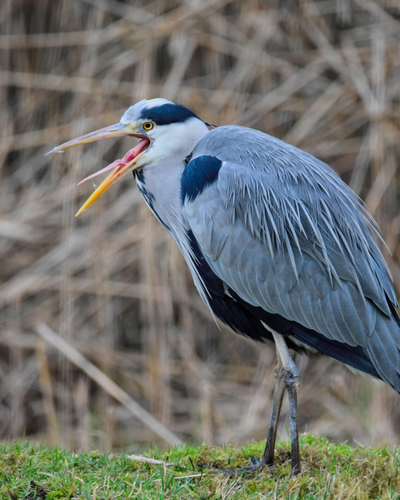 Grey Heron
In short
The most reliable field mark separating Great White Egret from Grey Heron is plumage: Great White Egret is entirely white at all ages, while Grey Heron is never all-white, showing grey upperparts and a contrasting white head and neck with black markings. In flight, both species retract their necks, but the egret appears more slender and gleaming white, while the heron looks bulkier with obvious grey and black. Bill and leg color also help: Great White Egret has a yellow bill and black legs, while Grey Heron has a pinkish-yellow bill and brownish legs. Juveniles of both species resemble adults in these key respects, so age does not usually complicate the ID.
Identification tips
- Plumage color is decisive: Great White Egret is always pure white; Grey Heron is always grey above and white below, with a white head and neck and black markings. This works for all ages and seasons.
- Bill color: Great White Egret has a yellow bill (may darken slightly in breeding season); Grey Heron has a pinkish-yellow bill, which becomes brighter in breeding adults. Bill is also thicker and more powerful in Grey Heron.
- Leg color: Great White Egret has black legs and feet; Grey Heron has brown legs. In breeding season, egret's lower legs may become paler, but never brown.
- Head pattern: Grey Heron shows a bold black supercilium and crest extending from the eye to the back of the head; Great White Egret's head is plain white, lacking any black.
- Neck markings: Grey Heron has bluish-black streaks on the front of the neck; Great White Egret's neck is plain white with no streaking.
- Size and structure: Grey Heron is slightly larger and heavier, with a bulkier body and thicker bill, but size overlap is significant and not reliable unless birds are side by side.
- Jizz in flight: Both fly with necks retracted, but egret looks more slender and all-white; heron appears heavier, with broad grey wings and white neck/head.
- Juvenile confusion: Juvenile Grey Herons are duller and greyer, but still never white; juvenile Great White Egrets are identical to nonbreeding adults (all-white). No age-specific wing patterns complicate the ID.
- Breeding plumes: Both species develop ornamental plumes in breeding season, but only the egret remains all-white; the heron's plumes are grey or blackish.
- Habitat overlap: Both occur in similar wetland habitats, so do not use habitat alone for separation.
- Vocalizations: Both give harsh croaks and squawks, but calls are not reliably separable in the field.
- Behavior: Both hunt by standing or stalking in shallow water; egret may appear more graceful and upright, heron more hunched and deliberate.
- Perched posture: Egret stands tall and slim, heron bulkier with a more pronounced S-curve to the neck.
- Context: In areas where one species is rare (e.g., Great White Egret in parts of northern Europe), rarity may help, but always confirm with plumage and structure.
- Common pitfalls: Do not confuse all-white plumage of egret with pale-headed heron; always check for grey in wings/back and black on head for heron.
Size
Both are large herons, but Grey Heron is slightly larger and heavier: it stands up to 100 cm tall, with a length of 84–102 cm and a wingspan of 155–195 cm, and weighs 1.02–2.08 kg. Great White Egret stands up to 1 m, measures 80–104 cm in length, with a wingspan of 131–170 cm, and weighs 700–1,500 g (average 1,000 g). In the field, size overlap is substantial, and unless birds are side by side, size alone is unreliable for separation.
Plumage
Plumage is the clearest difference at all ages. Great White Egret is pure white in all plumages, including juveniles, nonbreeding, and breeding adults. In breeding season, it develops ornamental plumes on the back, but remains all-white. Grey Heron is never all-white: adults have ashy-grey upperparts, greyish-white underparts, a white head and neck with a bold black supercilium and crest, and black streaks on the neck. Immature Grey Herons are duller, with greyer head stripes and a paler grey face, but still show grey upperparts and are never white overall. In flight, the egret is a gleaming white bird, while the heron shows a two-tone pattern with grey wings and back and white neck and head. There are no distinctive juvenile wing patterns (such as black triangles or trailing edges) in either species that would confuse the issue; the all-white vs. grey-and-white contrast is consistent across ages.
Behaviour
Both species are typically seen wading in shallow water, standing still or moving slowly as they hunt. In flight, both retract their necks, giving a compact, hunched profile. The egret often appears more graceful and slender, with slower, steadier wingbeats. The heron looks heavier and more lumbering, with broader wings. When perched, the egret stands tall and slim, while the heron appears bulkier, with a more pronounced S-curve to the neck. Both species may be seen singly or in loose groups, and both breed colonially.
Habitat
Habitat overlap is extensive: both species frequent wetlands, lakes, rivers, marshes, ponds, and coastal areas. Great White Egret has a wider global distribution, but in Europe and much of Eurasia, both can be found in the same habitats. Context is not usually helpful for separation, except in regions where one species is much rarer.
Voice
Neither species is highly vocal away from colonies. Great White Egret gives a low, hoarse croak when disturbed, and at colonies emits croaking 'cuk cuk cuk' and higher-pitched squawks. Grey Heron is also generally quiet but may utter harsh croaks or squawks, especially in flight or at the nest. Calls are similar in tone and not reliable for field separation.