
Great White Pelican vs Dalmatian Pelican
Pelecanus onocrotalus versus Pelecanus crispus
Play a quiz with Great White Pelican and Dalmatian Pelican
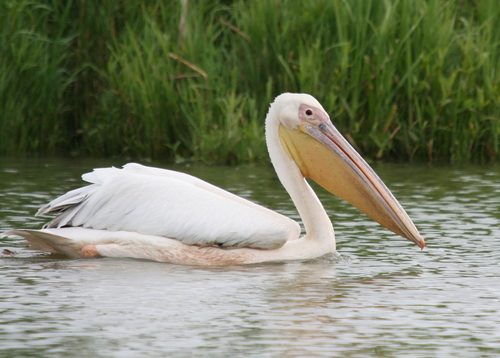 Great White Pelican
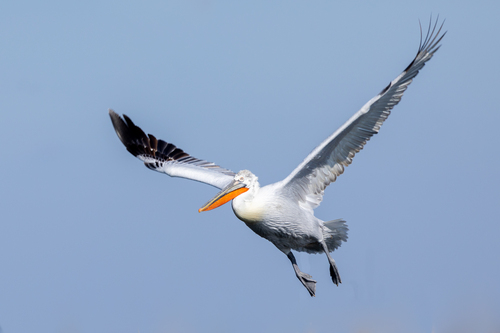 Dalmatian Pelican
In short
The most reliable field mark to separate Great White Pelican from Dalmatian Pelican is the head and nape: Dalmatian Pelican always shows a shaggy, curly crest on the nape and back of the head, giving a scruffy look, while Great White Pelican has a smoother, less pronounced crest. In flight, both are huge, pale pelicans with black primaries, but Dalmatian shows a greyer overall tone and dark grey legs, while Great White is cleaner white with pinkish or yellowish legs. Bill color and pouch are also key: Dalmatian's pouch is vivid orange-red in breeding season, while Great White's is more yellowish or pinkish. Juvenile plumages are duller in both, but Dalmatian juveniles are overall greyer and less contrasting. Size overlap is considerable, but Dalmatian is on average slightly larger and bulkier, especially in males.
Identification tips
- Nape Crest: Dalmatian Pelican always shows a shaggy, curly crest on the nape and back of the head, giving a scruffy, unkempt look. Great White Pelican has a much smoother head and nape, with only a short, less obvious crest. This is the single most reliable mark at all ages and seasons.
- Leg Color: Dalmatian Pelican has dark grey legs, easily seen when perched or standing. Great White Pelican has yellowish to pinkish legs. This is diagnostic in good light.
- Bill and Pouch Color (Breeding Season): Dalmatian's pouch turns vivid orange-red in breeding season, while Great White's is more yellowish or pinkish, with a bluish-grey bill and red tip. Outside breeding, Dalmatian's pouch is yellowish or greyish, but the upper mandible remains greyish with an orange tip.
- Overall Plumage Tone: Dalmatian Pelican is silvery-white to greyish, often looking dingier or creamy, especially in winter. Great White Pelican is clean white with a faint pink tinge, especially on the neck and breast in breeding plumage.
- Juvenile Plumage: Juvenile Dalmatian Pelicans are overall greyer and duller, with less contrast between upperparts and underparts, and a less obvious crest. Juvenile Great White Pelicans have brownish underparts, palest at the rump and belly center, and a dark bar over the lesser underwing coverts, but still look paler and cleaner than Dalmatian.
- Upperwing Pattern (All Ages): In flight, both show black primaries contrasting with pale upperwings, but Great White Pelican has bright white upperwing coverts and tertials, creating a sharper contrast with the black flight feathers. Dalmatian's wings are more uniformly pale greyish-white with black tips, lacking the crisp white/black contrast.
- Size and Structure: Dalmatian is on average slightly larger and bulkier, with a longer, heavier bill (37–45 cm vs. Great White's 28.9–47.1 cm). However, size overlap is considerable and not reliable on lone birds.
- Neck and Head Shape: Dalmatian often appears longer-necked and bulkier, especially when perched. Great White Pelican's neck is thick but the head profile is smoother and less scruffy.
- Flight Jizz: Both fly with slow, powerful wingbeats and necks pulled back, but Dalmatian may appear slightly heavier and broader-winged, especially in synchronized flocks.
- Leg Color in Flight: When seen from below, Dalmatian's dark grey legs may be visible against the pale belly, while Great White's legs are paler and less contrasting.
- Facial Skin Color (Breeding Season): In breeding season, Great White Pelican females have brighter orange facial skin, while males have pinkish skin. Dalmatian's facial skin is less colorful, with the pouch providing the main color.
- Habitat and Range: Both species overlap in range and habitat, so this is not a reliable mark, but Dalmatian may be more tied to large freshwater lakes and rivers.
- Behavior at Nest: Dalmatian Pelican forages close to the nest (within 1 km) during breeding, while Great White Pelican may travel much farther for food. This is only useful in breeding colonies.
- Vocalizations: Dalmatian may grunt or hiss at the nest, but both species are generally quiet; voice is not a reliable field mark.
- Pitfalls: Immature birds of both species can be confusing, especially in poor light or at distance. Focus on nape crest, leg color, and overall plumage tone for best separation.
Size
Both species are among the largest flying birds, but Dalmatian Pelican is generally the largest pelican. Great White Pelican averages about 9520 g in body mass, with males reaching up to 15 kg and females much smaller. Dalmatian Pelican averages about 9.5 kg, but with a slightly longer bill (37–45 cm vs. Great White's 28.9–47.1 cm) and a wingspan typically 2.7–3.2 m, overlapping with Great White's 2.26–3.6 m. In the field, size alone is unreliable due to overlap and sexual dimorphism, but Dalmatian often appears bulkier and longer-necked, especially when perched.
Plumage
Juveniles and immatures: Dalmatian Pelican juveniles are overall greyer and duller, with less contrast between upperparts and underparts, and a less distinctive crest. Great White Pelican juveniles have brownish underparts, palest at the rump and belly center, and a dark bar over the lesser underwing coverts, but still appear paler and cleaner than Dalmatian. In flight, both show black primaries contrasting with pale upperwings, but Great White's upperwing coverts and tertials are bright white, creating a sharper contrast with the black flight feathers, while Dalmatian's wings are more uniformly pale greyish-white with black tips. Adults: Dalmatian Pelican is silvery-white to greyish, often appearing dingier or creamy, especially in winter, with a shaggy, curly nape crest. Great White Pelican is mostly white with a faint pink tinge and yellowish base to the foreneck, and a much smoother head profile. Bill and pouch color differ: Dalmatian's pouch is vivid orange-red in breeding, otherwise yellow-grey; Great White's is bluish-grey with a red tip and yellow gular pouch, tinged pink in breeding. Leg color is diagnostic: Dalmatian has dark grey legs, Great White has yellow-flesh to pinkish orange legs.
Behaviour
Both species soar with slow, powerful wingbeats and fly with necks pulled back in an 'S' shape. Dalmatian Pelicans are noted for synchronized flock flight and particularly energetic takeoff from water, requiring strong pushes and heavy flapping. Great White Pelicans also fly in groups but may appear slightly less coordinated. Dalmatian tends to forage close to the nest during breeding (within 1 km), while Great White may travel tens of kilometers for food. Both are generally quiet, but Dalmatian may grunt or hiss at the nest.
Habitat
Both species breed and forage in swamps, shallow lakes, and wetlands across southeastern Europe, Asia, and Africa. There is significant habitat overlap, so context is not reliably diagnostic. However, Dalmatian may be more tied to freshwater lakes and rivers, while Great White can be found in a wider range of shallow wetland habitats.
Voice
Both species are mostly silent, but Dalmatian Pelican can produce deep, guttural grunts, hisses, or barking sounds at the nest, especially in the breeding season. Great White Pelican is also generally quiet; vocalizations are not a reliable field mark for separation.