Birdr

Greater Blue-eared Starling vs Cape Starling

Lamprotornis chalybaeus versus Lamprotornis nitens

Play a quiz with Greater Blue-eared Starling and Cape Starling
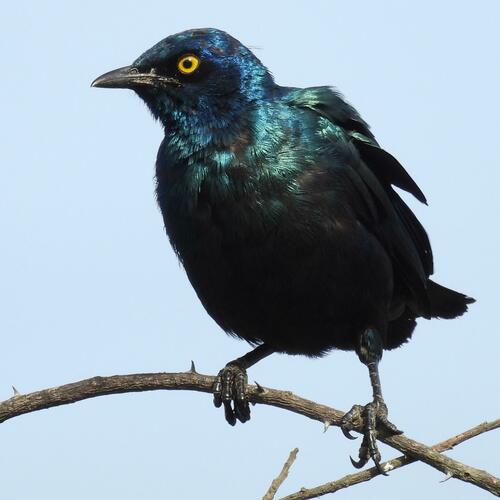
Greater Blue-eared Starling (Lamprotornis chalybaeus) Greater Blue-eared Starling
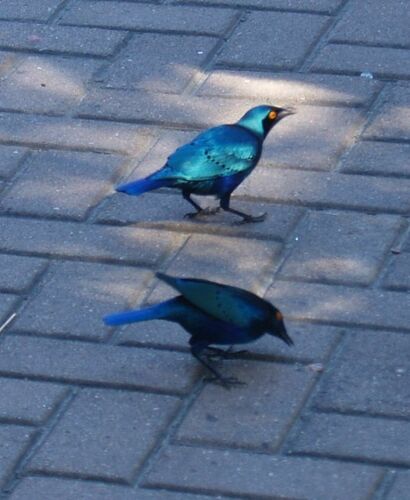
Cape Starling (Lamprotornis nitens) Cape Starling

Media

Loading…

In short

The Greater Blue-eared Starling and Cape Starling are both iridescent starlings with overlapping ranges in Africa, making them tricky to differentiate. The most reliable field mark is the eye color: the Greater Blue-eared Starling typically has bright yellow eyes, while the Cape Starling has orange to red eyes. Both species share a similar structure and iridescent plumage, so focus on eye color and subtle differences in plumage tone.

Identification tips

Size

Both species are similar in size, typical of medium-sized starlings.

Plumage

Both starlings have glossy, iridescent plumage. The Greater Blue-eared Starling has a more intense blue sheen, especially on the head and upperparts, while the Cape Starling may appear slightly greener or less intensely blue.

Behaviour

Both species are social and often found in flocks, exhibiting similar foraging and social behaviors.

Habitat

Both species inhabit open woodlands, savannas, and areas near human settlements. They often overlap in range, so habitat alone is not a reliable differentiator.

Voice

Vocalizations are similar and not a reliable field mark for differentiation.

Submit a better description

Use the same sections as the comparison. Your text is published immediately.

The Greater Blue-eared Starling and Cape Starling are both iridescent starlings with overlapping ranges in Africa, making them tricky to differentiate. The most reliable field mark is the eye color: the Greater Blue-eared Starling typically has bright yellow eyes, while the Cape Starling has orange to red eyes. Both species share a similar structure and iridescent plumage, so focus on eye color and subtle differences in plumage tone.

  • Eye color: Greater Blue-eared Starling has bright yellow eyes; Cape Starling has orange to red eyes.
  • Plumage tone: Look for a more intense blue sheen on the Greater Blue-eared Starling.
  • Range overlap: Be aware of overlapping habitats and ranges; focus on eye color for reliable identification.

Both species are similar in size, typical of medium-sized starlings.

Both starlings have glossy, iridescent plumage. The Greater Blue-eared Starling has a more intense blue sheen, especially on the head and upperparts, while the Cape Starling may appear slightly greener or less intensely blue.

Both species are social and often found in flocks, exhibiting similar foraging and social behaviors.

Both species inhabit open woodlands, savannas, and areas near human settlements. They often overlap in range, so habitat alone is not a reliable differentiator.

Vocalizations are similar and not a reliable field mark for differentiation.

Discard your changes?

You have unsaved edits. If you leave now, those changes will be lost.

Greater Blue-eared Starling · Cape Starling · My Tricky Birds