Birdr

Greater Blue-eared Starling vs Purple Starling

Lamprotornis chalybaeus versus Lamprotornis purpureus

Play a quiz with Greater Blue-eared Starling and Purple Starling

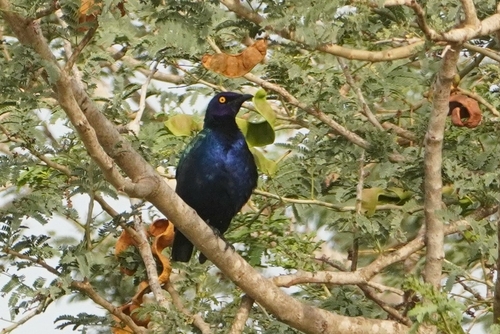
Greater Blue-eared Starling (Lamprotornis chalybaeus) Greater Blue-eared Starling
Purple Starling (Lamprotornis purpureus) Purple Starling

Media

Loading…

In short

The Greater Blue-eared Starling and Purple Starling can be distinguished by their plumage and structural differences. The Greater Blue-eared Starling has a more pronounced blue sheen on its body, while the Purple Starling displays a deeper purple hue. Both species share similar habitats and behaviors, making plumage the most reliable field mark.

Identification tips

  1. Look for the blue sheen on the Greater Blue-eared Starling, especially in good light. 2. Note the deeper purple gloss of the Purple Starling, which may appear darker. 3. Observe in open habitats where both species may occur together, using plumage tone as the primary differentiator.

Size

Both species are similar in size, typical of medium-sized starlings, with no significant differences in structure noted.

Plumage

The Greater Blue-eared Starling exhibits a bright blue sheen across its body, particularly noticeable on the head and underparts. In contrast, the Purple Starling has a deeper purple gloss, which can appear darker in certain lighting conditions. Both species have iridescent plumage, but the tonal difference is key.

Behaviour

Both species exhibit typical starling behaviors, such as foraging in groups and being highly vocal. No distinctive behavioral differences are noted.

Habitat

Both species occupy similar habitats, often found in open woodlands, savannas, and near human settlements. They are adaptable and can be seen in a variety of environments.

Voice

Vocalizations are not distinctly different between the two species, both producing a range of whistles and chattering sounds typical of starlings.

Submit a better description

Use the same sections as the comparison. Your text is published immediately.

The Greater Blue-eared Starling and Purple Starling can be distinguished by their plumage and structural differences. The Greater Blue-eared Starling has a more pronounced blue sheen on its body, while the Purple Starling displays a deeper purple hue. Both species share similar habitats and behaviors, making plumage the most reliable field mark.

  1. Look for the blue sheen on the Greater Blue-eared Starling, especially in good light. 2. Note the deeper purple gloss of the Purple Starling, which may appear darker. 3. Observe in open habitats where both species may occur together, using plumage tone as the primary differentiator.

Both species are similar in size, typical of medium-sized starlings, with no significant differences in structure noted.

The Greater Blue-eared Starling exhibits a bright blue sheen across its body, particularly noticeable on the head and underparts. In contrast, the Purple Starling has a deeper purple gloss, which can appear darker in certain lighting conditions. Both species have iridescent plumage, but the tonal difference is key.

Both species exhibit typical starling behaviors, such as foraging in groups and being highly vocal. No distinctive behavioral differences are noted.

Both species occupy similar habitats, often found in open woodlands, savannas, and near human settlements. They are adaptable and can be seen in a variety of environments.

Vocalizations are not distinctly different between the two species, both producing a range of whistles and chattering sounds typical of starlings.

Discard your changes?

You have unsaved edits. If you leave now, those changes will be lost.

Greater Blue-eared Starling · Purple Starling · My Tricky Birds