Birdr

Greater Sage-Grouse vs Sharp-tailed Grouse

Centrocercus urophasianus versus Tympanuchus phasianellus

Play a quiz with Greater Sage-Grouse and Sharp-tailed Grouse
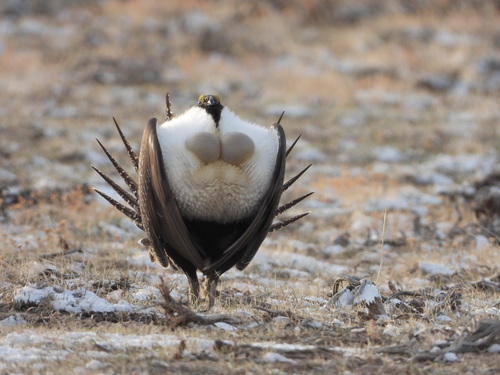
Greater Sage-Grouse (Centrocercus urophasianus) Greater Sage-Grouse
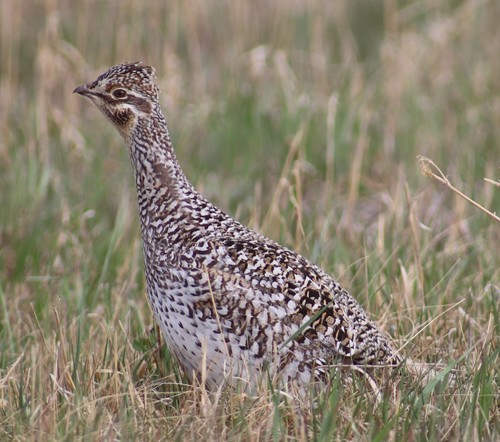
Sharp-tailed Grouse (Tympanuchus phasianellus) Sharp-tailed Grouse

Media

Loading…

In short

The most reliable field mark between Greater Sage-Grouse and Sharp-tailed Grouse is size: Greater Sage-Grouse is vastly larger and bulkier, easily dwarfing Sharp-tailed Grouse in any direct comparison. If you see a grouse in open sagebrush that appears turkey-sized, it's almost certainly a Greater Sage-Grouse; Sharp-tailed Grouse is much more compact and medium-sized. Both species can be seen in open country, but their preferred habitats differ: Greater Sage-Grouse is tied to extensive sagebrush, while Sharp-tailed Grouse favors mixed grassland or prairie with scattered shrubs. In flight, Greater Sage-Grouse appears heavier and slower, while Sharp-tailed Grouse is more agile and buoyant. If you can't judge size, look for habitat and overall jizz, as plumage differences are subtle at a distance.

Identification tips

  1. Size is the single most reliable field mark: Greater Sage-Grouse is enormous and turkey-like, while Sharp-tailed Grouse is medium-sized and chicken-like. If you can judge size, this should resolve most confusion (all ages and sexes).
  2. Habitat context: Greater Sage-Grouse is almost never found away from extensive sagebrush; Sharp-tailed Grouse prefers grasslands, mixed prairie, and open areas with scattered shrubs or aspen. If you are not in sagebrush country, Sharp-tailed Grouse is far more likely (all ages).
  3. Flight style: Greater Sage-Grouse takes off with a heavy, slow, and direct flight, often not flying far. Sharp-tailed Grouse bursts into rapid, agile, and buoyant flight, often flying farther and with more erratic movement (all ages).
  4. Group size and behavior: Greater Sage-Grouse often forms larger flocks, especially outside breeding season, and is less likely to perch in trees. Sharp-tailed Grouse is more often in small groups or pairs and may perch in low trees or shrubs (all ages).
  5. Tail shape (when visible): Sharp-tailed Grouse has a distinctive pointed tail, especially obvious in display or when flushed; Greater Sage-Grouse has a longer, more rounded tail, but this is not always obvious unless the bird is displaying or at rest (all ages, but best in males during display).
  6. Plumage pattern: Both are cryptic, but Sharp-tailed Grouse tends to show more distinct barring and spotting, especially on the flanks and underparts. Greater Sage-Grouse is more uniform gray-brown. This is subtle and not reliable at a distance (all ages).
  7. Male display (lekking): If you see males displaying, Greater Sage-Grouse males have dramatic white breast plumes and large yellow air sacs; Sharp-tailed Grouse males dance with pointed tails raised and wings spread, showing white undertail (adult males in spring).
  8. Perching behavior: Sharp-tailed Grouse may be seen perched in trees or shrubs, especially in winter; Greater Sage-Grouse almost never perches in trees (all ages).
  9. Geographic range: Greater Sage-Grouse is restricted to the western US and southern Alberta/Saskatchewan; Sharp-tailed Grouse is found farther north and east, including Alaska and much of Canada (all ages).
  10. Vocalizations (not described in notes): Not diagnostic with the provided information.
  11. Juvenile/immature separation: No distinctive age-specific upperwing or flight marks are described in the notes for either species, so rely on size and habitat for young birds.
  12. Seasonal context: Both species may form flocks outside the breeding season, but Greater Sage-Grouse flocks are often much larger.
  13. Lek habitat: Greater Sage-Grouse leks are in open sagebrush flats; Sharp-tailed Grouse leks are often in grassland with less than 30% woody vegetation.
  14. Flush distance: Greater Sage-Grouse often allows closer approach before flushing, while Sharp-tailed Grouse may flush at longer distances, especially in open grassland.
  15. Hunting context: Greater Sage-Grouse is a popular game bird in sagebrush country; Sharp-tailed Grouse is hunted in grassland regions. If you hear local hunters discussing grouse, their terminology may reflect the dominant species in the area.

Size

Greater Sage-Grouse is by far the largest grouse in North America, averaging about 2450 g in mass, nearly three times the weight of Sharp-tailed Grouse, which averages 885 g [wikidata]. This size difference is dramatic in the field: Greater Sage-Grouse looks turkey-like, with a deep chest and long tail, while Sharp-tailed Grouse is much more compact and chicken-sized. Even in flight, the bulk and wingspan of Greater Sage-Grouse are obvious, making it appear heavy and slow compared to the lighter, more agile Sharp-tailed Grouse.

Plumage

No distinctive juvenile or immature upperwing patterns are described for either species in the provided notes, so age-specific flight marks are not available for separation. Both species have cryptic, mottled brown and gray plumage adapted for camouflage in open habitats. Greater Sage-Grouse adults show a more uniform, grayish-brown overall coloration with less contrast, while Sharp-tailed Grouse often shows more distinct barring and spotting, especially on the underparts and flanks. In display, male Greater Sage-Grouse have striking white breast plumes and inflatable air sacs, but these are only visible at close range and during lekking. Sharp-tailed Grouse males display with raised, pointed tails (hence the name) and show a white undertail, but these marks are not always visible unless the bird is displaying or flushed at close range. In general, plumage differences are subtle and not reliable at a distance.

Behaviour

Greater Sage-Grouse tends to walk slowly and deliberately, often seen in small groups or large flocks in open sagebrush, rarely perching in trees. When flushed, they take off with a heavy, labored flight and usually land again within sight. Sharp-tailed Grouse are more likely to be seen in smaller groups or pairs, sometimes perching in low shrubs or trees at the edge of grasslands. When flushed, they burst into rapid, agile flight, often flying farther and with more erratic, buoyant movement than Greater Sage-Grouse. During the breeding season, both species display at leks, but the displays are quite different: Greater Sage-Grouse males perform elaborate strutting with chest plumes and air sacs, while Sharp-tailed Grouse males dance with tails raised and wings spread.

Habitat

Habitat is a strong separator. Greater Sage-Grouse is almost exclusively found in extensive, unbroken sagebrush country of the western US and southern Canada [wikipedia]. If you are in a landscape dominated by sagebrush with little or no grassland, expect Greater Sage-Grouse. Sharp-tailed Grouse prefers mixed grasslands, prairies, and open areas with scattered shrubs or aspen, and is more common in the northern and western Great Plains, Alaska, and much of Canada. Sharp-tailed Grouse is also more tolerant of fragmented or patchy habitats and can be found in areas with more grass and less sagebrush. If you see a grouse in a grassy prairie with scattered shrubs or small trees, especially outside core sagebrush country, it's more likely a Sharp-tailed Grouse.

Submit a better description

Use the same sections as the comparison. Your text is published immediately.

The most reliable field mark between Greater Sage-Grouse and Sharp-tailed Grouse is size: Greater Sage-Grouse is vastly larger and bulkier, easily dwarfing Sharp-tailed Grouse in any direct comparison. If you see a grouse in open sagebrush that appears turkey-sized, it's almost certainly a Greater Sage-Grouse; Sharp-tailed Grouse is much more compact and medium-sized. Both species can be seen in open country, but their preferred habitats differ: Greater Sage-Grouse is tied to extensive sagebrush, while Sharp-tailed Grouse favors mixed grassland or prairie with scattered shrubs. In flight, Greater Sage-Grouse appears heavier and slower, while Sharp-tailed Grouse is more agile and buoyant. If you can't judge size, look for habitat and overall jizz, as plumage differences are subtle at a distance.

  1. Size is the single most reliable field mark: Greater Sage-Grouse is enormous and turkey-like, while Sharp-tailed Grouse is medium-sized and chicken-like. If you can judge size, this should resolve most confusion (all ages and sexes).
  2. Habitat context: Greater Sage-Grouse is almost never found away from extensive sagebrush; Sharp-tailed Grouse prefers grasslands, mixed prairie, and open areas with scattered shrubs or aspen. If you are not in sagebrush country, Sharp-tailed Grouse is far more likely (all ages).
  3. Flight style: Greater Sage-Grouse takes off with a heavy, slow, and direct flight, often not flying far. Sharp-tailed Grouse bursts into rapid, agile, and buoyant flight, often flying farther and with more erratic movement (all ages).
  4. Group size and behavior: Greater Sage-Grouse often forms larger flocks, especially outside breeding season, and is less likely to perch in trees. Sharp-tailed Grouse is more often in small groups or pairs and may perch in low trees or shrubs (all ages).
  5. Tail shape (when visible): Sharp-tailed Grouse has a distinctive pointed tail, especially obvious in display or when flushed; Greater Sage-Grouse has a longer, more rounded tail, but this is not always obvious unless the bird is displaying or at rest (all ages, but best in males during display).
  6. Plumage pattern: Both are cryptic, but Sharp-tailed Grouse tends to show more distinct barring and spotting, especially on the flanks and underparts. Greater Sage-Grouse is more uniform gray-brown. This is subtle and not reliable at a distance (all ages).
  7. Male display (lekking): If you see males displaying, Greater Sage-Grouse males have dramatic white breast plumes and large yellow air sacs; Sharp-tailed Grouse males dance with pointed tails raised and wings spread, showing white undertail (adult males in spring).
  8. Perching behavior: Sharp-tailed Grouse may be seen perched in trees or shrubs, especially in winter; Greater Sage-Grouse almost never perches in trees (all ages).
  9. Geographic range: Greater Sage-Grouse is restricted to the western US and southern Alberta/Saskatchewan; Sharp-tailed Grouse is found farther north and east, including Alaska and much of Canada (all ages).
  10. Vocalizations (not described in notes): Not diagnostic with the provided information.
  11. Juvenile/immature separation: No distinctive age-specific upperwing or flight marks are described in the notes for either species, so rely on size and habitat for young birds.
  12. Seasonal context: Both species may form flocks outside the breeding season, but Greater Sage-Grouse flocks are often much larger.
  13. Lek habitat: Greater Sage-Grouse leks are in open sagebrush flats; Sharp-tailed Grouse leks are often in grassland with less than 30% woody vegetation.
  14. Flush distance: Greater Sage-Grouse often allows closer approach before flushing, while Sharp-tailed Grouse may flush at longer distances, especially in open grassland.
  15. Hunting context: Greater Sage-Grouse is a popular game bird in sagebrush country; Sharp-tailed Grouse is hunted in grassland regions. If you hear local hunters discussing grouse, their terminology may reflect the dominant species in the area.

Greater Sage-Grouse is by far the largest grouse in North America, averaging about 2450 g in mass, nearly three times the weight of Sharp-tailed Grouse, which averages 885 g [wikidata]. This size difference is dramatic in the field: Greater Sage-Grouse looks turkey-like, with a deep chest and long tail, while Sharp-tailed Grouse is much more compact and chicken-sized. Even in flight, the bulk and wingspan of Greater Sage-Grouse are obvious, making it appear heavy and slow compared to the lighter, more agile Sharp-tailed Grouse.

No distinctive juvenile or immature upperwing patterns are described for either species in the provided notes, so age-specific flight marks are not available for separation. Both species have cryptic, mottled brown and gray plumage adapted for camouflage in open habitats. Greater Sage-Grouse adults show a more uniform, grayish-brown overall coloration with less contrast, while Sharp-tailed Grouse often shows more distinct barring and spotting, especially on the underparts and flanks. In display, male Greater Sage-Grouse have striking white breast plumes and inflatable air sacs, but these are only visible at close range and during lekking. Sharp-tailed Grouse males display with raised, pointed tails (hence the name) and show a white undertail, but these marks are not always visible unless the bird is displaying or flushed at close range. In general, plumage differences are subtle and not reliable at a distance.

Greater Sage-Grouse tends to walk slowly and deliberately, often seen in small groups or large flocks in open sagebrush, rarely perching in trees. When flushed, they take off with a heavy, labored flight and usually land again within sight. Sharp-tailed Grouse are more likely to be seen in smaller groups or pairs, sometimes perching in low shrubs or trees at the edge of grasslands. When flushed, they burst into rapid, agile flight, often flying farther and with more erratic, buoyant movement than Greater Sage-Grouse. During the breeding season, both species display at leks, but the displays are quite different: Greater Sage-Grouse males perform elaborate strutting with chest plumes and air sacs, while Sharp-tailed Grouse males dance with tails raised and wings spread.

Habitat is a strong separator. Greater Sage-Grouse is almost exclusively found in extensive, unbroken sagebrush country of the western US and southern Canada [wikipedia]. If you are in a landscape dominated by sagebrush with little or no grassland, expect Greater Sage-Grouse. Sharp-tailed Grouse prefers mixed grasslands, prairies, and open areas with scattered shrubs or aspen, and is more common in the northern and western Great Plains, Alaska, and much of Canada. Sharp-tailed Grouse is also more tolerant of fragmented or patchy habitats and can be found in areas with more grass and less sagebrush. If you see a grouse in a grassy prairie with scattered shrubs or small trees, especially outside core sagebrush country, it's more likely a Sharp-tailed Grouse.

Discard your changes?

You have unsaved edits. If you leave now, those changes will be lost.

Greater Sage-Grouse · Sharp-tailed Grouse · My Tricky Birds