
Greater Scaup vs Lesser Scaup
Aythya marila versus Aythya affinis
Play a quiz with Greater Scaup and Lesser Scaup
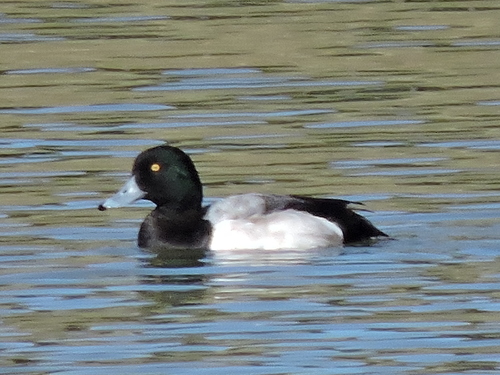 Greater Scaup
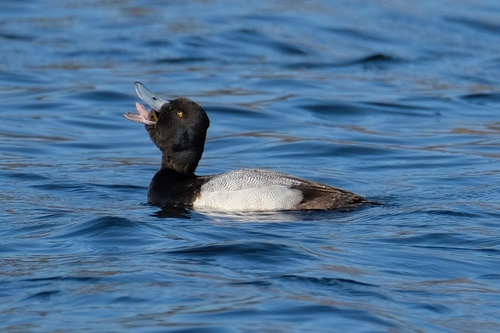 Lesser Scaup
In short
The most reliable field mark to separate Greater and Lesser Scaup is the extent of the white wing stripe in flight: Greater Scaup show a white stripe running from the secondaries well out onto the primaries, while Lesser Scaup have white only on the secondaries, with the primaries appearing much grayer. This mark works best on adults and older immatures in flight. At rest, Greater Scaup are bulkier with a rounder, fuller head and a broader, more spatulate bill, while Lesser Scaup look more compact with a peaked or angular hindcrown and a narrower bill. Females and immatures are especially tricky, but careful attention to head shape, bill width, and the amount of white at the bill base can help. Both species can occur together in large flocks, so direct comparison is often possible.
Identification tips
- White wing stripe in flight: Look for the extent of white on the upperwing. Greater Scaup show white from the secondaries onto the primaries (almost to the wingtip); Lesser Scaup have white only on the secondaries, with primaries grayish. This is the single best mark for all ages in flight.
- Head shape at rest: Greater Scaup have a smoothly rounded, full head with a high forehead and smoothly sloping nape. Lesser Scaup have a more angular or peaked hindcrown, sometimes forming a small tuft, and a less prominent forehead. Compare birds side by side if possible.
- Bill shape: Greater Scaup have a broader, more spatulate bill, especially toward the tip. Lesser Scaup's bill is narrower and straighter. This is subtle but visible at close range or in photos.
- Bill nail: The black nail at the tip of the bill is usually wider on Greater Scaup, but this is hard to judge unless very close.
- Body bulk: Greater Scaup are noticeably bulkier and heavier-bodied, especially when seen next to Lesser Scaup. However, size overlap and posture can mislead, so use in combination with other marks.
- Flank and back color (adult males): Greater Scaup males have bright white flanks and a paler, more vermiculated back. Lesser Scaup males have darker backs and flanks with olive tones. Lighting and feather wear can obscure this.
- Head sheen (adult males): The head of Greater Scaup can show green or purple gloss; Lesser Scaup is often described as purple. However, sheen color varies with light and is unreliable at distance.
- Female and immature face pattern: Both have a white patch at the bill base, but Lesser Scaup females and immatures usually have less white, and sometimes almost none. This is variable and not always reliable.
- Juvenile/immature confusion: Juveniles and first-winter birds of both species are very similar. Rely on wing stripe in flight and structural marks rather than plumage.
- Mixed flocks: In North America, both species often occur together. Compare individuals side by side for best results.
- Habitat context: In Eurasia, scaup are almost always Greater; in North America, both are possible, especially on large lakes and coastal waters.
- Behavior: Both dive for food and form large rafts; behavior is not a strong separator.
- Voice: Not a practical field mark for separation.
- Beware of overlap: Many marks are subtle and variable. Use a combination of wing pattern, head shape, and bill structure for the best chance of correct ID, especially in females and immatures.
- Photograph for later study: When in doubt, take photos showing the wing in flight and the head/bill in profile for later comparison.
Size
Greater Scaup are generally larger and bulkier than Lesser Scaup, with a length of 39–56 cm and a wingspan of 71–84 cm, compared to Lesser Scaup's 38–48 cm length and 68–78 cm wingspan. Greater Scaup are about 20% heavier and 10% longer on average, though there is overlap. In the field, Greater Scaup often appear noticeably more robust, especially in mixed flocks, but size alone is not always reliable due to overlap and posture.
Plumage
- In flight (all ages): The most diagnostic mark is the white wing stripe. Greater Scaup show a white stripe that extends from the secondaries well onto the primaries, reaching close to the wingtip. Lesser Scaup have white only on the secondaries; the primaries are grayish, so the white stripe stops short of the wingtip. This is most visible in good light and on birds with fresh plumage.
- Adult males: Both have dark heads with iridescence, but Greater Scaup's head is rounder and the sheen can be green or purple depending on light, while Lesser Scaup's head is more peaked with a small hindcrown tuft and the sheen is often described as purple (but this is unreliable in the field). Greater Scaup males have a paler, more vermiculated back and brighter white flanks; Lesser Scaup males have a darker back and more olive on the flanks.
- Females and immatures: Both are brown with a white patch at the bill base, but Lesser Scaup females and immatures tend to have less white around the bill and a duller appearance overall. Juveniles of both species resemble adult females, but Lesser Scaup juveniles often have almost no white at the bill base. Greater Scaup females are bulkier with a rounder head and broader bill.
- Eclipse/plumage variation: Drakes in eclipse plumage of both species look more like females, but Greater Scaup retain a slightly paler and bulkier look.
Behaviour
Both species are diving ducks and often form large flocks ('rafts'), sometimes mixed. Greater Scaup can form very large, dense rafts, sometimes numbering in the thousands. Both dive for food, but there are no strong behavioral differences in foraging or flocking visible at a distance. Courtship displays are complex in both, but not usually a field mark.
Habitat
Both species occur together in winter on large lakes, coastal bays, and estuaries. Greater Scaup are more likely to be found on saltwater coasts in Eurasia, while Lesser Scaup are more strictly North American and can be found farther inland. Habitat is not a strong separator in mixed North American flocks, but in Eurasia, scaup are almost always Greater.