
Greater Short-toed Lark vs Eurasian Skylark
Calandrella brachydactyla versus Alauda arvensis
Play a quiz with Greater Short-toed Lark and Eurasian Skylark
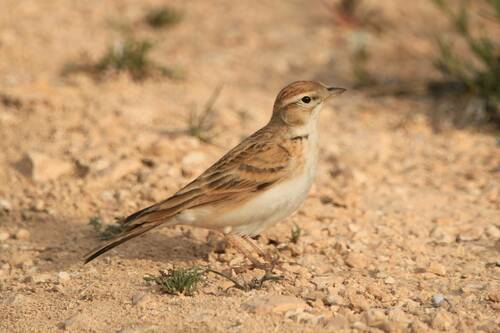 Greater Short-toed Lark
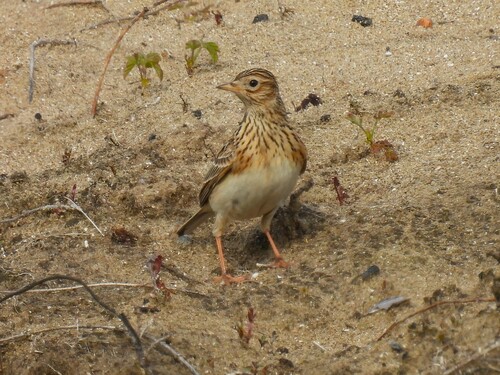 Eurasian Skylark
In short
The most reliable field mark to separate Greater Short-toed Lark from Eurasian Skylark is overall size and structure: Greater Short-toed Lark is distinctly smaller, with a shorter tail, shorter wings, and a noticeably stubbier, more conical bill. In flight, Eurasian Skylark shows broad wings and a short tail with white edges, while Greater Short-toed Lark appears compact and pale, lacking obvious white in the tail or wing. Perched, Skylark often shows a short, bushy crest, whereas Greater Short-toed Lark has a flat crown and a pale supercilium. Both are streaked brown above and pale below, but Skylark is bulkier and more robust overall. Juvenile/immature upperwing patterns are not described for either species in the notes, so focus on structure and tail/wing pattern in flight.
Identification tips
- Size and Structure: Eurasian Skylark is much larger and bulkier than Greater Short-toed Lark. If you have any size reference, this is the most reliable field mark. Greater Short-toed Lark is compact, with a short tail and short wings.
- Bill Shape: Greater Short-toed Lark has a strong, pointed, conical bill that is shorter and stubbier than the Skylark's. Skylark's bill is longer and finer, though still lark-like.
- Crest: Eurasian Skylark often shows a short, blunt crest, especially when alert or agitated. Greater Short-toed Lark lacks a crest and has a flat crown.
- Tail Pattern in Flight: Skylark shows white edges to the tail and rear wing, especially obvious when flying away. Greater Short-toed Lark has a dark tail with no obvious white edges.
- Wing Shape in Flight: Skylark has broad wings and a short tail, giving a broad, rounded impression. Greater Short-toed Lark's wings and tail are both short, making the bird look compact and stubby in flight.
- Supercilium and Face Pattern: Greater Short-toed Lark has a pale supercilium (eyebrow) and dark patches on the sides of the neck. Skylark's face is plainer, with less contrast and no strong supercilium.
- Crown Color: Some Greater Short-toed Larks in the west have a rufous crown, which Skylark never shows. However, this is variable and not always visible.
- Plumage Tone: Greater Short-toed Lark is paler overall, especially below, and often appears washed-out compared to the richer brown Skylark.
- Flock Behavior: In winter, Greater Short-toed Lark forms tight, synchronized flocks that fly together, often low and fast. Skylark is more often seen singly, in pairs, or in loose groups.
- Perched Posture: Skylark often sits upright, sometimes with crest raised. Greater Short-toed Lark sits more horizontally, with a flat crown.
- Song Flight: If you see a bird hovering high and singing for minutes, it is a Skylark. Greater Short-toed Lark does not perform such prolonged, high song flights.
- Habitat Context: Skylark is more likely in lush, grassy, or cultivated fields; Greater Short-toed Lark prefers dry, open, or stony ground.
- Vocalization: Skylark's song is long, musical, and bubbling; Greater Short-toed Lark's is a dry twitter or short, varied melody.
- Sex and Age: Both sexes are similar in both species; no strong seasonal or sex-based differences are described. Juvenile/immature-specific upperwing patterns are not detailed for either species in the notes provided.
- Pitfalls: Distant or silhouetted birds can be tricky, especially in flight. Focus on size, tail/wing shape, and flocking behavior if plumage is hard to see.
Size
Eurasian Skylark is much larger (18–19 cm in length) and heavier than Greater Short-toed Lark, which is described as 'smaller than the skylark' and among the smallest larks. The Skylark has a bulkier, more robust body, longer wings, and a longer tail. Greater Short-toed Lark is compact, with a short tail and short wings, giving it a much daintier appearance next to a Skylark. If seen side-by-side, the size difference is striking.
Plumage
Juvenile and immature-specific upperwing patterns are not detailed for either species in the provided notes. For adults, both are brown and streaked above with paler underparts, but Greater Short-toed Lark is paler overall, with a pale supercilium and dark neck patches. Eurasian Skylark is dull brown above, with a short blunt crest (often raised when alert), and shows white edges to the tail and rear wing in flight—these white edges are visible when the bird is flying away. Greater Short-toed Lark lacks these white edges and instead appears plainer and paler, with a dark tail but no contrasting white. Some Greater Short-toed Larks in the west have a rufous crown, but this is variable. Both sexes are similar in both species.
Behaviour
Eurasian Skylark is famous for its long, hovering song flights, often high above open fields, sometimes appearing as a distant dot. It frequently perches on the ground or low vegetation, occasionally raising its crest. Greater Short-toed Lark is more likely to be seen in compact, synchronized flocks, especially in winter, flying low and fast over open ground or coming to water. It tends to squat in small ground depressions when roosting. The Skylark is more solitary or in loose groups outside the breeding season, while Greater Short-toed Lark often forms tight flocks.
Habitat
Both species favor open country, but Eurasian Skylark is strongly associated with open farmland, grassland, and heath, often in cultivated or semi-natural fields. Greater Short-toed Lark also prefers open ground but is more typical of dry, bare, or sparsely vegetated habitats, including steppe, semi-desert, and stony fields. If you see a lark in lush grassland or crop fields, Skylark is more likely; in dry, barren, or sandy areas, Greater Short-toed Lark is favored.
Voice
Eurasian Skylark is renowned for its long, continuous, bubbling warble delivered in hovering flight, often lasting several minutes or even up to 20 minutes in the breeding season. Greater Short-toed Lark's song is a dry twittering or a more varied, imitative melody, but is much less musical and sustained than Skylark's. If you hear a long, high, musical song from a bird hovering high overhead, it is almost certainly a Skylark.
Greater Short-toed Lark · Eurasian Skylark · My Tricky Birds