
Greater Short-toed Lark vs Woodlark
Calandrella brachydactyla versus Lullula arborea
Play a quiz with Greater Short-toed Lark and Woodlark
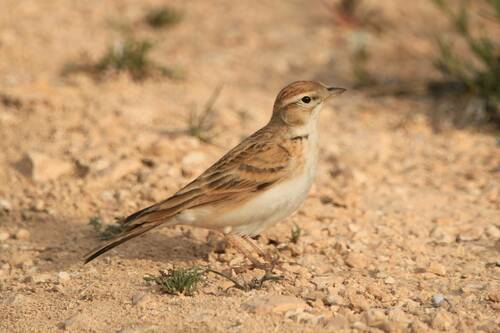 Greater Short-toed Lark
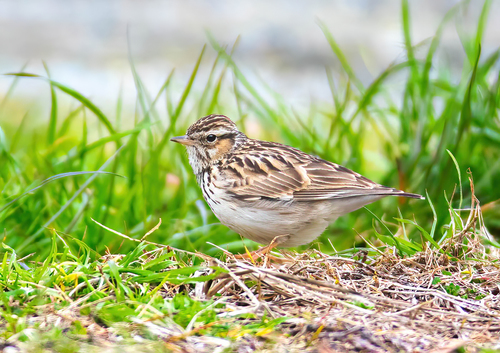 Woodlark
In short
The single most reliable field mark for separating Greater Short-toed Lark from Woodlark is the Woodlark’s bold white supercilium that meets at the nape, forming a striking pale 'eyebrow band'—a feature never shown by Greater Short-toed Lark. In flight, Woodlark shows a short tail with white tips but lacks the white tail edges and wing rear edge of Skylark, while Greater Short-toed Lark’s tail is dark with less obvious white. Structurally, Woodlark is slightly larger and more compact, with a stubbier bill and a short, broad-winged look in flight; Greater Short-toed Lark is smaller, more delicate, with a pointed bill and longer, narrower wings. Both are brown above and pale below, but the larks’ head patterns and bill shapes are key. Voice and habitat can help, but focus on head pattern and structure for the most reliable separation.
Identification tips
- Head pattern is key: Woodlark always shows a bold white supercilium that meets at the nape, forming a pale 'eyebrow band'—look for this in all ages and seasons. Greater Short-toed Lark’s supercilium is paler, less bold, and does not meet at the nape.
- Bill shape: Greater Short-toed Lark has a strong, pointed, pinkish bill with a grey culmen—noticeably longer and finer than Woodlark’s shorter, stubbier bill. Bill color may be hard to see at distance, but shape is often visible.
- Tail shape and pattern: In flight, Woodlark has a short tail with white tips but no white tail edges; Greater Short-toed Lark’s tail is longer, darker, and lacks obvious white edges or tips.
- Crest: Woodlark has a small, sometimes visible crest, but it is usually inconspicuous. Greater Short-toed Lark lacks a true crest.
- Crown color: Some Greater Short-toed Larks in western populations show a rufous crown, which is never present in Woodlark. However, this is variable and not always reliable.
- Neck patches: Both species can show dark patches on the neck sides, so do not use this alone for identification.
- Structure and jizz: Woodlark is more robust and compact, with a shorter tail and broader wings, especially obvious in flight. Greater Short-toed Lark is smaller, slimmer, and more delicate, with a longer, finer bill and narrower wings.
- Flight style: Woodlark’s display flight is fluttery and spiral, often circling as it sings. Greater Short-toed Lark’s flocks fly in tight, synchronized groups, especially in winter.
- Plumage above and below: Both are brown above and pale below, so this is not a useful separator.
- Habitat context: Woodlark is more likely in open woodland, clearings, or heathland with some trees; Greater Short-toed Lark is found in open, dry, treeless habitats like steppe or fields.
- Song: Woodlark’s song is a melodious, repeated 'lu-lu-lu' or 'toolooeet', often given in flight. Greater Short-toed Lark’s song is a dry twitter or variable melody, less musical.
- Flock size: Large, compact, synchronized flocks suggest Greater Short-toed Lark, especially in winter; Woodlark is more solitary or in pairs.
- Perched posture: Woodlark often appears more upright and compact when perched; Greater Short-toed Lark is lower to the ground and more delicate.
- Seasonal context: Both species are present year-round in parts of their range, but Woodlark is more resident in the west, while Greater Short-toed Lark is more migratory and forms larger flocks in winter.
- Sex and age: Sexes are similar in both species; no strong age-specific marks are described except for the consistent head pattern in Woodlark.
Size
Woodlark is the larger of the two, measuring 13.5–15 cm in length, while Greater Short-toed Lark is smaller than Skylark and noticeably more petite than Woodlark. In the field, Woodlark appears more robust and compact, with a shorter tail and broader wings, while Greater Short-toed Lark is daintier, with a finer, more pointed bill and a generally slimmer build. These differences are subtle but can be appreciated with direct comparison or experience.
Plumage
- Juvenile/immature wing pattern: No distinctive age-specific upperwing or flight pattern marks are described for either species in the sources. Both show generally brown upperparts and pale underparts at all ages, so focus shifts to head and tail pattern.
- Head pattern: Woodlark always shows a bold white supercilium that meets at the nape, creating a pale 'eyebrow band'—this is unique and visible in all plumages and ages. Greater Short-toed Lark has a pale supercilium but it does not meet at the nape and is less striking.
- Tail pattern: Woodlark has a short tail with white tips but lacks white tail edges; Greater Short-toed Lark’s tail is dark with less obvious white and appears longer and thinner in flight.
- Bill: Greater Short-toed Lark has a strong, pointed, pinkish bill with a grey culmen; Woodlark’s bill is shorter and stubbier.
- Crown: Some Greater Short-toed Larks in the west show a rufous crown, but this is variable and not present in Woodlark.
- Neck patches: Both can show dark patches on the side of the neck, but this is not a strong separator.
- Crest: Woodlark has a small, often inconspicuous crest; Greater Short-toed Lark does not have a noticeable crest.
Behaviour
Greater Short-toed Lark often forms large, compact, synchronized flocks in winter, especially when flying to water or roosting in open ground. Woodlark is more solitary or found in pairs during the breeding season, and its display flight is distinctive: the male flutters and spirals upwards, circling as he sings at a steady height. Both species can sing from the ground or a perch, but Woodlark’s song flight is more prominent and fluttery. In the evenings, Greater Short-toed Lark roosts on open ground, squatting in small depressions.
Habitat
Woodlark prefers open woodlands, clearings in pine forests, heathland, and areas with scattered trees or saplings, often in sandy or disturbed ground. It is more likely to be found in semi-wooded or forest-edge habitats. Greater Short-toed Lark favors open, dry, and often barren ground with sparse vegetation, such as steppe, dry grassland, or agricultural fields, and is less likely in wooded or shrubby areas. Habitat overlap is possible in open country, but Woodlark is rarely found far from some tree cover, while Greater Short-toed Lark avoids it.
Voice
Woodlark’s song is a melodious, warbling, repeated 'lu-lu-lu' or 'toolooeet', often delivered in a display flight. Greater Short-toed Lark’s song is more variable, ranging from a dry twittering to a more imitative melody, but lacks the musical, fluting quality of Woodlark. Both species can sing from the ground or a perch, but Woodlark’s song is more distinctive and musical.