
Greater Spotted Eagle vs Steppe Eagle
Clanga clanga versus Aquila nipalensis
Play a quiz with Greater Spotted Eagle and Steppe Eagle
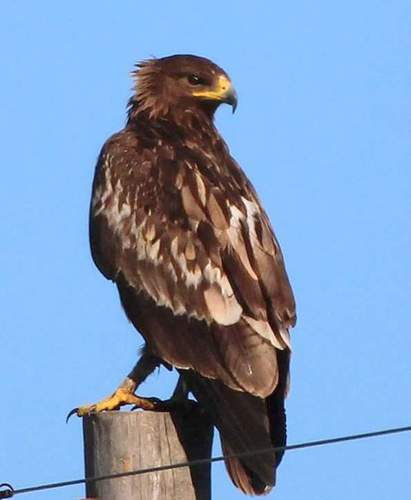 Greater Spotted Eagle
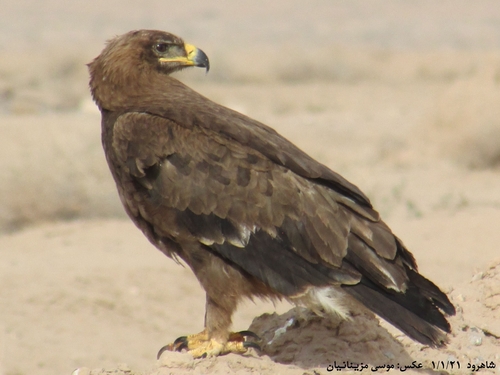 Steppe Eagle
In short
The most reliable way to separate Greater Spotted Eagle from Steppe Eagle is by focusing on structure and wing shape, especially in flight: Steppe Eagle is bulkier, with longer, more rectangular wings and a larger, more robust head, while Greater Spotted Eagle is more compact and has proportionately broader, shorter wings and a smaller head. Juvenile plumage can be confusing, but Steppe Eagle juveniles show prominent white tips to wing coverts and tail (often worn with age), whereas Greater Spotted Eagle juveniles are darker and more uniform, lacking strong pale nape or tail patches. Adults are best separated by Steppe Eagle’s paler nape patch and longer gape-line, versus the uniformly dark and plain-headed look of Greater Spotted Eagle. Both species can appear similar at a distance, so careful attention to structure and subtle plumage details is essential, especially in immature birds.
Identification tips
- Juvenile/immature wing and tail pattern: Steppe Eagle juveniles have broad, white tips to the greater coverts, wings, and tail, forming obvious pale panels in flight and sometimes visible when perched. These markings become worn and less obvious with age but are a key mark in fresh juveniles. Greater Spotted Eagle juveniles lack these bold white tips and are more uniformly dark above and below.
- Nape patch: Adult Steppe Eagles (especially eastern birds) show a prominent pale rufous to yellowish nape patch, visible both perched and in flight. Greater Spotted Eagle adults lack a pale nape patch; if any pale area is present in juveniles, it is only slightly paler than the rest of the plumage and never ochre or orange.
- Head and gape-line: Steppe Eagle has a large, robust head and a very long gape-line that extends behind the eye, giving a fierce facial expression. Greater Spotted Eagle has a smaller, plainer head and a shorter gape-line.
- Wing shape in flight: Steppe Eagle’s wings are longer, broader, and more rectangular with pronounced 'fingers' at the tips, and the bird appears powerful and robust. Greater Spotted Eagle’s wings are shorter, broader, and the bird appears more compact and less elongated in flight.
- Build and posture: Steppe Eagle is bulkier and often perches upright in the open or stands on the ground for long periods. Greater Spotted Eagle is more compact, less upright, and less likely to be seen standing on the ground.
- Size: Steppe Eagle is generally larger and heavier (body mass ~2723g) than Greater Spotted Eagle, but there is some overlap, especially with female Greater Spotted Eagles and small male Steppe Eagles.
- Plumage uniformity: Greater Spotted Eagle is typically darker and more uniform in plumage, especially on the upperwing coverts and arms, while Steppe Eagle shows more contrast with pale nape and sometimes paler feather tips (especially in juveniles).
- Tail shape: Steppe Eagle has a longer, more rounded tail, while Greater Spotted Eagle’s tail is shorter and appears more squared-off.
- Flight style: Steppe Eagle’s flight is more powerful and aquiline, with deep, labored wingbeats; Greater Spotted Eagle’s flight is steadier and more compact.
- Habitat context: Steppe Eagle is more likely in open steppe or arid areas, while Greater Spotted Eagle favors wetter habitats and forest edges, but this is not always reliable during migration.
- Perched jizz: Steppe Eagle appears larger-headed, more upright, and often perches in the open; Greater Spotted Eagle is more compact and less upright.
- Eye color: Both have brown to hazel eyes as adults, but Steppe Eagle juveniles have distinctly dark brown eyes; this is not a strong field mark but may help in close views.
- Leg feathering: Steppe Eagle’s legs are very well-feathered, almost disheveled in appearance, compared to the neater look of Greater Spotted Eagle.
- Hybrid confusion: Be aware that hybrids (mainly between Greater and Lesser Spotted Eagles) can complicate identification, but Steppe Eagle does not hybridize with Greater Spotted Eagle.
- Seasonal wear: Steppe Eagle juvenile pale tips wear off by the second winter, so older immatures can look darker and less distinctive; rely more on structure and head/gape at this age.
Size
Steppe Eagle is generally larger and much bulkier than Greater Spotted Eagle, with a typical body mass around 2723g [wikidata]. The Steppe Eagle’s head is larger and more robust, and its wings are longer and broader, giving it a more imposing presence both perched and in flight. Greater Spotted Eagle can overlap in size with smaller Steppe Eagles, but is usually more compact, with a shorter tail and wings that appear broad but not as long. Females of both species are larger, but Steppe Eagle females are especially massive, often noticeably outsizing even large Greater Spotted Eagles.
Plumage
Juvenile and immature birds are often confused, but Steppe Eagle juveniles show broad, conspicuous white tips to the greater coverts, wings, and tail, and a rufous-buff nape patch (especially in eastern birds). These pale tips wear off with age, so by second winter, the pale markings become narrower and more abraded, and by third year, the plumage is a variable mix of old and new feathers, often looking scruffy until adult plumage is attained at year five. Juvenile Greater Spotted Eagles are darker overall, with more uniform blackish-brown upperwing coverts and arms, and lack the strong pale nape patch—if present, it is only slightly paler than the rest of the plumage and never ochre or orange. Juvenile Greater Spotted Eagles also lack the bold white tips to the tail and wing coverts seen in Steppe Eagle. Adults: Steppe Eagle adults are dark brown but often show a prominent pale nape patch and a long, strong gape-line extending behind the eye, while Greater Spotted Eagle adults are uniformly dark, lacking a pale nape, and have a smaller, plainer head. Both species have yellow cere and feet at all ages. In flight, Steppe Eagle’s wings are longer and more rectangular, with more pronounced 'fingers' at the wingtips, compared to the shorter, broader wings of Greater Spotted Eagle.
Behaviour
Steppe Eagles often perch upright and openly on isolated trees, posts, rocks, or even on the ground, where they may stand for long periods and walk with a horizontal posture. They are relatively tame and approachable compared to many other Aquila eagles. Greater Spotted Eagles are less likely to be seen standing on the ground for extended periods and generally appear more compact and less upright when perched. In flight, Steppe Eagle’s flight is more powerful and aquiline, with deep, labored wingbeats, while Greater Spotted Eagle appears steadier and more compact, with less pronounced wing extension.
Habitat
Both species are large, migratory raptors of open country, but Steppe Eagle is more often seen in very open landscapes, such as steppes, plains, and semi-desert, often perching in the open or on the ground. Greater Spotted Eagle prefers wetter habitats, such as marshes, river valleys, and forest edges, and is less likely to be seen in completely open steppe or arid environments. However, overlap can occur during migration and winter, so habitat alone is not always diagnostic.